So this actually came up in an interview of mine recently, and I was initially taken aback (perhaps wrongly) that I got the impression the academic interviewing me did not seem to consider Leopold II's 'Congo Free State' as an example of imperialism.
I've discussed this with several (non-historians) and they have all tended to conclude it was an example of imperialism. Here are a couple of points raised in favour:
Several points against:
Again, just chucking around ideas, any comprehensive answer from someone far more knowledgeable than myself would be appreciated ahahaha
2 Answers 2019-01-09
1 Answers 2019-01-09
I’ve been doing some digging about the American Revolution but I can’t find weather Britain fixed up thief act or not. In other words did Britain continually tax their other colonies after they lost the American Revolutionary War or did they put a tighter grip on their other colonies?
1 Answers 2019-01-09
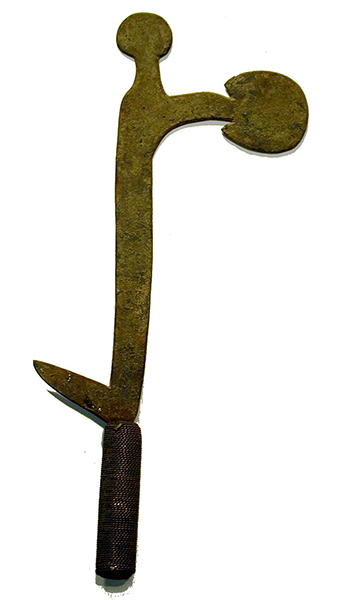
It's definitely a pattern and I'm not really sure what it stems from - were these really primarily throwing weapons? And if they were - why such unusual shapes, instead of a simple star or boomerang pattern?
https://i.pinimg.com/originals/ef/ca/a3/efcaa3a7a15fae6848bc741472793d2d.jpg
https://upload.wikimedia.org/wikipedia/commons/6/66/African_throwing_knives_snake_muder.png
https://www.hamillgallery.com/KNIVES/ThrowingKnives/Banda04.jpg
2 Answers 2019-01-09
How were the battle-wounded and handicapped Vikings treated?
1 Answers 2019-01-09
1 Answers 2019-01-09
2 Answers 2019-01-09
What was the climate like? Was anyone opposing him? Anyone fleeing the country?... Asking for a friend
1 Answers 2019-01-09
1 Answers 2019-01-09
Especially on matters where there are lots of stories floating around (such as traditional religious history vs. actual history), how can the average person learn what is and isn't widely agreed upon by professionals?
1 Answers 2019-01-09
Please Be Aware: We expect everyone to read the rules and guidelines of this thread. Mods will remove questions which we deem to be too involved for the theme in place here. We will remove answers which don't include a source. These removals will be without notice. Please follow the rules.
Some questions people have just don't require depth. This thread is a recurring feature intended to provide a space for those simple, straight forward questions that are otherwise unsuited for the format of the subreddit.
Here are the ground rules:
Top Level Posts should be questions in their own right.
Questions should be clear and specific in the information that they are asking for.
Questions which ask about broader concepts may be removed at the discretion of the Mod Team and redirected to post as a standalone question.
We realize that in some cases, users may pose questions that they don't realize are more complicated than they think. In these cases, we will suggest reposting as a stand-alone question.
Answers MUST be properly sourced to respectable literature. Unlike regular questions in the sub where sources are only required upon request, the lack of a source will result in removal of the answer.
Academic secondary sources are prefered. Tertiary sources are acceptable if they are of academic rigor (such as a book from the 'Oxford Companion' series, or a reference work from an academic press).
The only rule being relaxed here is with regard to depth, insofar as the anticipated questions are ones which do not require it. All other rules of the subreddit are in force.
39 Answers 2019-01-09
I'm doing research on the Battle of Svolder. The one thing that I find hard to understand is how the Iron Ram was used by Eiríkr to 'peel off' Olaf's ships one by one, until only the Long Serpent was left.
How would this 'peeling' work? Did Eiríkr literally wedge his ship between the last two ships in Olaf's line, thereby physically separating the last ship from the rest and then boarded it with superior numbers?
Or was this the case that Eiríkr simply flanked Olaf's line, followed by other support ships, then boarded the furthers ship on the flank and picked off the crews one by one until he reached the Long Serpent?
I've read sources that focus more on this being a flanking maneuver, while others mention wedging in-between Olaf's ships on the flanks. What I find most problematic, I guess, is the plausibility of Eiríkr's ship maneuvering around during the course of the battle to peel off Olaf's ships one by one. What am I missing?
Any chance someone here might be able to clarify this a bit more for me?
1 Answers 2019-01-09
1 Answers 2019-01-09
I've been thinking about this over the past five years, and I'd really like to get historians' perspective on the magnitude of the issue. Here are a couple links to the basic arguments
Pro, from original whistleblowing: https://arstechnica.com/tech-policy/2013/12/launch-code-for-us-nukes-was-00000000-for-20-years/
Con, including a highly qualified official denial: https://foreignpolicy.com/2014/01/21/air-force-swears-our-nuke-launch-code-was-never-00000000/
I understand there are a lot of nuances involved (and that second article has very many links, not all of which I read through.) So, as a historian, how would you summarize what actually happened here?
And what kind of a risk would you say it presented? Would a rogue missile control officer be able to start World War III? Can they still today presuming the codes have been changed?
How vulnerable to catastrophe do experts say the launch systems are to hacking or other external threats? E.g., if the codes are eight digits long, could they be brute forced by someone with access to a secured network tap?
1 Answers 2019-01-09
1 Answers 2019-01-09
1 Answers 2019-01-09
The Wikipedia article mentions a botched bomb job at one apartment complex, Russian politicians discussing bombings before they happened and "suspicious" deaths amongst people connected to the investigation into the bombings. I am very curious as to whether or not these bombings can be convincingly described as "false flag" operations by the Russian Government, what the current state of the evidence is etc.
Mods, please remove this if it breaks the Askhistorians rules, as I understand anything related to 1999 is fair game. (Even though the bombings are 'technically' 19.5 years in the past)
2 Answers 2019-01-09
Hello, r/AskHistorians, when I was watching videos of stukas online, I realised that many combat aircraft of that era had rear-mounted gunners, and on larger bombers there were gunners on ventral turrets etc. How did these gunners avoid damaging their own aircraft? Are there any recorded instances of an aircraft being downed or damaged by its own gunners?
1 Answers 2019-01-09
1 Answers 2019-01-09
Similar to how there were loyalists in the colonies?
1 Answers 2019-01-09
So I am not history buff, but I do find history interesting, and in a recent video (https://youtu.be/uLLv8E2pWdk) I watched it seems to make a fairly convincing case that spears were generally better than swords, so with that what made them take the back seat to swords in most armies? It seems one can train a spearman easier, cheaper and easier to make a spear, and it most cases it is more effective than swordsmen, and a spearman can carry other weapons on their belt if need be.
1 Answers 2019-01-09