Dragons appear in folklore from all over the world. Japanese, Germanic, you name it. It would appear that dragons developed organically in these cultures, independent from one another.
How did this happen?
1 Answers 2018-05-11
What is the most common theory regarding where he is from? Norway or Sweden? Or is there a theory of another possible locations? Are there any books regarding this?
Most of what I read/found is documented AFTER they came.
1 Answers 2018-05-11
The UN is supposedly against the annexation of land by any party in any type of conflict, but had there been any exceptions to that? And what must be theoretically be done for the UN to make such an exception? A peace deal both countries agree on, perhaps? Thanks
1 Answers 2018-05-11
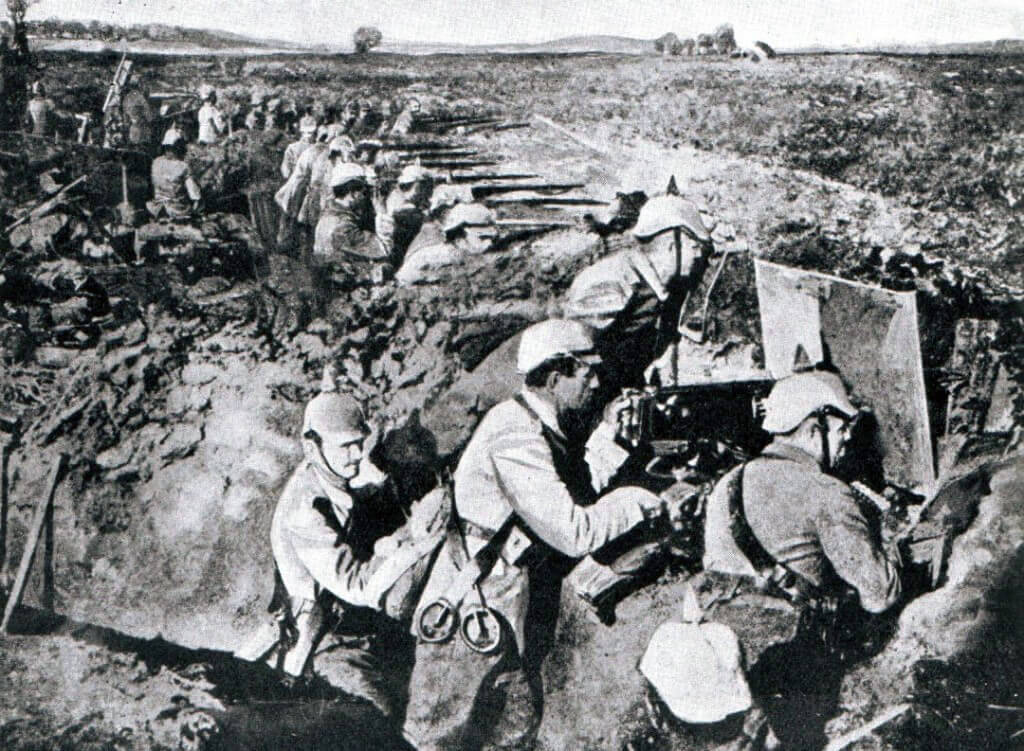
Look at the German soldier manning the machinegun:
What are those things? What was their purpose?
1 Answers 2018-05-11
After reading the rules, I think that this is an appropriate question for this sub, please accept my apologies if it is not.
I am trying to research my Grandad's service in WWII. I would have thought that this would be a simple enough thing to find out, but I'm not having any luck.
My Grandad was from Birmingham England, and served in Jamaica in WWII.
I'm trying to find out what regiment he was in etc, but no matter what search terms I use, I only seem to be able to find information about Jamaican soldiers in WWII, not British soldiers who served in Jamaica.
Searching for his name is not productive, because his surname is also a common verb.
This is everything I know:
He had no prior military experience and did not have a military career - he was conscripted because of the war and was discharged at the end of it.
He was stationed in Jamaica for the majority of his time in the war.
At some point, he was guarding Italian prisoners of war (I believe this was in Jamaica, but I am not 100% sure).
His regiment was disbanded, though I don't know when it was disbanded or whether it was incorporated into another regiment or just completely disbanded.
I'm usually pretty good at researching stuff, but I just keep hitting dead ends on this one.
Can anyone point me in the right direction?
4 Answers 2018-05-11
Today:
You know the drill: this is the thread for all your history-related outpourings that are not necessarily questions. Minor questions that you feel don't need or merit their own threads are welcome too. Discovered a great new book, documentary, article or blog? Has your Ph.D. application been successful? Have you made an archaeological discovery in your back yard? Did you find an anecdote about the Doge of Venice telling a joke to Michel Foucault? Tell us all about it.
As usual, moderation in this thread will be relatively non-existent -- jokes, anecdotes and light-hearted banter are welcome.
11 Answers 2018-05-11
Hi everyone,
I’m currently conducting some research about the state of British Politics after the second world war and was wondering if I could be recommended any important historiography or debate around the 1945 general election and the subsequent victory of the Labour Party. In a similar light, could I also ask for particularly important reasons why Labour then lost the 1951 election?
Thanks, I look forward to reading your responses!
2 Answers 2018-05-11
What are the major differences between average people who think they know a lot about history versus those who are actual historians and practice history in the media? How accurately does this describe history student in general?
8 Answers 2018-05-11
It seems to me that there were societies that had been quite nationalistic -- and been highly conscious of their nationhood -- even in Antiquity. So why can't we recognize this and cease our seeming relegation of references to nationalism and nationhood solely to the last 200-300 years?
1 Answers 2018-05-11
Hey all,
So last night I was listening to a talk by Greece's ex-finance minister Yannis Varoufakis and he said that bankers in ancient Athens were slaves. Is this true? I find it hard to believe but, hey, you never know.
1 Answers 2018-05-11
1 Answers 2018-05-11
There is of course a very decent chance that this premise is flawed, and alcohol was never a substitute for water in the first place...
1 Answers 2018-05-11
Hi,
I put up two questions here about 2 weeks ago, I hope it's not a problem if I bump them a little bit. I understand that answers may be complex or and time-consuming to type, especially since they have multiple parts. If anyone can do that, I'm also happy with an answer that just gives 2-3 very good sources from which I could inform myself.
So, my quesitons are:
~~~
I have read (at wikipedia, mind you, which might not be correct, but I use it to try and get a general feel for things I'm not educated in) that norwegian law from 1160 had regulations concerning domestic slaves, and laws from the 1270's still mention former slaves.
Is that true? If so, does that mean that some form of thraldom was still practiced around the 1200's, or is it simply that certain articles of the law survived on paper long after they fell out of actual use? If it's the former, what did it mean to be a thrall, and how common was it?
~~~
I'm curious about civil war-era Norway - specifically, I wonder what an "average" person living in a rural existence, but in one of the affected areas, experienced from it. Since it lasted for more than a century, I would assume the conflict did not always burn with the same intensity. In that case, I'd be interested about the highs and lows too.
Were people often subject to raiding? Were they personally affected by the war in some singificant way? Was it common to know someone who went to fight in the war? Was it unusually dangerous to travel?
~~~
+1: I read that around 1220, it was still common for people in Norway to own their own land. How did that affect feudal relationships? Did those people still owe fealty to someone?
Thanks for any answer!
1 Answers 2018-05-11
In preparation for my dissertation
2 Answers 2018-05-11
I was just wondering because the thick lances with large hand guards that are always depicted in romantic imigas of jousts look a bit unwieldy for a proper battlefield.
1 Answers 2018-05-11
In preparation for my dissertation next year
1 Answers 2018-05-11
Just curious as to whether was any significant opposition to this act at the time.
1 Answers 2018-05-11
Hello, I want to do a research project on letters from soldiers of ww1, and I need a lot of them. I need letters from soldiers who are British, French, German, Italian, Russian and it would be great to find some Turkish, Hungarian, Serbian and Greek letters.
So, do you know of any good books which have a lot of letters (preferably translated) from a specific nation? or any good reliable source I can draw from?
Thanks in advance.
1 Answers 2018-05-11
Here is the necklace in question.
The background she told me was that one was given to her and each of her sisters from their parents when they resided in the UK. She does not know if they are each unique or identical. She hardly if ever takes it off, but is not aware of its origin or symbolism.
I recognise the fleur-de-lis but not the crest. Any insight to its origins and symbolism you could glean would be appreciated.
2 Answers 2018-05-11
Asking because of the different theories around Lennon's song "And Your Bird Can Sing".
1 Answers 2018-05-11
1 Answers 2018-05-11
In the USA there are sounds which come from Ireland...the R sound etc.
Here in Australia, people sound more like Londoners.
1 Answers 2018-05-11