Edit: of course it was Ramses II
1 Answers 2017-02-06
Thank you, in advance, to the community, especially its moderators. One of this sub's greatest achievements is its ability consistently maintain its high standards, no matter the topic at hand.
Edit: For that matter, why do people seem to hate Hillary more than Bill?
4 Answers 2017-02-06
Hello fellow historians! I am currently writing a historiographical paper and was wondering if you have any tips and tricks.
Also I was wondering if there are any University Press sources or Journals that may help with my paper
Thank
1 Answers 2017-02-06
1 Answers 2017-02-06
1 Answers 2017-02-06
[deleted]
1 Answers 2017-02-06
I had always heard that the europeans' weaponry was not actually that much more effective than the native americans'. Is this true?
In:
Northern North America
Mesoamerica
Andean Region
The rest of South America
or any other regional division that you think appropriate.
2 Answers 2017-02-06
I'm just curious if there are any good accounts or stories about the thoughts and opinions of surviving founding fathers and important revolutionary figures in regards to the War of 1812?
It was 30 odd years after the Revolution and despite the British being in war mode with France, the US declare war. I'm roughly aware of the circumstances that led to the declaration, but I have struggled to find info about the leaders and important figures from the revolution because they must have been somewhat 'against' and uncertain about going to war again given how close things were in the revolution and how unprepared they actually were this time around.
1 Answers 2017-02-06
Given that most regions of Europe were very feudal, and most people were dirt-poor serfs with few rights, how did Venetian society compare? It was a "republic," as well as a massive trade hub. Did this have any effect on the quality of life/level of freedom for the average citizen?
1 Answers 2017-02-06
The framers of the constitution studied the classics (Greek and roman literature) and the ability to read in both was a requirement to get into college.
When and why did the study of the classics fall out as a major precursor to admittance to higher education?
1 Answers 2017-02-06
1 Answers 2017-02-06
1 Answers 2017-02-06
1 Answers 2017-02-06
I have been interested in East Germany for a few years now, and I already know that older officers were put out to pasture. But, what would happen to officers/other levels of employee who were below retiring age? Would they be transferred to the West's equivalent (such as the BND), or were they made redundant and required to find a new job on their own?
1 Answers 2017-02-06
I just had a thought about it and as someone who knows very little about guns it intrigued me.
1 Answers 2017-02-06
This is the closest I could find in regards to what I am referring to. Basically, they have a unique inflection on certain words and it just sounds different. Was this normal to everyone at the time, or was this unique then? Like, if I was alive during the 30's and 40's, would I talk the same way, or was this limited to public figures?
1 Answers 2017-02-06
tl;dr:
Does popular history provide more benefit than hurt?
How is it viewed in academic circles?
What role do you think it should play in our society and the pursuit of historical knowledge?
Full debate background:
I recently had a debate with a colleague of mine over 'popular history'. Specifically, history that is written in a less academic/scientific tone and more focused and making history engaging and exciting to the general population.
These works often take a bit of artistic license that doesn't exist in the academic world. They are more flexible on theorizing how certain pieces of the puzzle may fit together even if the evidence isn't (yet) there.
However, some early theories that fall under the 'crazy ideas' of 'popular history' (such as Alexander von Humboldt proposing connected continents in the 1800's based solely on different plant species) have lead to entire fields of research that we now accept as fact.
I believe 'popular history' is valuable, as it helps people who would normally have no interest in history, get engaged in our collective past. It also lets us propose those more outlandish "what-ifs" that have lead to some great fields of study.
My colleague, on the other hand, believes popular history to be highly detrimental and looks down on popular historians as hacks. His view was that it unravels the value we gain from history and too easily spreads false-fact to the point where it can become the common viewpoint.
I figured in a world where the debate about valid 'facts' and knowledge on the internet is so front and center, it would be interesting to hear what individuals in the field feel about popular history and its place in historical study?
13 Answers 2017-02-06
1 Answers 2017-02-06
And did MI5 really think he was working for the KGB?
I don't know if this is something historians today would actually know, but I'd be interested to hear any answers about sources, evidence, etc.
1 Answers 2017-02-06
I found, on the Wikipedia article for life expectancy, that the life expectancy of those in the Neolithic (and Paleolithic) eras was around 33 years, which was one of the highest numbers up until 1900. I am having trouble believing this, because of the counter-intuitive nature of the information, and because it's wikipedia. Is it really true that the majority of human progress until after 1900 was detrimental to human life expectancy? And why was that the case?
1 Answers 2017-02-06
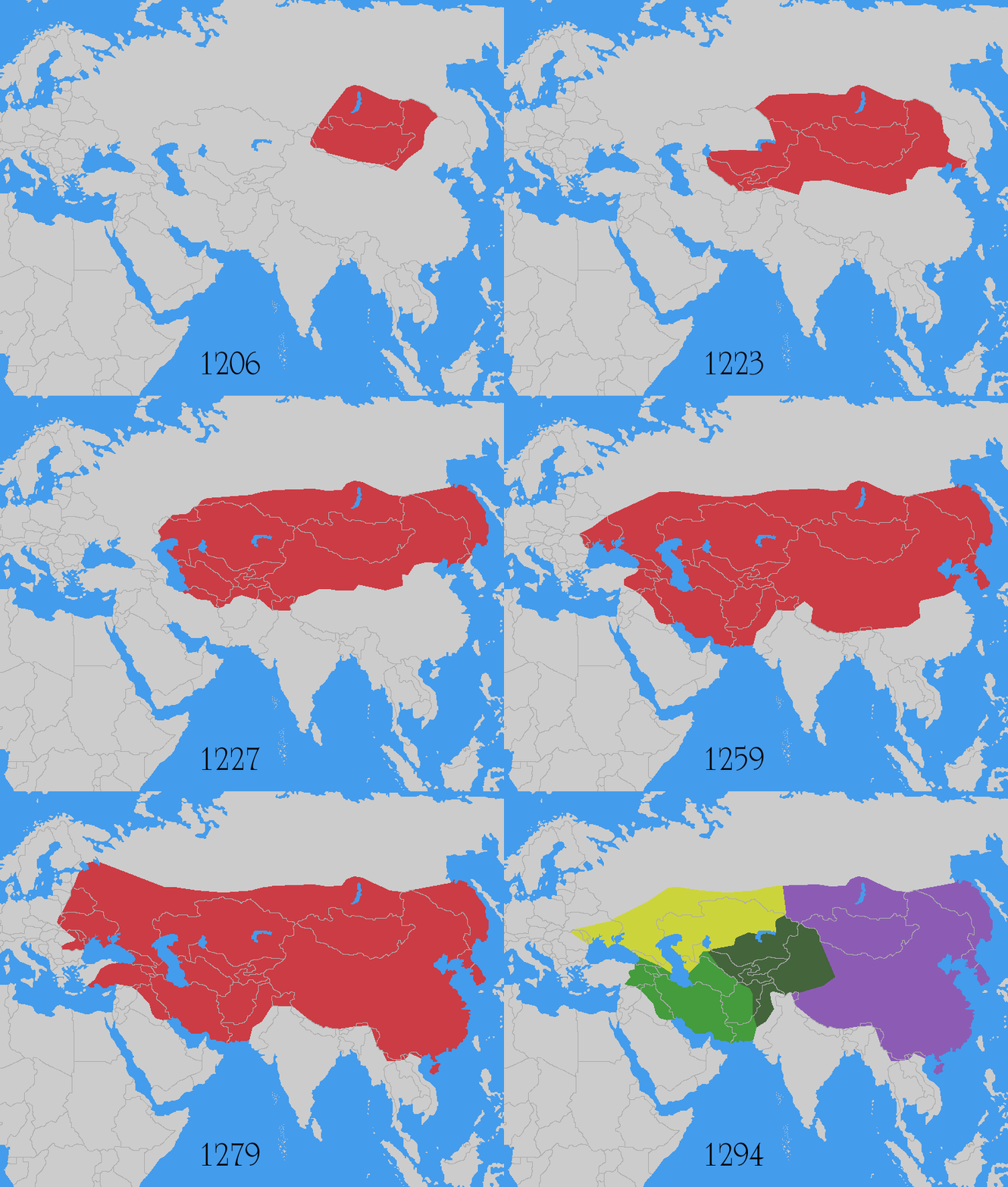
This GIF recently made it onto /r/all and it got me wondering about the huge empires of the past (Roman, Mongolian, British, etc.) and how they were administered, maintained and run in a time before phones, planes and other rapid means of transport and communication.
Basically, how do you maintain an empire and keep it from fragmenting if getting a message to the governors and bureaucrats in the far reaches takes weeks or months?
3 Answers 2017-02-06
Later medieval periods always depict spears or longswords
2 Answers 2017-02-06
1 Answers 2017-02-06
So I've found a lot of maps drawn by the British (among others from western Europe) from (mainly) the nineteenth century. That claims the existence of a country that didn't exists (from my understanding). I find it hard to believe that Europeans had no idea about the political borders at that time. I am talking about maps like the ones here: 1 - 2 - 3 - 4 - 5 - 6 - 7 - 8 . Why would such thing occur? What did they think of the region? Did the neighboring countries even have any control over Baluchistan?
1 Answers 2017-02-06