came across a reference in a book which simply notes that it was "'spontaneously annexed' in 1888 by a military officer"
1 Answers 2016-12-02
U.S. strategy in the Vietnam War has been roundly criticized for overemphasizing conventional threats (the NVA) and meeting them with conventional methods, while their strategic position in Vietnam was being undermined by unconventional means (the VC infrastructure), which required other methods to deal with (counterinsurgency, civil actions, etc). The Phoenix Program to me looks like an exception to the rule; I'd be interested in hearing how it fit together with everything from our Vietnam experts.
1 Answers 2016-12-02
Historically for a long time, the mother tongue of the lowlanders was Scots, a Germanic language derived from Northumbrian Old English. Scottish (Gaelic) was the mother tongue of the highlanders not the lowlanders whereas Old English (and its derivative Scots) was the mother tongue of the lowlanders.
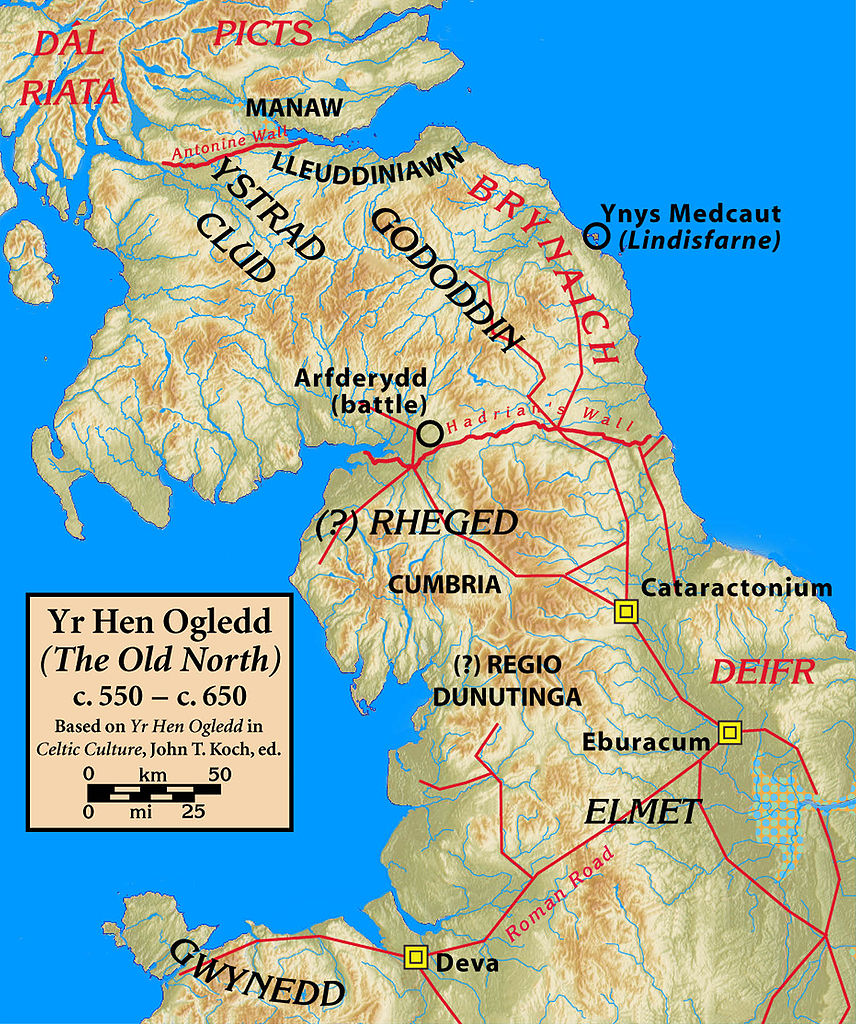
Prior to the Germanic & Gaelic invasions/migrations to Britain, the language spoken in the lowlands was Brythonic, a language related to Welsh. Whereas the language spoken in the highlands was Pictish. As can be seen on this map. I'm fairly confident that Scottish (Gaelic) was never spoken by the majority population in the lowlands. Lowland Scots also have significant genetic influence from the Anglo-Saxons and Vikings due to the occupation of that region by them.
So how come the Scottish Lowlands are part of Scotland and not England when they have more in common with England in terms of language/history/ancestry? Since England was historically much more powerful than Scotland, I find it interesting that the Scottish Lowlands are not considered part of Northern England. What are the reasons behind this?
1 Answers 2016-12-02
I just finished reading Tom Holland's "Rubicon" and while it filled in a lot of gaps in my knowledge, corrected many errors I'd learned in history class, and gave me some new small bits of interesting info (like Romans thinking it was barbaric to drink milk) - one of those tidbits that sticks with me most is that one of quirks the Romans thought odd of the Gauls is that they did not lay down to eat. I may have heard of Cato's public mourning of the republic via eating in a sitting up position prior to this reading, but didn't understand its magnitude then and still don't quite. Did all Romans of all classes eat laying down - for instance laborers, slaves or gladiators? Was this common in other civilizations outside Rome at the time as well?
1 Answers 2016-12-02
My grandfather died before I was born, but I grew up on stories of my grandfather's experiences in WWII. We have some heirlooms that he left behind, namely his Distinguished Service Cross and some letters he wrote. Unfortunately, we don't have much. My father's birthday is coming up next year and I would love to be able to put together some materials about my grandfather for him.
Where the heck would I find these records? What information would I need to access them? Paywall? I have looked around a bit, but I have not really had any success.
Any help would be much appreciated.
Further info: His name was from Denver. I believe he was in an AA battalion and was, eventually, a berevit Lt. Colonel. I think.
ETA: Sorry if this is the wrong sub. If so, what would be?
ETA pt. 2: Removed Name
3 Answers 2016-12-02
seeming as Iran has transformed from a once modern and secular nation, into the Islamic republic we see today, I was wondering whether or not the Iranian revolution was started to establish an Islamic state, or was it more to do with getting rid of the monarchy?
2 Answers 2016-12-02
So I've been decently obsessed with Jefferson lately and I was just wondering if the newly released song from the Hamilton mixtape accurately sums up how he felt about slavery. Specifically, his verse:
Sir The constitution clearly states That the states have to wait Until eighteen-oh-eight to debate On whether to end the slave trade And whether or not you want it, guys That is the final compromise we made
But for a second let us say that we can legislate Unanimous emancipation, freedom reigns, and yes, it's great We cannot cure prejudice or righteous, desperate hate So back to Africa or do they get a separate state? In 1784, I tried to float banning slavery in the West My notion didn't get a single vote Slavery's a sin, it's growing like a cancer But we can't address the question if we do not have an answer
1 Answers 2016-12-02
1 Answers 2016-12-02
The reason I'm asking this is because as I was reading a biography on Niccolo Machiavelli, the author stated that one of the reasons Machiavelli was a supporter of militias is that Italian mercenaries back then didn't truly fight battles against other mercenaries. Apparently both companies met in the field and through an unspoken shared code of conduct they engaged in a complex choreography that closely resembled a pitched battle but in reality resulted in minimal casualties to both sides. The reasoning for this was that if you were dead, how would you enjoy your gold? Furthermore, it would have been expensive to actually replace men after a battle, and profit was all the Condottieri were after.
Was this actually a thing that happened? If so, then how exactly did these fake battles go about? I doubt that there is a detailed description of one of these battles but I hope that some information can be gleaned from this, seeing as how it's such a radical departure from what war is supposed to be like.
Thank you for reading!
1 Answers 2016-12-02
I realize this probably changed by country, and am not necessarily focused on one single country's system. Were there incentives for volunteering instead of being drafted? Also, if someone was captured as a POW but was liberated before the end of the war, did they rotate back into service or were they sent home upon their release?
I just can't imagine how demoralizing it must have been to not know when you might return from war and wonder if soldiers had a date in mind they could dream about returning home. Apologies if this topic has been covered before, I searched and quickly checked popular questions but didn't see one that addressed this.
2 Answers 2016-12-02
Hi everyone, I have a mini-presentation about religion in Medieval Age. I am from Turkey and my english teacher gave me that presentation topic. Unfortunatelly I only know that life was dominated by church in those times. She said I should focus on religious class, why they were so important, monasteries,monks and their lives. She said they were the only ones who read and write so I should talk about their power. Sorry for my bad english and thanks.
2 Answers 2016-12-02
I saw an old addresses about Eisenhower regarding little rock in another thread and got me thinking about Presidents and TV. Did they only start addressing when most Americans had TV's? When was this? Could Truman have been first? (Link: https://www.youtube.com/watch?v=8bzmtkhXAno)
2 Answers 2016-12-02
Vote for the answer(s) you liked best this past month! Submit ones you liked and don't see submitted here yet!
14 Answers 2016-12-02
Also by our reckoning was he born in 1 BC or 1 AD?
1 Answers 2016-12-02
Today:
You know the drill: this is the thread for all your history-related outpourings that are not necessarily questions. Minor questions that you feel don't need or merit their own threads are welcome too. Discovered a great new book, documentary, article or blog? Has your Ph.D. application been successful? Have you made an archaeological discovery in your back yard? Did you find an anecdote about the Doge of Venice telling a joke to Michel Foucault? Tell us all about it.
As usual, moderation in this thread will be relatively non-existent -- jokes, anecdotes and light-hearted banter are welcome.
14 Answers 2016-12-02
I knew that back then, traditionally Samurai fought on horseback as archers (hence why the yumi/japanese bow is shorter on the bottom, kind of a clever design imo) From what I believe, Japanese horses were so small that a person could easily outrun an armored man on horseback, so what's the point in using them? on a side note, what made the Takeda clan's cavalry famous? I heard that their horses were of special breed, but how do they compare with other horses in Japan?
1 Answers 2016-12-02
I like this sub, but there are many good questions from interested enquirers that go unanswered because no one with the time, inclination and knowledge is available to answer them in sufficient detail or with sufficient supporting evidence.
I wonder if we could have a rule which states that usual moderating standards apply for the first two weeks (or maybe one week, even). After that, if the question has not been answered by someone who is qualified to do so under the standards of this subreddit, others may chip in with what knowledge they have. Perhaps these treads could be tagged in some way so that people can see the difference?
2 Answers 2016-12-02
1 Answers 2016-12-02
Hey everybody,
So my mother used to tell me a story about my grandfather that I would like to know if it could be true or not. I unfortunately couldn't ask him personally about it, because he suffered from parkinson's later in life and died before I developed a deeper interest in history.
So, my grandfather got drafted into the Wehrmacht very late in the war, because he was relativly young. I'm guesing we are talking 44/45 here. I don't know much about where he was stationed or anything else. It was not something which we discussed very often. I know that he was captured on the Austrian border. I don't know if it was by the Russians or Allies and I also don't know on which border excactly.
Now, here is the part of the story that I don't know is true or not:
Because he was from Upper Silesia, he was supposed to be send back there and basically live in the USSR. He didn't want to be send there (I think the rest of his family at that time has already fled the region) so he "accidentally" got his hand stuck in the train door, which led to him being sent to a rehabilitation center in Allied occupied territory. He met my grandmother there and my family basically stayed in the region until today.
Sorry for the wall of text and the little information I can give. I am prepared to accept the whole story as completly false. Any perspective on this story would be appreciated. In summary I think my main questions are this:
TL;DR: Were german POWs transfered into the USSR? Could he avoid this by getting hurt?
2 Answers 2016-12-02
This question is not for my homework in any way as I am currently doing IB and we don't learn jackshit about Nehru.
It's just that because I am part Indian, I needed to know some information about my country that I didn't have the chance of knowing.
It's so I can better formulate and evaluate my rather anti-Nehru opinion and see to what extent is my opinion really right, because atm, I don't have much to back it up.
I have heard most people say it was a failure, but some said it was a success. None of those people had any clear answers or evidence to back it up.
So that's why, this question.
Thanks.
1 Answers 2016-12-02
Ive always wondered this, for people who live in, say the UK. Britain doesn't only have a long history, but it's full of many events. Are there more history classes to teach it or is it skimmed over more?
2 Answers 2016-12-02
In The Persian Expedition, Xenephon talks about egressing through (modern day) Iraq and seeing absolutely massive fortifications, bigger than anything they had in Greece.
"...they marched one stage, six parasangs, to a great stronghold, deserted and lying in ruins. The name of this city was Mespila, and it was once inhabited by the Medes. The foundation of its wall was made of polished stone full of shells, and was fifty feet in breadth and fifty in height. Upon this foundation was built a wall of brick, fifty feet in breadth and a hundred in height; and the circuit of the wall was six parasangs" (which, if Google is to be believed, is 21 miles)
So, why would no one move into this defensible city? Or if not this one the smaller well defended cities they passed like Larisa? If it was valuable to the Assyrians, wouldn't the Persians want it?
2 Answers 2016-12-02
I would like to find a book that details the history of Rome, and more specifically also covers the years from 300 to roughly 1500.
I can't find a lot about Rome during that timeframe. But I would like to have an idea of what daily life was like for the people left behind during those ages. Did they trade in the marble that was left behind? Did yearly floods cover the forum romanum? Were statues looted?
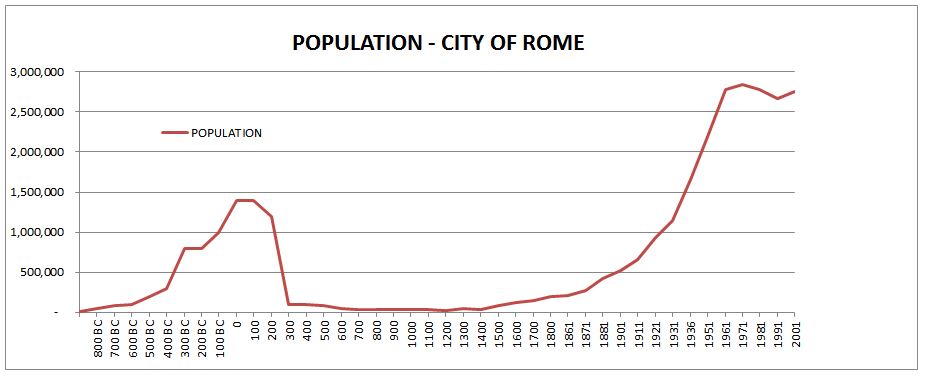
I find this an intriguing image, of a vast city landscape with great monuments and statues inhabited by only a few Thousand of people. Population estimate of Rome over time
2 Answers 2016-12-02
A theory I've heard people talk about in a superhero mmorpg is that the myths of King Arthur draw inspiration from some aspects of Norse mythology.
From a total layman's perspective, there's appeal there: drawing a stone sword that none other can lift is not entirely unlike Mjolnir as of the Marvel depicition being non-lifteable by those who are not worthy.
There's a sagely wizard type in both characters' lives: while Merlin draws from Myrddin Wyllt, there are depictions of Odin as a bearded wizarddy type...
And both are warrior types, typically portrayed as bearded sorts with long hair, and then there's the symbol connection: Arthur's sometimes shown as a Christian king with crosses being prominent, while Thor's symbol is basically a T-shaped hammer.
I don't know if there's anything to this connection, but it seems not entirely unlikely to my mind there's inspirations flapping about the general mythic consciousness from older myths until Arthur's invented.
2 Answers 2016-12-02