Except for the Battle of Iwo Jima, American casualties during the island hopping campaign were always lower than Japanese ones. This goes against what I assumed about siege warfare, that attackers can expect higher rates of attrition than defenders when attacking a fortified position. What happened?
2 Answers 2022-01-04
1 Answers 2022-01-04
1 Answers 2022-01-04
Its time to close out the year, and announce the final monthly awardees! (But stay tuned for the Best of the Year vote going up soon!
To close out the year, the panelists decision for "Flairs Choice Award" fell upon the shoulders of /u/vpltz, who tackled the question of "What happened the first few days after segregation ended in the United States?"
For the "Users' Choice Award", the community was in a bit of a festive spirit, and with the top laurels going to /u/kiwihellenist for their answer to "Pagan traditions in modern Christmas?"
For the "Dark Horse Award", which recognizes the combined top-voted non-flair user's answer, it is perhaps appropriate that the year closed out with by far the closest fought poll, with several candidates neck and neck to the finish, but just by a nose was /u/Friend_of_Augustine, and their answer for "What did a medieval army (more specifically, southern France during the Albigensian Crusade) do after they conquered a town or castle? Would they leave a garrison? Put somebody in charge who's loyal to them?"
For this month's 'Greatest Question', voted on by the mods, we were taken this month by "How did New Zealand's colder climate, mountainous terrain, and vast resources change Maori culture from their Polynesian cousins on smaller islands?" from /u/LordCommanderBlack. A fascinating question, so far it remains unanswered, sadly.
Finally, we come to December's "Excellence in Flairdom Award", which recognizes members of the AskHistorians communities for their contributions beyond any one, single answer. Earlier this year we set out to revitalize the 'Monday Methods' Feature with a call to the flairs (and mods) for contributions on... whatever they damn wanted! As such, this month's EIF recognizes the flairs who answered it:
As always, congrats to our very worthy winners, and thank you to everyone else who has contributed here, whether with thought-provoking questions or fascinating answers. And if this month you want to flag some stand-out posts that you read here for potential nomination, don't forget to post them in our Sunday Digest!
For a list of past winners, check them out here!
7 Answers 2022-01-04
A friend of mine argued that Pompeii society was especially hedenous/sexual as sexual texts were found in graffiti there which has not to the same extent been found in other places.
I however reasoned that the only reason for that is that more graffiti in general from the time is found in Pompeii due to the circumstances of it’s deatruction which preserved the city from that exact moment in difference to other roman settlements which often have survived and evolved until today leaving no graffiti from the time.
Is my reasoning correct or is he right that Pompeii was an extra sexual society??
Sorry for the poor English, it’s not my first language.
1 Answers 2022-01-03
So America western expansion is romanticized into the “Wild West” and the adventure filled frontier. It’s a whole genre that still commands public attention, as we can see from red dead redemptions popularity.
Does the Russian frontier in Siberia and Central Asia mythologized in the same way. Is there a whole genre based around 18th and 18th century eastern expansion in the same way we have Westerns in America?
2 Answers 2022-01-03
1 Answers 2022-01-03
Back in a US History 2 I had a prof who told me this. I don’t remember who the original leader was but she told me he was highly religious and just didn’t want black men voting. So he gather a group of hillbillies basically to dress up as costs and jump at black people randomly screaming at them to not vote.
At that time the KKK (To my knowledge not hers) were seen as stupid and ineffective at dealing with the recently freed black slaves, and it wasn’t until the Birth of a Nation film that racists took the group seriously as an outlet. Which I assume is due to this tactic, and it didn’t work.
Back to what she claims, since that didn’t work the group turned violent and that mad left the group specifically because of that. In turn making folks think even lesser of it (Not out of sympathy for black men) until they film causes a resurgence.
This feels extremely inaccurate but I want to know if there’s any truth to the statements she made.
This was in New York State btw, North of the US. Struck me as odd.
1 Answers 2022-01-03
I've heard they did a lot of things that probably would have been the closest thing to communism in the 16th century (banishment of private property, no loans with interest etc). Did the founders of Communism get any influence from this at all?
1 Answers 2022-01-03
1 Answers 2022-01-03
So I'm reading THE KILLER ANGELS for the first time and I'm struck by how often, and how avidly, Shaara seems to try to make congenial the opposing officers in the US Civil War. Obviously there is the much-cited friendship between Armistead and Garnett, but it seems like every other chapter features a scene in which one officer or another says something like, "Boy, there sure are a lot of worthy soldiers on the other side. Those fellas sure did give us hell today. I tip my hat to those [Rebs or Union soldiers]."
And the portrayal of Lee seems especially sympathetic. The entire book is full of descriptions of his grandpaternal care, his humane charisma, the loyalty he inspires in his men, his deep regard for human life, his fairness, etc.
It feels almost reverential.
And then in chapter six, Lee's interior monologue talks about how "wrong" the Confederates are, how "insane many of them are." Lee is characterized as a reluctant warrior, someone who entered a war he knew was wrong because he simply had to fight for his people (once the declaration of secession was made); the whole depiction seems almost like an apology for Lee and/or the entire Confederate enterprise.
To what degree is this portrayal of Lee---especially his conviction that the war is "wrong" and that he is involved in the fighting only reluctantly---in line with what is historically verifiable?
And is the gentlemanly, admiring regard that the officers seem to have for opposing soldiers more or less accurate for the time?
Apologies if this has been asked and answered ten thousand times on here already . . .
1 Answers 2022-01-03
And, if so, to what extent did MAD lead to the development of "proxy wars" between major powers, such as the Vietnam War and the Soviet invasion of Afghanistan?
1 Answers 2022-01-03
Ok, the headline sounds insane, but this Vanity Fair article has the following quote:
The last stop of this meditation is Zagorsk, Russia, where, troubled by the anti-Semitism he encountered there, my friend Andrew Solomon asked a local peasant why, in his estimation, there was such antipathy everywhere against Jews. Without a moment’s hesitation, the peasant answered, in Russian: “It is because the Jews have a secret vegetable they eat so they don’t become alcoholics like the rest of us. And they refuse to share that vegetable with anyone else.”
Does anyone have any additional info about this myth? Was it widespread? What is this magical vegetable called?
Edit: so, a bit more googling reveals that the vegetable is in fact hairy.
In the book Beliefs, Behaviors, & Alcoholic Beverages: A Cross-cultural Survey (Google Books) there's a reference to the vegetable.
1 Answers 2022-01-03
In searching the subreddit, I keep seeing comments explaining that feudalism as popularly understood didn’t actually happen.
In that case, what is the best way to understand the pattern of “land grant in exchange for military service and/or other taxes” that happened in Europe during the Middle Ages?
1 Answers 2022-01-03
I know it was their unique ships and seafaring prowess that allowed them to raid with relative impunity, settle in distant lands, and connect with far-flung trade networks. But WHY did they leave their own lands in such numbers, to settle or raid? What conditions in the Norse lands drove them to it?
1 Answers 2022-01-03
I'm writing a fictional book about pirates. It contains a massive navy belonging to a nation called Ursa, and many ships under the command of a pirate king as well. I know I'm asking for a lot of information here, but could anyone give me a basic rundown on how these ships rand, what roles needed to be filled, what types of ships a navy might have/a pirate might have, what they ate, etc.?
1 Answers 2022-01-03
Hey everyone ,
I'm looking for a book detailing on the Soviet-Nazi war
Some points which I'd like the books recommended to cover are :-
Some other questions : 1. Can anyone who owns or has read Stalingrad by Antony Beevor , tell me :
Thanks in advance
1 Answers 2022-01-03
Of course he was still fighting Germany, but it seems like at some point the Red Army was rather effective and the Soviet Union had victory in sight. If he could set up puppet states in Eastern Europe, why would the allies stop him in Finland, which did fight alongside the Nazis. Why not attack Finland?
1 Answers 2022-01-03
1 Answers 2022-01-03
I've come across several references to imperial birthday celebrations being established for monarchs in medieval China, Korea and India. I've seen this referenced for emperors and for dowager empresses. When a new monarch ascended the throne, what happened if his/her birthday was on the day of some other major festivity? Would they just be combined, or would the monarch be given a different "official" birthday, like the Queen's Birthday in the UK?
I'd be interested to hear of any examples you know about even if they don't match the places I was reading about (Chola India, Song China, and Goryeo Korea). Thanks!
1 Answers 2022-01-03
I've heard this claim several times, but I've never seen any concrete evidence presented either for or against the idea.
1 Answers 2022-01-03
During large scale European conflicts in the 19th century, one or more great powers were badly defeated militarily on several occasions. Examples of this would include the defeats of Austria and Prussia during the Napoleonic wars and France's defeats at Waterloo and after the Franco-Prussian war. However, to my (limited) knowledge this never really resulted in full scale annexations of these countries' territories, but rather small scale border changes, changes in alliances and other diplomatic consequences. This seems to be in stark contrast to most of history, where famous conquerors such as the Persians, the Romans and the Mongols mostly seemed to annex conquered territories and incorporated them into their own empires. Is this true and if so, why did it happen?
1 Answers 2022-01-03
They had a population of 300k and only 60k of those people died from the bomb, how did they manage to survive if they had no idea the nuke was coming?
Also Hiroshima doesn’t have that much radiation today and is even better off than it was before the war, why is it less than other places that we nuked like bikini atoll?
1 Answers 2022-01-03
Happy New Year to all, and a special thanks to the mods for this brief foray into some philology!
I have attempted to write this in a way that is accessible and comprehensible to a general reader, as well as attempting to remain relatively concise, and thus there are, of course, areas upon which I can expand or which may necessitate further discussion, and I am happy to do so in the comments.
Without further ado, let us begin.
What is ogham?
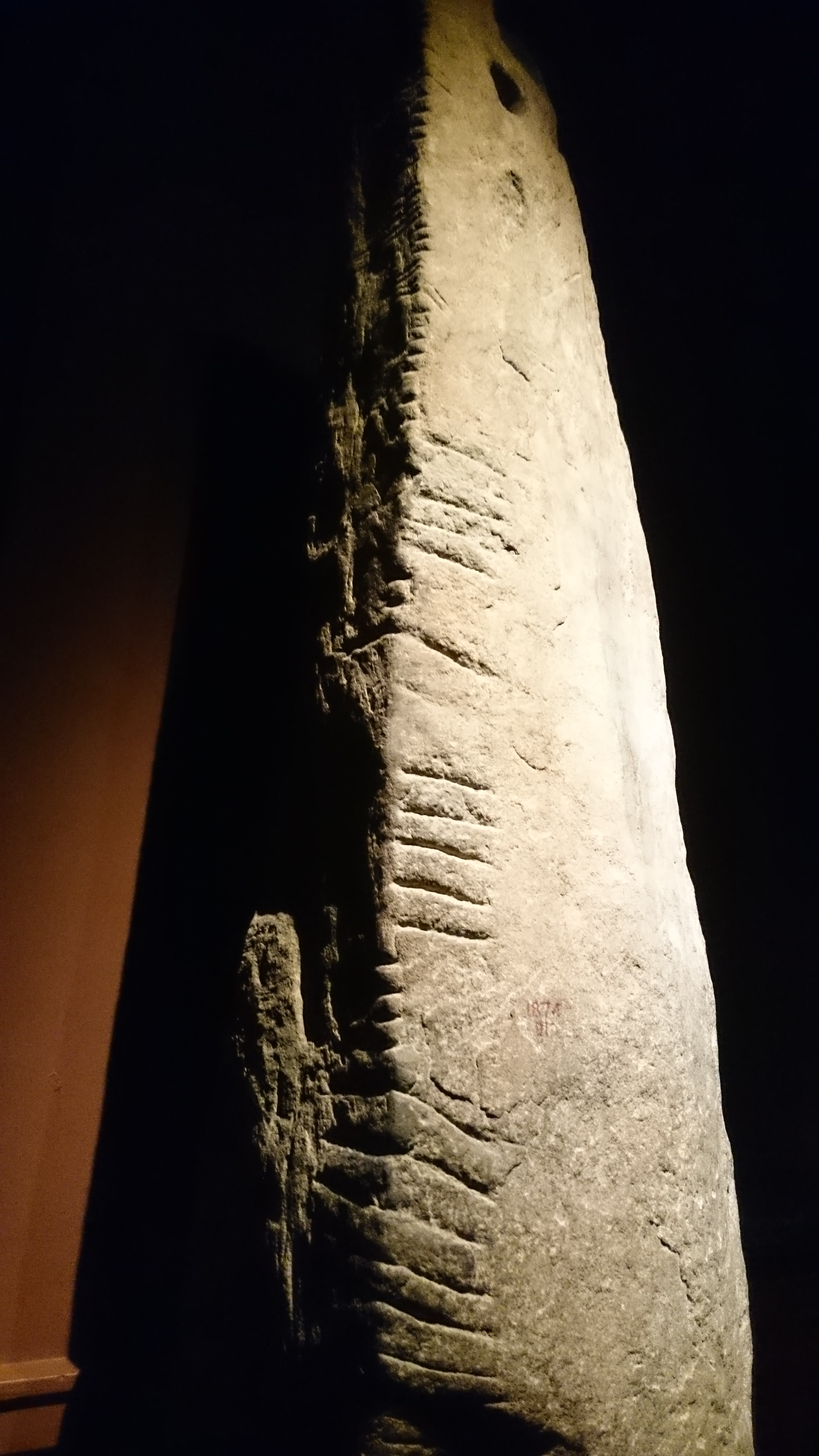
Ogham is an alphabet system consisting of notches and lines across a stemline, and it serves as our first written record of the Irish (Gaelic) language, having been in use between 400-600 AD. The system consists of four groups of five letters, with two of the groups protruding out either side of the stemline, one to the left and one to the right; one crossing the stemline diagonally, and the fourth appearing either on the stemline itself, or crossing it. With regards to the image linked above, there is a fifth group that we will be discussing further below.
But, for those familiar with the Irish language, it is immediately apparent that the ogham alphabet provided above contains letters which do not exist in the Irish language: Q, NG, and Z. (With a caveat here that /h/ does exist in Modern Irish, but rarely, primarily as a marker of mutation and in loan words, as it did not exist in early periods of the language.)
This is certainly odd, as why would an alphabet contain letters that do not exist in the language? Why include them if they weren't going to be used?
So where do they come from?
Our sources for ogham: ogham stones
Before answering that question, a bit of background about ogham is needed. Our earliest sources of ogham (5th-7th century) are found on ogham stones. Further information about the previous image.. As you can see, the spine of the stone was frequently used as the stemline for the inscriptions, written vertically, typically from top to bottom, and following the edge of the stones.
The stones appear to have been used in burials, as well as for boundary markers, indicating where someone’s land ended or began. Therefore, the content of the stones is fairly simple: we typically only have proper names. Many follow the formula [X] MAQQI [Y] aka [X] mac [Y] aka [X] son of [Y]. There are occasional tribal affiliations ('of the people of [Z]') and, as on CIIC 145 the inscription includes QRIMITIR cruimther ‘priest.’
This means that, unfortunately, we have no attestations of sentences or complex concepts. We have no verbs, no adjectives, and only a handful of nouns outside of personal names, etc. It also means that we don’t know how ogham might have been used (if it was used) to handle more complex constructions eg. were different sentences written along a different stemline? Although later medieval texts refer to messages being written in ogham on trees and pieces of wood, none of these survive (if they ever existed at all, as the practice may not have been a legitimate one.) Thus, we're left with relatively little by way of actual attestation.
That does not mean, however, that the ogham stones do not provide us with a wealth of linguistic information, because they absolutely do. We can trace changes in the language from the content of the ogham stones, from which we can extrapolate to our reconstructions of other aspects of the language.
The Irish language changed significantly in a relatively short period of time. The Primitive Irish period lasted only for a century (400-500 AD) and was marked by apocope, the loss of final vowels. Archaic Irish lasted between 50 to 100 years (500- either 550/600 AD, depending on your dating of Early Old Irish) and was ended with syncope – the loss of second/fourth internal vowels. (There are, of course, other changes that took place in the language during and after these periods, but these are the major changes by which we date the periods.)
To illustrate: CIIC 58 gives us the Primitive Irish name CATTUBUTTAS, with its original ending (-as) still intact. The same name appears, post-apocope, in the Archaic Irish inscription CAT]TABBOTT in CIIC 46 in which the ending has been apocopated (no more -as here) but the internal vowel -a- is still retained. The name in the Early Old Irish period, once we are firmly manuscript territory, appears as Cathboth – with the internal vowel syncopated – and eventually, Cathbad, for those familiar with Early Irish mythology
We can also view these changes in ‘real time’ so to speak, as, for example CIIC 244 contains the inscription COILLABBOTAS MAQI CORBBI MAQI MOCOI QERAI ‘of Cóelboth, son of Corb, of the descendants of Cíarae’ while CIIC 243 has MAQI-RITTE MAQI COLABOT MAQI MOCO QERAI ‘of Mac-Rithe, son of Cóelboth, son of the descendants of Cíarae.’ Clearly, this Cóelboth is the same in both inscriptions, but in one his name is given with the pre-apocope (COILLABBOTAS) form, and in the other, the post-apocope form (COLABOT.)
Our sources for ogham: manuscript ogham
As noted above, our stone sources of ogham are relatively limited in content, and you may have noticed that I made no mention of the alphabet. This is because no such guide to the alphabet exists on the stones themselves. While we do have bilingual stones that aided in translating/transliterating them, the ogham alphabet linked above has been given to us in manuscripts.
One of our sources for the ogham alphabet is Auraicept na n-Éces ‘The Scholars’ Primer,’ which is a didactic text that discusses Irish grammar, but also ogham in some detail. You can view the manuscript pages from the Book of Ballymote thanks to the wonderful people at Irish Script on Screen, however their website prohibits direct linking so you will have to open images 169r – 170v yourself to see the lists of the alphabets.
The texts in which the ogham alphabets are identified are typically dated to around the 7th century (although the manuscripts themselves are much younger,) which means they were written right around the time that ogham was no longer in use.
It is likely for this reason that we find discrepancies between manuscript ogham and stone ogham: ogham was either already a purely scholastic exercise, or was on the way out, meaning our scribes were less familiar with it than if it were their primary orthographic system. There are a number of discrepancies in the representation of the language, including the inclusion of mutation in the manuscripts, but for the purposes of this post we’ll focus on the alphabet itself.
A prime example comes in the list of the alphabet linked above: the fifth grouping of characters, the forfeda or ‘supplementary letters’ are not well-attested on stones. In fact, only the first symbol – given in the alphabet there as -ea- is attested, and more commonly as ‘K,’ (cf. CIIC 197, CIIC 198,) although later appearing as a vowel, like -e- or -ea- (cf. CIIC 187.
Our manuscript ogham sources also provide a number of other ogham alphabets that are otherwise unattested: they appear in these sources, and these sources only. Whether or not they were actually in use at any stage is unknown, and they have no representation on the stones. Additionally, outside of being listed as alphabets, they are not used in the manuscripts themselves and thus many of them have yet to be decoded. The function of these alphabets is still a subject of academic debate, with some scholars believing they were legitimate alphabets that were used in particular contexts, and others believing they were invented for some academic or didactic purpose.
Letter names
Something commonly stated about ogham is that it is a ‘tree alphabet,’ – if you Google it, or have ever encountered it in any media or pop history book, this is likely one of the first things you’ll come across, and this designation has led to a certain amount of extrapolation about the native Irish.
The reason the alphabet is often referred to as a ‘tree alphabet’ is because the manuscript ogham tradition provides us with the names of the letters, which are (generally) the names of trees or other plants. Unlike the English alphabet, in which the letter names are just...letter names, they have no other meaning (aside from the homonymic few,) whereas the ogham letter names given to us are also proper nouns.
The names were seemingly transmitted as kennings, essentially riddles, which is likely an important consideration when we finally get to our titular question. The kennings were intended to hint at the names by referring to the meaning of the name, or qualities of the name, like the types of hints used in crossword puzzles.
These kennings run of the gamut of being completely understandable to someone without the intellectual or cultural context in which they were created, to being entirely opaque. As example, kennings given for the letter -u-, named úr ‘clay, soil, earth’ are sílad cland ‘propagation of plants,’ and forbbaid ambí ‘shroud of a lifeless one,’ both of which can be potentially figured out by a modern reader: earth is needed for plants to grow, dead people are shrouded in the earth, etc etc.
But the kennings for the first letter, -b- beithe ‘birch tree’ are more puzzling: féochos foltchaín ‘withered leg with fine hair,’ glaisem cnis ‘greyest of skin,’ maise malach ‘beauty of the eyebrow.’ Personally, I don’t know that I would ever have landed on ‘birch’ from those, without the aid of the manuscript ogham tradition.
Mystery letters
Now, onto our titular question: why does the alphabet contain letters that did not/do not exist? How did they come to be in the ogham alphabet? Although we cannot know for certain, our best estimate is that these values represent linguistic change within the language, and an attempt to reconcile a sequential alphabet system with these changes.
An example that we can see is that of F, which undoubtedly represents an earlier V. The name for -f- is fern < * u̯ernā,* ‘alder tree,’ and we have Gaulish verno-dubrum ‘alder-water,' as a Celtic comparison. We do also have bilingual stones in which the symbol -f- is used to represent -v- in Latin: AVITTORIGES INIGENA CUNIGNI : Avitoria filia Cunigni (CIIC 362.) Based on the evidence at hand, we know that the sound /f/ was originally /v/, and the value of the letter F in the ogham alphabet likely changed to reflect those changes. (This is also why, for anyone who has looked into the ogham alphabet, you'll find conflicting alphabets from some sources. Those following the stones will include V as the third letter, while those following the manuscript tradition will include F.)
It logically follows, therefore, that the value of the other letters changed as the language changed. The trouble with this, however, is that - with the exception of Q, which is used in nearly every inscription - there are no attestaions of H or Z on any of the ogham stones, and there are no unambiguous attestations of NG. Meaning that we have no evidence from the 'original' ogham sources to help us puzzle out what they may have represented.
With Q, we know that it originally represented /K^u̯ / based on other etymological reconstruction, such as its use in the word MAQQI in the stones, which comes from makk^u̯ - . The assumption that the letter Q originally represented K^u̯ is perhaps validated by the fact that there is the word cert ‘bush’ < k^u̯ ertā, which seems a likely candidate for the original letter name, which is occasionally spelled quert by the manuscript tradition to try and justify the inclusion of Q. But, we are also provided with the homonym ‘ceirt’ meaning ‘rag,’ as the name in the manuscripts.
We’re likely looking at a similar situation with NG: the kennings give the word (n)gétal ‘wounding, slaying,’ which is otherwise unattested in the Old Irish corpus. It appears to be an older verbal noun of the verb gonaid, meaning ‘wounds, kills’ which comes from g^u̯ en-.
As we know that both /K^u̯ / and /G^u̯ / existed in the Primitive Irish period, and eventually merged with /k/ and /g/ respectively, likely around the 6th century, positing them as the original values for the letters Q and NG seems fairly reasonable. As they were originally distinct sounds from /k/ and /g/, (and especially in the instance of Q, a rather common one) they would have needed their own letter in the original ogham alphabet found on stones.
H & Z, however, are more of a mystery.
The name given by the manuscripts for H is húath ‘fear, horror,’ but the h- here is artificial: the word is úath, and while attaching a cosmetic h- to words beginning with vowels was a relatively common practice of certain Old Irish scribes, it was never understood as being pronounced. The kennings certainly point to úath 'horror' being the correct name, but scholars are uncertain about the etymology of the form and thus, without any attestation, it is entirely unclear what the original sound here may have been, especially as we would expect a consonant sound based on its position within the alphabet structure.
We have a similar problem with Z in that the name given for the letter sraiph, zraif, straif ‘sulphur,’ is of unknown etymological origin. If we were able to identify the origins of this word, the original value of the letter would likely become clear, but until then we can only guess. Some kind of -st-, -str- grouping or potentially even a S^u̯ have all been suggested.
Inclusion in manuscript sources
It seems a reasonable assumption, based on the evidence of F and Q especially, but likely also NG, that these troublesome letters originally represented sounds that no longer existed by the time of their inclusion in the manuscript sources: F originally represented a /v/ but had become /f/ by the time of writing while Q originally represented K^u̯ before its merger with simply /k/, which is likely also the case with NG > /g/.
But then, why were they included in the alphabet given in manuscript sources? If the sounds no longer existed, why did the scribes include them?
It has been suggested by McManus (1988, 166-167,) that the letter names, and their kennings, were fixed at a relatively early date (he suggests the 6th century) and that these were passed down as learned series. This leaves the scribes of our manuscript tradition with a bit of a puzzle: the kennings, and their associated letter names, now don't make any sense, with some of the letters appearing to redundant (the name ce(i)rt has an initial sound of /k/, the same as the letter C [coll,] the word gétal begins with the sound /g/ which already exists in the letter G [gort].) Imagine if someone were to give you the words 'cat' and 'cot' and say, "These start with different letters, tell me which letter is which."
But what is to be done? If we take the ogham stone tradition into consideration, Q is used in nearly every inscription, it cannot be simply ignored or erased, it needs to be included in order to avoid confusion. Perhaps even more importantly, the ogham alphabet is sequential. It would not make any sense to remove letters when they are represented by increasing linear strokes: removing both NG and Z would mean that the alphabet would have a symbol of two diagonal lines across the stemline (G) and then jump to five diagonal lines across a stemline (R.) It would upend the system.
The best that our scribes could do was assign cosmetic values to the sounds that no longer existed in order to keep the alphabet intact, and to distinguish them from already existing letters. In order to do so, they included letters from the Latin alphabet that were not present in Irish: as úath began with a vowel, and was both redundant and in the place of an expected consonant, they prefixed a cosmetic H; as the distinction between K^u̯ and K was lost (and indeed MAQQI was now mac) they represented it with a close Latin equivalent, Q, which was undoubtedly the same thought process that went into Z. NG may have been influenced by mutational contexts, but we may never know for certain.
Basically, the TL;DR version of this is: the letters of the ogham alphabet that do not exist in the Old Irish (or Modern Irish) alphabet undoubtedly represent sounds that were present in the language when ogham was created, but that were merged with other sounds through the process of linguistic change. As ogham was passed down to subsequent generations, they grappled with the seeming redundancy of sounds in the alphabet and inserted Latin letters to try and represent the sounds that were once distinct, in order to maintain both the sequential system of the ogham alphabet, and the inherited knowledge of the kennings.
Some further reading:
R.A.S. MACALISTER, Corpus inscriptionum insularum Celticarum. 2 vols. Dublin: Stationary Office, 1945, 1949. Vol. I reprinted Dublin: Four Courts Press, 1996
Kim MCCONE, Towards a relative chronology of ancient and medieval Celtic sound change. Maynooth: The Department of Old Irish, St. Patrick’s College, 1996.
Damian MCMANUS, ‘A chronology of the Latin loan-words in Early Irish’, Ériu 34 (1983), 21–71
-- ‘On final syllables in the Latin loan-words in Early Irish’, Ériu 35 (1984), 137–162
-- ‘Ogam: Archaizing, orthography and the authenticity of the manuscript key to the alphabet’, Ériu 37 (1986), 1–31.
--'Irish Letter-Names and Their Kennings', Ériu 39 (1988), 127-168
-- A guide to Ogam. Maynooth: An Sagart, 1991.
5 Answers 2022-01-03
Did the church often seek out hired work or entice local peasants to build? How much authority did local priests have on the matter? Although this depends on the period, how were these workers paid? Was it through cash, food, blessings, or something else?
1 Answers 2022-01-03