It is well known that Shaw fell in this famous battle with the 54th Massachusetts in the American Civil War and was buried with his men. However, I can't find the source to save my life, but I remember reading or seeing somewhere that before he was buried his body was paraded around in the fort, I presume in a mocking way, before he was "buried with his niggers" according the commanding Confederate officer Haygood. Does anyone know more about this?
I believe it may have been spoken of in Ken Burn's The Civil War documentary but not sure if it was there and, if so, where that info was sourced from.
1 Answers 2016-06-26
1 Answers 2016-06-25
Were there any round shields used, from the 12th century onward? Were there any handheld, as opposed to strap and carry, type shields present in that period? By whom? Thank you for your time.
1 Answers 2016-06-25
I've been reading a bit into 14th century England and have come by the three estates, those who work, those who pray and those who fight. When reading into those who fight, I understood that they were composed of the nobility, Lords, knights, etc. But I imagine that armies weren't composed solely of nobility, but also some common soldier or what have you, and the nobles perhaps lead them during battle? So where do these guys fit? I'm guessing those who work couldn't be drafted to become soldiers, then maybe these soldiers don't fit the three estates, like merchants, but then, what did they do in times of peace?
Thank you in advance!
2 Answers 2016-06-25
1 Answers 2016-06-25
In many cases, it seems like the Italian army performed much more poorly than anticipated. Specifically, the Greco-Italian War saw them fail to make headway against an outnumbered and poorly equipped opponent, and Operation Compass was a spectacular disaster for the Italians. What explains this? Alternatively, is this narrative of Italian incompetence incorrect/overblown?
2 Answers 2016-06-25
There is internal and external evidence that the Bible comes from other sources. Whether the repetitions (Moses and the rock) or known other versions (Noah story). Do we have anything similar for either of Homer's epics. I know we have evidence that something Troy like existed and there were probably some sort of wars. But I was thinking even more about all those Odysseus stories, the Sirens and Cyclops and Circe and the pigs. These seems like they could have been independent stories that were pulled together.
1 Answers 2016-06-25
[deleted]
1 Answers 2016-06-25
First off, sorry if it's not called a battle, but basically if I had just won a battle at a full coliseum, what could I expect to be doing that night? Would I go out and party and be treated like a celebrity, or would people just have been entertained by someone doing their job and I go on with business as usual?
1 Answers 2016-06-25
Hi, I have several questions, if someone would be so kind to answer them, it would be greatly appreciated.
When did the concept of knights of the Golden Spur first appear, and what caused the development of this form of knighthood?
More specifically, when did it first arrive in the Kingdoms of Spain, and how did this knighthood extend itself to overseas possessions like Sicily or Naples?
How different militarily were they from 'traditional' knights? Were they considered more elite? Or were they cut from the same cloth essentially? What did their training look like, and how regimented was their upbringing?
I've done a bit of reading here and there, and I've noticed that it was frequently mentioned that they were allowed to wear golden armor, and wield golden weapons, how true is that? Did you often see knights attired like the guy on the right? Would it be functional to wear so much gold, and what did their armor styles typically look like (with an emphasis on Aragonese and Southern Italian Knights)?
How invested was a King or Monarch in the raising/dubbing of a knight of the Golden Spur? A distant ancestor of mine was supposedly dubbed by the King of Aragon (Pietro D'Aragona{?}), although he was from Italy. Is it likely he may have known the King on a personal level, or was it a distinction for service to the crown? Also, how would they contribute to the King's campaign? How would they function in battle? Would they lead the charge, or would they operate in conjunction with other knights?
Lastly, what books can you recommend to me on this subject? Specifically on Knighthood in Spain and Italy.
Thank you!
1 Answers 2016-06-25
We talked about this in passing in class, and im getting conflicting information online, was the early feminist movement really willing to throw blacks under the bus?
1 Answers 2016-06-25
In my Latin class, there is a passage that we translated in which one of the characters writes a letter to another. The character wrote her delight that she got a reply to her previous letter in a week. The teacher explained that mail could vary wildly in delivery times for the same route, and that sometimes a person would arrive before the letter they sent to notify the other person of their arrival. Is this true? The story is set around 79-80 CE, which might make a difference.
1 Answers 2016-06-25
The Fortress of Terezin was used as a political prison during WWI and as concentration camp during WWII, [this is a picture of the plaque at the cell where Gavrilo Princip was held for 3 years.] (http://imgur.com/SWSofYb).
1 Answers 2016-06-25
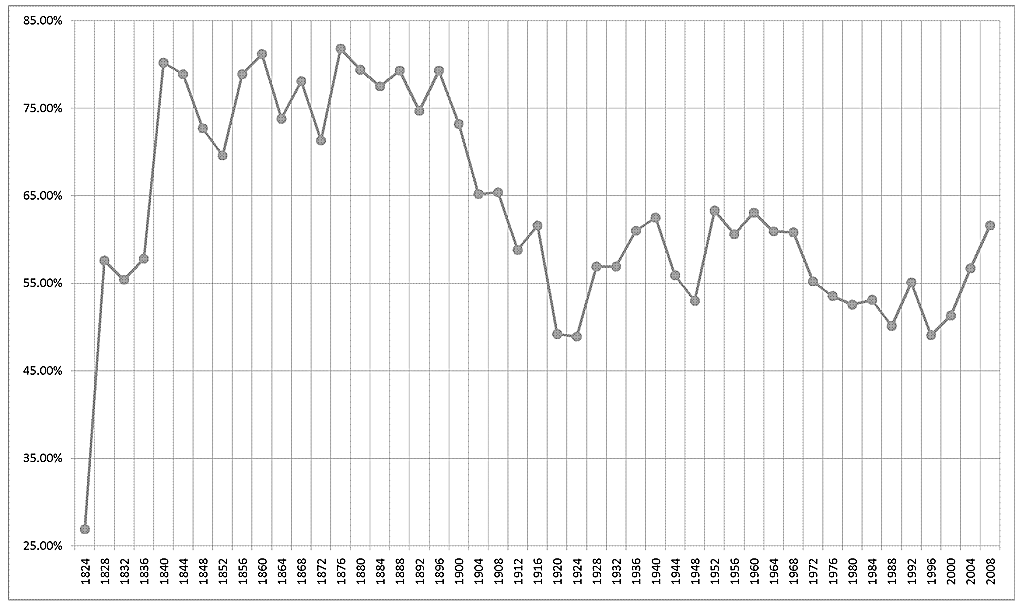
So I happened to stumble upon this graph of American voter turnout since 1824. And there are some noticeable and significant changes in voter turnout throughout history. I looked up timelines of voter policy and there doesn't seem to be any obvious correlations between the policies and the graph. So I'm curious, what outside factor caused these trends?
1 Answers 2016-06-25
When I say successful I'm referring to the development of technology, philosophy, science, economics, politics, architecture, engineering, influence on the world as a whole, and impact on modern society.
I'm confused as to why regions that faced the harshest conditions seems to have created societies that were successful in many of these areas, at least based on how it's settled today. Wouldn't societies with longer growing seasons, more natural resources, and less fatal winters be in an advantageous position?
1 Answers 2016-06-25
Did the money come from his family? Was he independently wealthy? I known the economy was very different back then but I don't know enough about it, or him to understand. Buying what he did at 22, today seems incredible to me.
1 Answers 2016-06-25
Today:
Saturday Reading and Research will focus on exactly that: the history you have been reading this week and the research you've been working on. It's also the prime thread for requesting books on a particular subject. As with all our weekly features, this thread will be lightly moderated.
So, encountered a recent biography of Stalin that revealed all about his addiction to ragtime piano? Delved into a horrendous piece of presentist and sexist psycho-evolutionary mumbo-jumbo and want to tell us about how bad it was? Need help finding the right book to give the historian in your family? Then this is the thread for you!
2 Answers 2016-06-25
As in, what led to the UK not joining in 1967 but joining in 73? What was the national mood around this in the first place? What were people expecting the advantages to be? What sort of questions were debated around the referendum of 1975? Were there national splits between the four nations like we've seen this week?
1 Answers 2016-06-25
To my knowledge, the Jews were pushed from Palestine in the first century CE, under Roman occupation. What happened when Rome began to collapse a few hundred years later? Did Palestine remain firmly under foreign control until the twentieth century?
Again, to my knowledge, the first sincere effort at returning to the Levant began in the 19th century. Why did it take so long? Since Rome was the power that initiated the diaspora, I might imagine that Rome's collapse (or its loss of foreign territory) could have spurred a migration back to the Levant.
Were other powers occupying portions of Palestine during the middle ages not amenable to the Jews' return (e.g., Byzantines, Persians, Arabs)?
As a related question, didn't the Jews displaced by the first diaspora (in Babylon) return to Israel after the conquest of Cyrus the Great? What makes the first diaspora (and its return) different from the second?
1 Answers 2016-06-25
Recently there was a question about how recently the trebuchet was in use in combat. I gave a short answer of around five lines stating that the trebuchet (and other simple mechanical launching systems) are still very much in use in asymmetrical warfare.
The relevant part of the thread can be seen here.
I was then given a 'final warning' by a moderator.
Another user then questioned the moderator's decision, which was then deleted.
I am unsure how I was meant to go about answering this question, given that it specifically concerned 'most recent use'. Should instead questions that ultimately break the 20 year rule by definition (or perhaps by answer) be deleted? Should I have stated that "I can find an example of their use in the 1970's, but they might be one a few years ago too, wink wink"?
The moderator encouraged the second user to start a META thread to discuss this further, and I am doing so.
EDIT: I should state that I am entirely in favour of the twenty-year rule that this subreddit enforces. However I feel that there are specific and rare edge-cases and question types where there is no way of answering the question without breaking it.
7 Answers 2016-06-25