To clarify, my primary curiosity is with the evolution of espionage as a whole. Centralized modern states are relatively new inventions, so it stands to reason that the intelligence services of such states are also relatively new developments. Elizabeth II has MI6, but what did Elizabeth I have?
1 Answers 2016-06-25
Hi,
Can you give me a basic explanation of the historiography of the Russian Revolution? What do revisionists etc believe the causes of it to be?
Thanks a lot.
1 Answers 2016-06-25
Most of us are familiar on some basic level with the ideas of Empire and colonialism. At least in the English-speaking west, a lot of us have some basic familiarity with the idea of European empires; national powers that projected themselves far beyond their borders into the New World, seeking out resources and people to exploit. But what do historians really mean when they talk about 'Empire'? What is it that distinguishes an imperial project from traditional expansionism, and what is the colonial experience like for both the coloniser and the colonised? And what do historians find is the lasting legacy and impact of colonial exploitation in differing contexts that leads us to describe things as "post-colonial"?
These are some of the questions that we hope to get to grips with in this AMA. We're thrilled to have assembled a team of eleven panelists who can speak to a wide range of contexts, geographical locations and historical concepts. This isn't just an AMA to ask questions about specific areas of expertise, those you're certainly welcome and encouraged to do so - it's also a chance to get to grips with the ideas of Empire, colonialism and postcolonialism themselves, and how historians approach these subjects. We look forward to taking your questions!
Due to the wide range of representation on our panel, our members will be here at different points throughout the day. It's best to try and get your questions in early to make sure you catch who you want, though most of us can try to address any questions we miss in the next couple of days, as well. Some answers will come early, some will come late - please bear with us according to our respective schedules! If your questions are for a specific member of the panel, do feel free to tag them specifically, though others may find themselves equally equipped to address your question.
Panelists
36 Answers 2016-06-25
1 Answers 2016-06-25
Okay, I realise my question maybe sounds a bit rough as there are several different architectural traditions, all with different elements in design. Yet it seems to me there are certain stylistic elements within the chinese, korean, japanese, vietnamese and to an extent Thai architecture that just look very similar and have a consistency troughout the ages. Just googled Han architecture, Ming and Qing architecture and it seems to me there is a bigger consistency going on than for example between early and late middle ages in europe.
So basically what I want to know is, when were these stylistic elements developed, where did they start, why was there such a consistency (or am I just too ignorant to notice bigger differences) and also were there other trends and traditions before and how did they look like?
1 Answers 2016-06-25
It's stated in the last couple of episodes that Hitler had ordered the SS to move into the Alps or other regions and to keep fighting even as Berlin was about to fall. I remember my grandfather mentioning once before he passed that he was shocked but relieved how quickly the war in Europe ended after Hitler died. A couple of google searches do show there was some sporadic conflicts across Europe for a few days post "V-E" day, but nothing like the insurgencies that happened in later wars. Why?
3 Answers 2016-06-25
I just read the intro to Francis Fukuyama's The End of History (yes, I will read the whole thing) and in it he says that the book is meant to be an argument for discussing history as coherent and directional, namely towards liberal democracy. He goes on to say that during the 20th century, the most profound thinkers rejected this view of history. He sees his book as restarting a conversation that was first taken up by Hegel and Marx, then later abandoned.
Fukuyama wrote that in 1992 and since then we've had books like Guns, Germs and Steel and Why the West Rules for Now, works that present a narrative of history moving in a particular direction and attempt to back up that narrative with scientific arguments (whether you think they achieved that or not).
The reason I was wondering if works like these existed in the 20th century is because there was an idea of history moving in a particular direction, at least in the popular imagination. I know academia in general had given up the idea, but was there anyone who tried to present a grand narrative? Or, if some idea of directional history existed, was it never presented with the same kind of academic arguments that you find in GGS or Why the West Rules?
2 Answers 2016-06-25
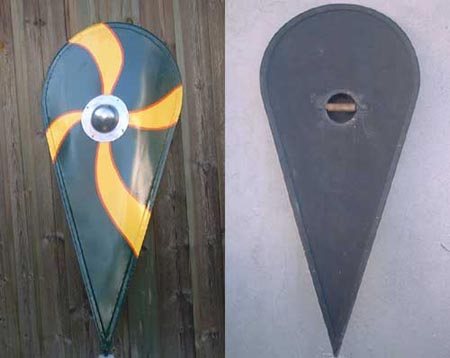
I often see kite shields with a shield boss, i've heard these were decorative. However i'm wondering if Norman shields had a grip like the one pictured here http://images.history-revisited.com/l/alias3/AH3967-viking-norman-kite-shield-bayeux-tapestry-.jpg
1 Answers 2016-06-25
Why not the other way around? We all hear about how the mayans died from weird diseases they were never exposed to that was brought over.
Why didn't the Spaniards/colonials die from weird Mayan diseases they were exposed to? Same for the settlers in America
1 Answers 2016-06-25
I've read that long axes and hammers were preferred as swords were miserable against well made plate armor, but we often see the sword in medieval fiction and even historical tapestries as a long, one or two handed weapon wielded en mass. Is this realistic or fantasy?
1 Answers 2016-06-25
1 Answers 2016-06-25
In this scene of Game of Thrones, episode 4x3, a guy on foot duels a guy on horse with lance and easily takes him out by throwing a dagger in his horse's face as he gets close.
Was this technique used much in the past? If every foot soldier had a simple dagger or two to throw at charging cavalry, shouldn't that have made cavalry useless? Was the technique of dagger throwing simply too hard to master, or was the target too small and fast? Or was there a taboo against targeting horses?
2 Answers 2016-06-25
What kind of weapons did they use, and why would they be favored in certain situations over infantry units?
1 Answers 2016-06-25
4 Answers 2016-06-25
hola amigos, i am writing a research paper on the factors of the 1929 stock market crash and i am wondering if using another paper's sources(from the bibliography) is considered "plagiarism". thanks m8s.
1 Answers 2016-06-25
Looking into Russian history, during the fall of the Golden Horde and rise of Moscow, historians seem to always give the label of 'first Tsar of Russia' to Ivan IV, even when the same book will talk about his great grandfather, Vasilii II, using the title domestically, and Ivan the Terrible's grandfather, Ivan II, using the title of Tsar internationally.
Ivan II seems like the candidate most likely to be considered the "First Tsar of Russia." I believe that in a treaty with Lithuania in the early 1500s, he forced them to refer to the Russian ruler as Tsar, though I may be a bit off on that. I know, however, that he started demanding Holy Roman Emperor Maximilian to use the title of "Tsar" to refer to Ivan II. It created a stir, as the Pope first saying that "there is only one emperor, and he does not reside in Moscow" (or something to that extent), and eventually decided that the word Tsar was not too "barbaric" for the Pope to say, and claiming the title of Tsar ranked above king, but below emperor.
And if not Ivan II, then Vasilii III, father of Ivan the Terrible, who had the Holy Roman Emperor finally use the title of Tsar in 1514.
Yet it's only when Ivan IV takes the throne that historians seem to give the Russian ruler the title of "Tsar," even though the title of Tsar had been granted by contemporaries 16 years before his birth, and 33 years before his coronation.
1 Answers 2016-06-25
3 Answers 2016-06-25
I've been searching for a while now, but to no avail to confirm who made the roman statue of the Roman emperor Claudius, depicting him as Jupiter, or if anyone actually does know. From my understanding, no one knows when the statue was made, but I am unsure if that also means no one knows who made it.
I need this particular snippet of information in order to help understand the purpose behind the statue regarding to its value as propaganda for a school project, so any help would be deeply appreciated!
1 Answers 2016-06-25
[deleted]
1 Answers 2016-06-25
I was just reading a post in explainlikeimfive why guillotine blades are slanted. There were a lot of posts about tomatoes and how going at an angle through the neck is easier than going straight down. I do not see how going at an angle could decrease resistance. I am not a physicist, but it seems like going at an angle only increases the length of the cut while not decreasing any amount of resistance. (Mods, if this is out of place, go ahead and remove it. This is just the only sub I could think of that might be able to give me a real answer and not anecdotal evidence from cooks about cutting tomatoes.)
1 Answers 2016-06-25
[deleted]
1 Answers 2016-06-25
Basically, were there any Renaissance Era one hit wonders? Or pre Renaissance?
1 Answers 2016-06-25