Have theologists ever tested Middle Eastern religious scripture like Hobbes, Spinoza and Locke? Did any social contract theory ever come from the Middle East?
1 Answers 2016-05-14
[deleted]
1 Answers 2016-05-14
I just got back from a baseball game where the washroom lineups were intense. Just wondering how things were handled in terms of waste management in a place like the Coliseum or any other large arena type place
1 Answers 2016-05-14
1 Answers 2016-05-14
So playing the game "Medieval 2 Total War" i noted that some states/kingdoms had only basic gunpowder units (e.g "Hand Gunners" and "Arquebusiers") while other had more professional, elite units e.g "Musketeers". There is also difference between types of artillery different nations could deploy, ranging from basic "bombard" to "Monster bombard" only few nations have at their disposal. So my question is, witch nations were the most proficient in adopting gunpowder in their military tactics?
1 Answers 2016-05-14
Specifically I'm curious about the law in Longmeadow, Massachusetts prohibiting two men from carrying a bath tub on the town green., and the law in Boston allowing for a duel at a certain time of day on the green
1 Answers 2016-05-14
2 Answers 2016-05-14
I've always heard and read it referred to as an empire- but surely it couldn't always have been one? At what point did it become an empire? And how does one define an empire in this case? Would it be to do with settlement patterns? Or the legacy of the Byzantine Empire after the 1453 capture of Constantinople?
2 Answers 2016-05-14
I've been going over the roles of different aircraft in world war 2 and it's struck me that often what I read focuses on only one popular fact. I was looking at the wikipedia article on the british mosquito, in the fighter bomber section it, for instance, seems focused on it's use against submarines, ignoring almost everything else. Others iirc focused only on effectiveness against tanks, and how many tanks they destroyed ignoring everything else iirc. Anyway, I was wondering what historians consider to be the big events in the history of aerial ground combat support.
I've read from US centric sources, for instance, that early tactical doctrine was developed by the US supporting the marines. In other places I've read that it was developed in the spanish civil war by the germans.
A lot of attention is given to russian and german fighter bombers, and, to a lesser extent american, but the wikipedia article on the mosquito was very interesting showing a successful evolution over the war on the british side.
And I also would like to know how much changed from the end of world war 2 to 1996, with desert storm, and the balkans, and other more modern conflicts with the development of precision guided weapons.
Thanks
3 Answers 2016-05-14
Hi guys, I've heard some conflicting information about the middle east and how it's conflicts are mostly(or not at all) the Usa's fault. The two sides I hear the most are.
1: the west has destabilized the area since the 1900s and caused many countries to fall into turmoil.
Or
2: the middle east has been war torn for the last two thousand years, and was in a poor state prior to usa engagement.
I know the answer is probably much more complex, anyone care to explain it a bit better? Thanks!
1 Answers 2016-05-14
Did Washington, Jefferson, etc, call themselves "The Founding Fathers?" That seems weird even for them. So when did we start calling them that?
1 Answers 2016-05-14
I've always thought this video was one of the coolest things I've ever seen: https://www.youtube.com/watch?v=d8LiQFnkuJY
It's South Korean riot police using (supposed) Roman battle tactics in a crowd control scenario. How accurate is this video, i.e. is this what a skirmish might have looked like back then?
1 Answers 2016-05-14
ty for answers, i suppose reality is quite different than what i thought would happen based on movies ( two armies literally fight until one is completely dead or runs). So it seems as if those in the front ranks of the winning army have a bit less chance of survival but still good, but for the losing side those in the front were dead anyway, not because it was it was a lot more fatal to be at the front, but because their army was defeated. Still, i guess people were just really brave and were ok with being assigned to being at the front of the army
3 Answers 2016-05-14
I am aware that the Pathians stood between the Roman Empire and the Han Dynasty. Were any direct attempts at contact ever made?
1 Answers 2016-05-14
1 Answers 2016-05-14
1 Answers 2016-05-14
1 Answers 2016-05-14
Just a note to anyone that answers this question knows, I know absolutely nothing about precolonial African kingdoms so please forgive me
So I saw the above quote from R. Guisepi's Africa and The Africans In The Age Of The Atlantic Slave Trade, (1992) & it struck me as an interesting statement for several reasons; the relationship between the mass-production of firearms & the precolonial contacts that brought African kingdoms into contact with said guns, the psychological effects that this would've had on the civilians living under this regime & how that would shift thinking within the country from order to disorder & if this would have any impact on the wider picture of slavery in the Caribbean.
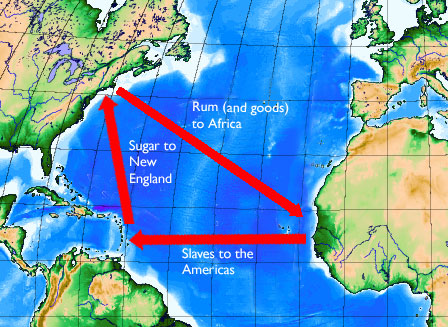
Not only that but the fact that when taught about the slave trade in schools we're mostly taught about the supposed "triangular" nature (e.g. Abduction of slaves >> transportation to West Indies >> Transportation of goods brought back from the WI to the colonial powers) of the trade as depicted here & never what was happening before, after or as a result of the trade in the African kingdoms. (even though in the UK with the new reforms we're starting to slowly broaden our horizons historically to other topics. but that's another story entirely)
Thank you for any help :)
1 Answers 2016-05-14