For example, was there ever a time and place where someone other than the highest commander (like say the equivalent of a colonel in the US Army) was giving orders to both soldiers and sailors?
1 Answers 2016-04-18
I understand the massive "Ship of the lines" would line up in front of one another, and whichever ship had the sturdiest hull and most cannons would sink the other. Is this true for smaller ships as well, or did they manoeuvre around more, trying to find better angles from which to strike?
1 Answers 2016-04-18
I know that in most of Asia drinking water was boiled (making tea and the like), and in much of Europe alcohol was used, but what did people in the Americas use before European settlement to keep their drinking water safe to drink?
4 Answers 2016-04-18
So, first of all, forgive me if this is the wrong sub to post this in. Please feel free to point me in the direction of the proper sub, I'm just absolutely dying to have this question answered.
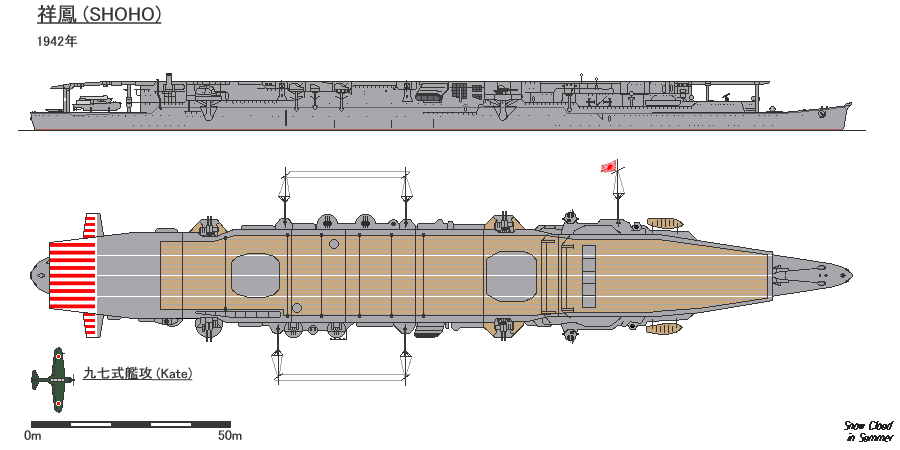
Me and a few friends have recently been playing World of Warships, and we've become very curious about the "stubs" on the back end of the runway on old aircraft carriers.
The Zuiho had these (seen in the diagram here). Multiple other aircraft carriers have had versions of them, some smaller, and many aircraft carriers don't have them at all.
My friends and I have searched pretty much everywhere we can think of to find an answer to this. The wikipedia doesn't answer it, we couldn't find any books on google scholar that gave the information. Our best lead was finding an image that is almost certainly a diagram for a model of the aircraft carrier, that has the structures labeled. We tried to decipher the japanese (I believe it's Katakana), but to no avail.
Could anyone help out, either with knowing the answer, or pointing us in the right direction to find it? The curiosity, and difficulty of finding an answer, has consumed us. I think we've together spent probably around 8 hours searching for answers, to no avail.
2 Answers 2016-04-18
This may be a stupid question, but I figure it's worth asking. I recently visited the Museum of History in Seoul and it really struck me that almost all artifacts dating a couple hundred years ago were in Chinese characters, not Hangul. At what point did they begin to adopt a national identity, or rather an ethnically and culturally separate idea from that of China?
2 Answers 2016-04-18
What I'm trying to figure out is (this is research for a novel) if you had a multi-generational family of traveling people, like a circus or theater troupe, and say they've been doing a performing circuit through Eastern Europe, Austria, Germany, France etc...They have various family members born in different locations, they don't have a permanent home, and they're constantly crossing international borders... What type of nationality documentation do they have? What countries do they belong to? Are they all different? Do papers get updated or denied? What happens when WWI and WWII break out?
For example, Poland wasn't really "Poland" as we know it today until 1918. Before that the areas that would later be considered "Poland" had ethnically Polish people living in them, who spoke Polish, but the areas they lived in were controlled by various other groups (Austria, Russia, etc), so those people, if they even had such things as government ID or birth certificates, would probably be listed as Austrians or Russians or what have you.... right? Or did they have some other way of identifying them? I know the modern concept of passports and birth certificates isn't exactly the same as it was in the past, and that every region/country didn't have a universal system for tracking it's population back in those days... For example I know Japan still uses some form of family/clan registration that is very different from a lot of the western world.
So to make things simpler, let's say we have a 3 generation family, some are Austro-Hungarian, some are born in the various different parts of Poland. Same applies to the grandchildren generation.
When WWI breaks out, are they stranded wherever they are? Are they forced to flee back to one particular country? Are the of-age men forced to fight for X country? Same with WWII.
Sorry for such an awkward and complicated question! I wish I could think of a simpler way to ask it.
1 Answers 2016-04-18
Hey everyone! I was hoping you all could possibly help me out. I have to write a 10 page paper on how colonial products, such as sugar, of the British empire affected its economy and how those colonial products affected the lives of the British people in the mid 18th century.
I wanted to do this paper on opium when the East India Company went to India. Do you think I could pull this off, or should I just do something like tobacco, etc?
1 Answers 2016-04-18
This question is strongly based on colonial America, for the British from the 1750's to the 1770's, and the Continental army (obviously) in the 1770's. I'm specifically asking about these two nations because they're the only ones I could find images for what the designs might have looked like. (did the French and Spanish also did the same thing with their regiments in colonial America?)
Anyways, wouldn't it be easier to make one uniform design for all the regiments across the colonies for every rank instead? (private, grenadier, sapper, officer, lieutenant, captain, general, you know). I don't get why they would take time to have a different facing colour and design, linings on hats, different boots and shoes. Isn't it inconvenient?
The British
why (in the French and Indian war) did each British private regiments have different coat facing like this, this and this and grenadier regiments like all of these, and then just literally 2 decades after (what is now, the the American revolutionary war) private uniforms look like this and this, and grenadiers look like this, this, and this.
Like, wouldn't it be simple enough for all British privates (during the American rev) to look something like this, and all grenadiers to look something like this? (for example). I noticed that mostly British uniforms are usually portrayed with black facings, while others are portrayed with white, dark blue, and even green facings.
The Continental Army
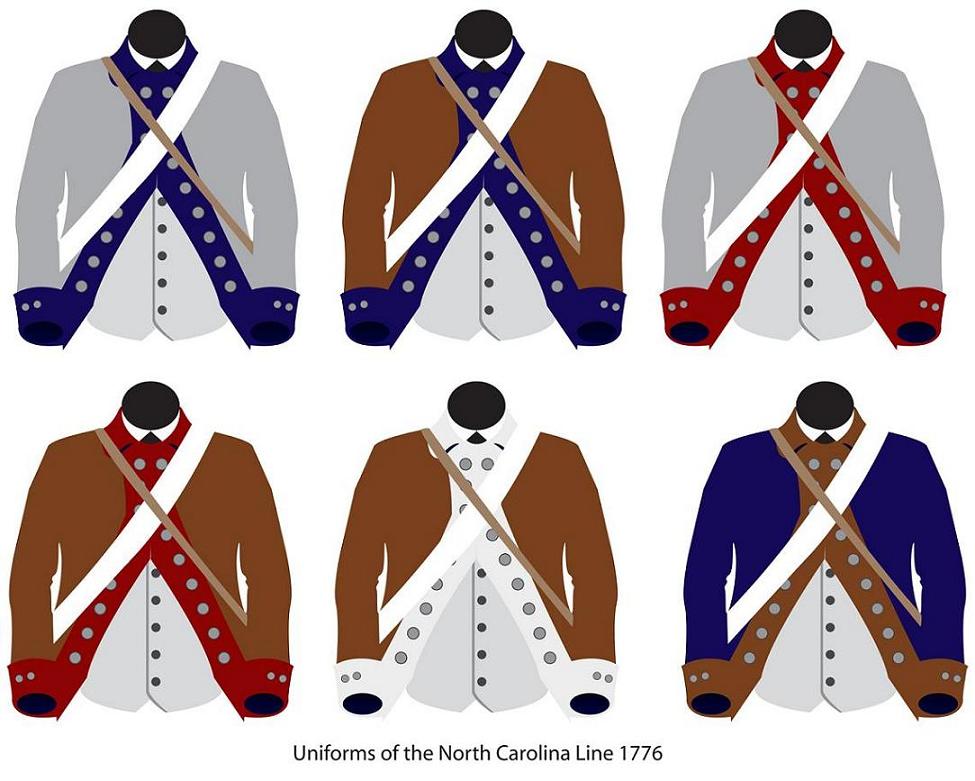
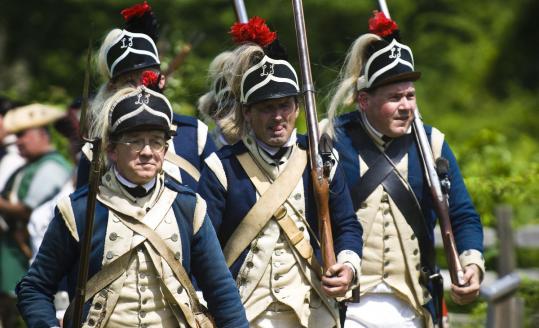
Usually the basic Patriot uniform I think of would look something like this one (but with a tricorne hat). But nooo, there are loads of other ones, like these ones from North Carolina alone, but usually patriot uniforms look like this everywhere else. And then there are these guys who I have no idea what rank those uniforms and hats come from. Why the hell do all these soldiers look different? (rank? regiment?). According to the original website that has this image of Continental officers reenactors, one officer is from Massachusetts and the other one is from New Hampshire.
It's so overwhelming. I can never know which uniforms of what ranks would have actually looked like in real life, given all these portrayals.
Would they do the same thing with their navies? Would they have different styled uniform designs for every single ship?
2 Answers 2016-04-18
1 Answers 2016-04-17
5 Answers 2016-04-17
Let's see: the portrayal of this ship in Disney's PotC is a huge galleon with a ridiculously large stern. The Assassin's Creed depiction seems much more believable, but still questionable. How did it look like in real life when it was equipped with around 32-40 cannons? I believe there must be some sort of blueprint, detailed drawing, or whatever else somewhere.
1 Answers 2016-04-17
You know the ones. Built from stone, walls, keep in the middle.
1 Answers 2016-04-17
Meaning, who was invading or who was ruling or other key events that may have been happening around 0 A.D (?) I have a really hard time of understanding the timeline of humanity's past since then.
2 Answers 2016-04-17
I've noticed in places like China, Japan, Thailand , etc. it's not easy finding houses/buildings that are more than a century old whereas in Europe there's plenty of them still standing, even from medieval times. Is it the materials used?
1 Answers 2016-04-17
I know that they are not still radioactive, but it seems strange to me that people would want to live there.
1 Answers 2016-04-17
I understand (or am at least aware) that this characterization is bad historiography, that the time period in question wasn't objectively "worse" than any other and so on. My question is not what made the "Dark Ages" dark but what caused them to become thought of as such? When did this characterization begin, who spread it, and why was/is it so common, at least among layfolk?
1 Answers 2016-04-17
TV shows and educational videos of the 50s seemed to show how you should live your life. Mom stays at home, kids are well behaved, everyone was clean cut and proper. Everything was pleasant and happy. Why is this? Who exactly was the brainchild of pushing this idealistic life on Americans?
1 Answers 2016-04-17
5 Answers 2016-04-17
I was wondering how important it was to be able to give a speech within Late Republican Rome; there seems to always be a speech involved somewhere or other.. Was it something everyone could do or only a select few? Is there any scenes in which someone's speech giving skill changed a decision or such?
1 Answers 2016-04-17
Nowadays, most Americans (at least I hope) would say that what the United States government did to Native Americans in the past was wrong. When did this become the general consensus? I know there were some transitional views before the US fully accepted Native Americans ("kill the savage, save the man" or something like that), but when did the view of Native Americans in the United States become a people group who were wronged by European settlers?
3 Answers 2016-04-17
So I've read and heard several reasons. As far as I've understood, the Luftwaffe was originally targeting RAF bases and places important for Britains war economy, but went for London and other cities after Churchill bombed Berlin. Is this the most important cause, or is it just the trigger? What were Hitler's primary goal with the Blitz?
1 Answers 2016-04-17