[deleted]
1 Answers 2016-01-27
There is a long history of Jewish communities creating Hebracized versions of various writing systems (Arabic, Latin, etc). Did such a thing ever happen with ancient Egyptian? Are there Hebracized versions of Egyptian Hieroglyphics floating around somewhere?
1 Answers 2016-01-27
Sometimes you can see shapes floating in your peripherals. Sometimes when you stand up very quickly or hit your head, you see lights pop in and out of your vision. Ancient people must have noticed these things. What did they think these things were?
1 Answers 2016-01-27
2 Answers 2016-01-27
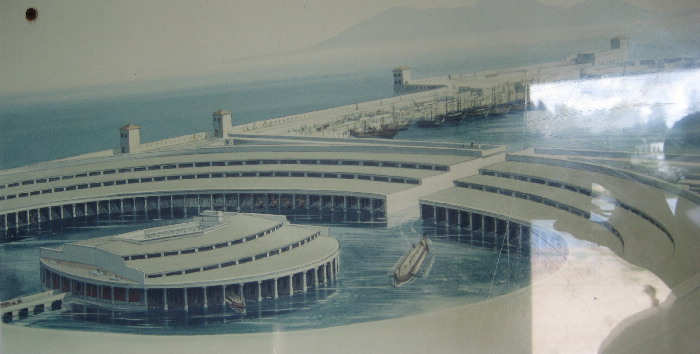
Was Carthage's port design one of the most advanced and effective of it's time period? What are some other famous military ports? I've heard that Carthage's ship deployment was one of the fastest in the world. Literally hundreds of ships pouring out all at once due to the circular design of all the docks and it could hold up to 250 ships.
Also, was the inner circle structure all docks or where other facilities or uses for it? Where did they keep the dry docks? Was the port sectioned off from the main city or was the giant iron chains the only thing keeping the enemies of Carthage from seizing the city?
edit: For those of you wondering, this is what the Carthage port looked like
1 Answers 2016-01-27
I know Roman's had the Elysium fields but you had to be a EPIC caliber Hero to get into those. It was dull old hades for most ordinary mortals. Judaism used to mock the fledgling Christian cults for their belief in an After Life as well.
Forgive my cynicism but the thing is, it seems like a natural graft if I was planning on building a following base: "No no no, pleasure everlasting AFTER you die. You just have to do what I say in this life. ...Now blow me and give me 10%"
Did most people just not think about it or was this a mind blowing concept at the time and it only now seems obvious because I grew up with Heaven being shoved in my face since I was a babe?
2 Answers 2016-01-27
I recently saw a post on Facebook that mentioned him, and after some research I found out he created a National Socialist party in Belgium, what happened after that? And how important was his party in occupied and post WW2 Belgium?
Premise: I don't know a lot about him, mainly because I'd never heard of him or Rexism, so if my question is flawed please forgive me.
2 Answers 2016-01-27
I understand this is a very narrow topic and we probably don't have many specialists in this field here, but I'll try my luck.
One of the most famous Dukes of the Grand Duchy of Lithuania is currently known as Vytautas. This is the name used in Lithuania, also the name English wikipedia uses as the "main" name and the title for the article. Russian Wikipedia gives us Витовт which is basically Russian form of the same Vytautas written in Cyrillic. Wikipedia articles in many other different languages use some form of Vytautas as well, but none provide any sources so I assume they just use the currently popular name.
However as far as I know this is a made up name. Lithuanian linguist Kazimieras Būga made it up at some point in late 19th or early 20th century. While Lithuanian sources say he just "restored true names for Lithuanian dukes" they never provide any evidence for it. I don't even know a rationale behind his decision, i.e. why Vytautas and not Vitoldas, what made him think this is a "true" form of the Duke's name. And since the times Būga lived in are known as rising nationalism times for Lithuania, and Vytautas just happened to be similar to tauta (Lithuanian for a nation), it makes me even more suspicious this name is just a made up name with no real roots in history.
So my question is, how much do we really know about the real name of Vytautas and all other dukes from the Grand Duchy of Lithuania? Since many of them were "restored" by Būga, including but not limited to Vytautas' father Kęstutis, the King of Lithuania Mindaugas and so on. I know the Latin name for Vytautas was Alexander Vitoldus, is it possible that Vitoldus was his real name? Or is it more likely it was just a latinized form of his real name that nobody knows now?
1 Answers 2016-01-27
Any evidence to support that Marc Antony actually said this? Was he even at Julius Caesar's funeral?
1 Answers 2016-01-27
I realize it would have been a lot, but wars cost too and it would have preserved the Union... am I being an idiot?
5 Answers 2016-01-27
It seems to me that the Pope was basically saying that the legacy of the Roman Empire lay with the church in Rome rather than in Constantinople, and I can't imagine that Byzantines would agree.
1 Answers 2016-01-27
So I'd wondered this for a little while and I think this might be a worthy question here.
Let's say you lived in one of the countries in the Iron Curtain (like Poland) and you wanted a change of scenery and wanted to move to a different SSR or country in the "sphere of influence". How difficult would it be? Did each Soviet republic have differently run immigration systems? Would it be easier to move to a sphere of influence country if you were from the USSR than another Iron Curtain country?
1 Answers 2016-01-27
Are there any records of systems for gestures or other body-communication prior to what you see in modern field manuals for soldiers?
1 Answers 2016-01-27
I noticed a massive spike in the usage of the word "iron" according to Google's ngram viewer between 1663 and 1668, but I haven't found any info on it (don't know where to look). Any ideas?
2 Answers 2016-01-27
As a child I learned about our local Native Americans, the Iroquois. However, recently I've heard the term "Iroquois" may be considered offensive because it means something rude in Algonquin. Would it be more correct then to refer not to the Iroquois but to the Haudenosaunee, as this is the league of six nations they created?
1 Answers 2016-01-27
Or as a broader question - what social factors lead to this increase on crime?
1 Answers 2016-01-27
I'm really not sure if this is the right place for this, but I've been missing my old history classes I took in undergrad and I was wondering if there were any good online resources to learn Greek and/or Roman history at my own pace. I always found that time period to be extremely interesting, and was hoping some of you might have some good suggestions. I'm currently in med school and while I love it to death, I find myself missing some diversity.
Thanks!
1 Answers 2016-01-27
This weekly feature is a place to discuss new developments in fields of history and archaeology. This can be newly discovered documents and archaeological sites, recent publications, documents that have just become publicly available through digitization or the opening of archives, and new theories and interpretations.
2 Answers 2016-01-27
I've only really heard it with Hugo and Dickens. If it's true, were less known authors paid like that? What were contemporary reasons for this? How much were they paid per line or word?
3 Answers 2016-01-27
More broadly, I'm wondering if there's a specific reason that certain ethnic groups (Italian, Russian, and Irish) are associated with organized crime syndicates more often than others?
7 Answers 2016-01-27
Queen Elizabeth I ruled England in a time (1558 - 1603) where women were very much considered to be 'the weaker sex'. In what ways did Elizabeth deal with this prejudice? And was it in any way a help, rather than a hindrance, to her as a sovereign?
1 Answers 2016-01-27
1 Answers 2016-01-27
Hello and welcome to my AMA on the German Secret Service in America during World War I.
My name is Heribert von Feilitzsch. I grew up in Germany close to the border to East Germany and Czechoslovakia. My grandfather who was born in the 1880s fought in the Austro-Hungarian army as a cavalry officer in World War I. I remember being fascinated by the colorful uniforms, the spiked helmet, and crank powered field telephones in his closet. I wished I had been old enough to ask him questions about a war that is now 100 years past.
I came to the United States in 1988 and studied history at the Universities of Arizona and Virginia. For the last 20 some years I have studied the role of the United States and Mexico in World War I. While I found several good books on the topic, I realized quickly that they were written many years ago, before the Internet and the opening of many archives to the public. In the last four years I have published four books on the topic. Two deal with the role of Mexico just before and during World War I, two with the role of the United States in the same time period.
I am an independent scholar and author. Because I have no affiliations I self-finance my research, writing, and publishing. This gives me the chance of scholarly work that claims to be as objective as humanly possible. I am guided by documents and evidence. My conclusions are derived from where the facts take me. Although I cannot be certain that I am correct in my argumentation 100% of the time, I am trying to keep the highest standards of documentation. My books typically contain 800 to 1,000 endnotes, my sources are listed, and, as fellow researchers know, I am perfectly happy to share scanned original documents.
I will answer any questions that concern the time period of 1908 to 1918 that have to do with Mexico, the United States, and Germany. I am especially well-versed in intelligence history and German involvement in U.S. and Mexican relations.
If you are interested in my books and historical blogs, please visit www.felixsommerfeld.com or www.facebook.com/secretwarcouncil. All my books are available on either www.felixsommerfeld.com or www.amazon.com. For today only, I introduced special discounts for all of you.
Edit: Thank you all for participating. I will be back sometime in the near future. In the meantime, check for the many events I am attending this year, including a presentation at UNAM, San Antonio on March 4 and a speech in Columbus, New Mexico on March 12. My newest book, The Secret War Council: The German Fight against the Entente in America in 1914 is available since last week. Maestro de Espias, the Spanish translation of In Plain Sight is on the stands all over the U.S. and Latin America on February 11. Thank you again for your great questions. So long, Heribert
14 Answers 2016-01-27