How did they affect the Papal authority at the time? Is it true that the defeat of the Crusader (?) armies created a safe environment for the Lutheran Reformation? Was Jan Žižka the great and revolutionary military leader that Czechs seem to believe? Any good books on the conflict and its aftermath?
1 Answers 2015-12-13
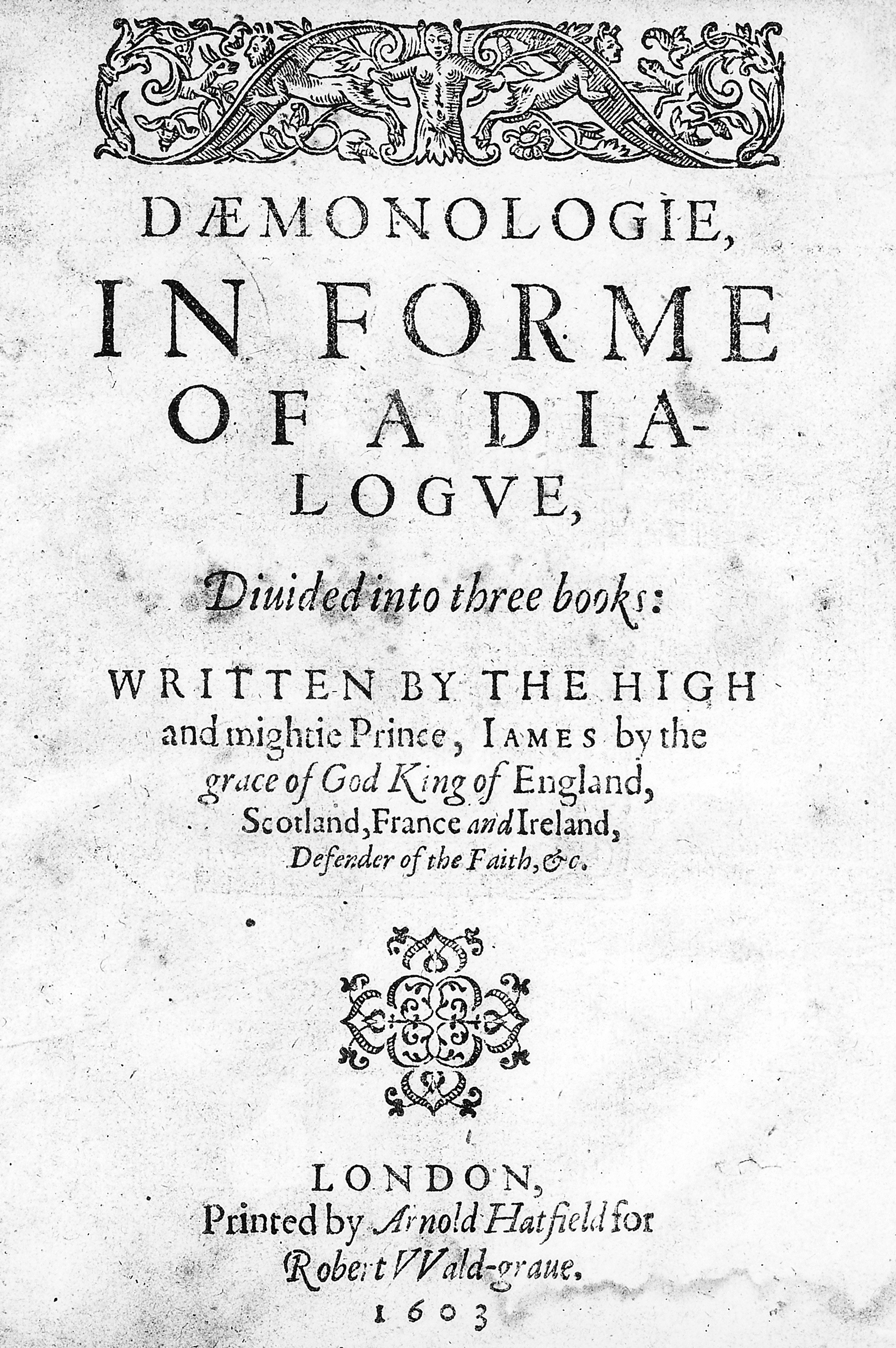
This is the image to which I am referring. It is from a dialogue on witchcraft written by James. Unless I am mistaken, James ruled far later than the period in which England held any major territories in France.
Did other English monarchs also lay claim to this title? If so, why? Wouldn't a public declaration of this nature have made the real king of France angry?
3 Answers 2015-12-13
What I mean by this is, why was the Byzantine Empire never able to really develop a stable hereditary succession system, even though most of Europe was developing it and even in the Empire dynasties like the Isauros passed on power from Father to child relatively consistently? Why was the title of Emperor never tied to a bloodline?
1 Answers 2015-12-13
Also did a human being 7000 years ago 5000 BCE (Founding of the Empire 0) have similar features to the humans today? Would Egyptians then look different from Egyptians now? Or is 7000 years too short of a period?
1 Answers 2015-12-13
[deleted]
1 Answers 2015-12-13
[deleted]
1 Answers 2015-12-13
With the internet today I would imagine that it would be very hard to do yet I read about plenty of anecdotal evidence from redditors who have supposedly been living in Japan for a long time.
EDIT: To clarify, my question is if they did and if they are still doing it today.
1 Answers 2015-12-13
Well in the meadow we can build a snowman
And pretend that he is Parson Brown
He'll say are you married we say no man
But you can do the job when you're in town
What are these 1930s people even saying? Pretending to be married to the snowman? Hiring people to..build snowmen for them? Asking people to ...be they're wives for the weekend?
I work in retail/food service and hear this song 10 times a day. Help me understand it. Please and of course, thank you for considering this question.
1 Answers 2015-12-13
1 Answers 2015-12-13
I was reading on Wikipedia and said that the Austrian army carried the Girandoni air rifle 1780-1815. What use were the airguns? I can't imagine it was very lethal, if at all.
1 Answers 2015-12-13
The targeting of British Officers by sharpshooters really make a significant contribution to eventual victory?
2 Answers 2015-12-13
1 Answers 2015-12-13
1 Answers 2015-12-13
Also, what was the historical Japanese word for sex that "pillowing" is translated from? (Written in rōmaji, please.) Thanks!
1 Answers 2015-12-13
Wow these answers are amazing, thank you. I was thinking about what Frederick Jackson Turner's frontier thesis says about the frontier, and the individualism, and anti-authority sentiment it bred, created a distrust for any sort of imposing government organization, and countered the idea that a standing army was necessary for security.. And how the closing of the frontier somehow contributed to a change in that sentiment (i'm not really sure how) That being said Turner also posits that the frontier army post was the "a nucleus for settlement". Were those frontier posts, not considered a standing army? It seems contradictory to me so any clarification would be greatly appreciated? Thanks!
5 Answers 2015-12-13
I'm currently researching the Rape of Nanjing, and in reading Iris Cheng's book on the subject, which tends to take great liberty with figures to illustrate some points, she let out this claim:
It is striking to note that while the Allied forces surrendered at the rate of 1 prisoner for every three dead, the Japanese sieves at the rate of only 1 per 120 dead.
Alarmed by this unsourced statement, I looked into some of the numbers, starting from Wikipedia and working from there. From the estimates the page provided on POW counts and casualties for the Japanese during the war, my math gave me a ratio of 1:42. Not that bad, still within a an order of magnitude of each other. Then, further down the rabbit hole, I found this one off NYT article, claiming the Soviets captured some 500,000 Japanese during the war.
I came to a Wikipedia page titled "Japanese prisoners of War in the Soviet Union," which gave three sources, one being a throwaway BBC article that gives no sources, two being foreign language sources, and the last being Gulag: A History by Anne Applebaum, a book which I can't gauge the credibility of very easily. It repeated this 500,000 figure.
In my research, I also came to see the strong resistance American combat soldiers gave to capturing Japanese alive, which got some wheels turning over the possibility of a convenient revision of the war in American retelling.
I suppose the question I'm asking is: How many Japanese POWs were actually taken in the war? And why are Americans responsible for comparably so few of them, according to some sources? And what sources can I trust on this subject?
2 Answers 2015-12-13
1 Answers 2015-12-13
Sometime during the 16th century, an extended family of inbred cannibals allegedly haunted the road outside of Edenborough. They robbed, murdered, and ate people who passed by. The story goes that they did this for 25 years before people found out about it from a survivor, and then the king lead an army to root them out of their cave and kill them all.
How factual is this story?
1 Answers 2015-12-13
So I'm currently working on an essay for a military history class, and I've come a cross a rather curious problem. No matter where I happen to look, I am unable to find anything on the "first" knights in Medieval Europe. I've narrowed down my search to the conquests of Charlemagne, and his creation of fiefdoms to help keep law and order over his lands, and how knights sprouted of the need for a point of authority, but I can't find anything to goes into the specifics. What did these knights look like? What kind of armor/weapons did they have? How were they used in combat? Basically the details are what I'm looking for. I'm not asking anyone to give me an explanation, I was just looking for links to works that I could read to help me information. Any help is greatly appreciated.
1 Answers 2015-12-13
Lately I've been reading so many ancient historians. One thing these all have in common is they are entertaining, fun to read, pretty much true at least most of the time, and I can't put them down. But they take a lot of liberty in pushing an agenda or glorifying great men.
Modern history books on the other hand make me want to yawn and fall asleep. They seem so darn focused on facts and dates.
As a computer programmer and mathematician (not a historian by any stretch of the imagination), I would like to know when the facts and dates became so important to historians?
1 Answers 2015-12-13
1 Answers 2015-12-13
...due to their sophisticated cities that were connected without widespread horseback riding?
If so, what polity did they 'mirror' most closely?
2 Answers 2015-12-13
In just about every WWII movie I watch (accurate or not) there's usually a scene where Allied soldiers find a room full of German Officers who killed themselves for fear of being captured by Allied forces. Did anyone keep track of the suicide rate of German soldiers and officers during this time? I mean hell, it's even common knowledge that Hitler supposedly killed himself.
1 Answers 2015-12-13