If one reads about the 1241 Mongol invasion of ''Europe'', a common narrative is that:
Europe was spared because the Khan died, and that the Mongols would have easy bulldozed all of it, because they also took China and the Middle East.
But how true is this?
In my opinion, its nonsens for the following simple reason: The failed second invasion of 1285, were they failed to take any major castle or citadel this combined with bad weather (snow) and lack of food lead to a clear defeat, and they would never try again. (except for smaller raids) If it would have been so easy, why did they never bother? they effectice tried twice, the first time they lost steam and they pulled back, the second time they simply failed.
https://en.wikipedia.org/wiki/Second_Mongol_invasion_of_Hungary
Can i thus conclude the Mongols were simply not good enough at siege warfare? And that all their other strengths are also of not much use (good in open battles and on steppes etc)
Reason they would have imo failed would be: (i shortened a bit, please correct if wrong) 1: Not many large pitched battles, european armies often avoided those. 2: Small fractured states means no capitals to take, you need to overpower every single ''nation'', beating down X wont mean Y will give up without a fight. 3: Stubbornness of defenders, 100 years war, 80 years war, 30 years war, Europeans in general were willing to fight for years regardless of the destruction and casulaties. Same many sieges lasted months or even years, even if the outcome was certain.
Also, the only way to win is to take those castles and fortresses, you cant avoid them see: https://www.reddit.com/r/AskHistorians/comments/1l68g8/why_siege_a_castle_during_medieval_warfare/?
And after 1285, the amount and strength of castles only grew and sieges became ever more prevelant (like the sieges of Calais and Orleans or in the Middle East during the Crusades)
So my question is: Doesnt the failure of the 1285 invasion show that the mongols never had a realistic chance to succesfull raid and invade europe like they did in China? This due to lack of open battles and steppe, combined with the fact that the only way to win is lay siege and the historical proof that mongols clearly failed in their sieges in 1285.
Or am i missing something crucial?
Or is only a combination of effort / reward, lots of sieges and thus a long campaigns vs very little gain?
ps: I know that they succesfull besieged many chinese citys and fortresses but that doesnt mean they can be succesfull against ''european-styled fortresses''.
2 Answers 2015-10-29
[deleted]
1 Answers 2015-10-29
As far as i know in most countries people use "slang" in different parts of the country, sometimes from shortened words or influenced by other languages. I can't imagine it being different in the roman empire, or any other old civilizations for that matter, but is there any actual proof for the use of "slang"?
1 Answers 2015-10-29
I scanned the rules and promoted resources and couldn't find anything related to asking about this or literature of the type, so I thought I'd ask. All help is appreciated!
1 Answers 2015-10-29
4 Answers 2015-10-29
This week, ending in October 29 2015:
Today's thread is for open discussion of:
History in the academy
Historiographical disputes, debates and rivalries
Implications of historical theory both abstractly and in application
Philosophy of history
And so on
Regular participants in the Thursday threads should just keep doing what they've been doing; newcomers should take notice that this thread is meant for open discussion only of matters like those above, not just anything you like -- we'll have a thread on Friday for that, as usual.
1 Answers 2015-10-29
From Anglo Saxon kingdoms through to the present? A map or series of maps? Or a flow chart or something showing how they were broken up by William and then evolved from there?
1 Answers 2015-10-29
2 Answers 2015-10-29
I came across an interesting paper in the Indian journal of history that I would like to share :
Why did scientific renaissance take place in Europe and not in India ?
Here is the abstract:
Scientific renaissance in medieval Europe and its absence in medieval India can be explained in terms of several causal factors which were positively operative and negatively non-operative in the respective instances. Ancient Indian science had achieved some meritorious successes, but these advantages were squandered through casteism, vainglory and non-appreciation of several factors such as manual labour, mechanization and education at all levels of society. Additionally, India received the Islamic onslaught and civilization in its decadent state when it had little intellectual resource to offer to this sub-continent.
Europe on the other hand, had stressed on the importance of manual efforts, mechanical inventions, early capitalism, questioning and even defying, if necessary, the theological doctrines encroaching on the natural and social sciences, and lastly the infinite zeal to learn from other civilizations. India had the chance to imbibe the spirit of scientific renaissance in Europe during its Mughal Era, but did not avail of this opportunity. The proposition that ‘had the British not come to India’, India would have automatically revived its national cohesion and scientific spirit is hardly tenable.
If there is already a good post on /r/askhistorians discussing the reasons that led to the renaissance I apologize for posting this, but I could not find anything using the search utility.
The paper seems to be blaming the state of Indian society, it's culture and religion - which is a bit different from what I've read in the past. I have heard that caste was a factor, but the author here emphasizes the role of caste in considerable detail. The author also touches on the history of religion in each civilization, and the role that played in it all. For example there is mention of the Christian reformation and how that catalyzed certain intellectual movements. The mainstream Indian popular opinion seems to begin and end with the Muslim invaders ruling India at the time.
So I was wondering what is the general historical consensus in academic circles for the renaissance happening in Europe and not India or China. I would like to read any books or online sources on the topic as I find comparing civilizations extremely interesting.
2 Answers 2015-10-29
1 Answers 2015-10-29
Why not something more accurate or majestic, thing just seems underwhelming
1 Answers 2015-10-29
I know there were 2 different factions, and the one backed by Sam Houston wanted to join the U.S., so why did it not happen until much later?
What was the support of the average Texan for joining the U.S. Or making its own country?
1 Answers 2015-10-29
I'm working my way through the Oxford History of the U.S. series, but there's a gap between the Civil War and 1929. I filled in the Reconstruction era with Eric Foner's "Reconstruction; America's Unfinished Revolution", which was great. Can anybody recommend general histories for the period from Reconstruction to 1929 or thereabouts?
2 Answers 2015-10-29
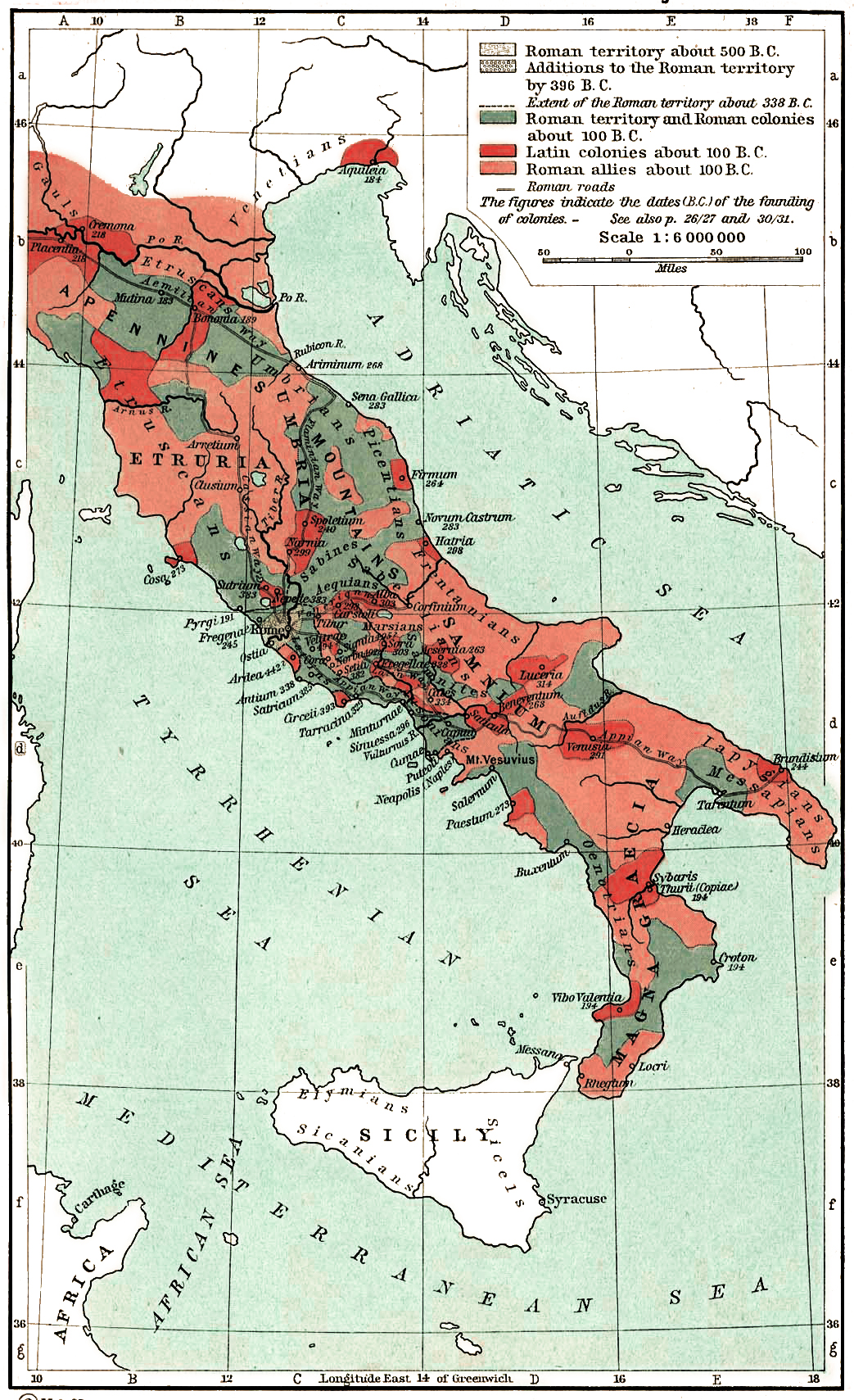
[Marcus Livius Drussus](https://en.wikipedia.org/wiki/Marcus_Livius_Drusus_(tribune) was a Roman tribune of the plebeians in 91 BC who was assassinated after proposing a controversial law which would have given citizenship to Rome's Italic allies (something like light pink in this map). This was the last straw for the Italics, who then started the [Social War](https://en.wikipedia.org/wiki/Social_War_(90%E2%80%9388_BC) with 100k troops already ready to go. This war was a major destabilizing event for the republic and led to Sulla's first civil war and some other very ugly precedents, which is why some see the Social War as the beginning of the republic's end.
So was this war avoidable? Before Drussus was assassinated, was there enough support from the Senate and/or the people to think general enfranchisement had any hope of passing into law before war broke out?
1 Answers 2015-10-29
Political debates today are generally nothing more than silly circus entertainment shows. Very little substantial discussion takes place.
I've heard that back in Abraham Lincolon's time candidates would stand up on a platform one at a time and speak for several hours in a row without interruption and people would silently listen. Then the next candidate would take the stage and speak for several hours without interruption. How much truth is there to that? If that's not what it was like, what was it truly like?
Thanks!
5 Answers 2015-10-29
I've just noticed that none of the early Greek writers I know of seem to have mentioned the Romans, even in passing. I know that they were just a small city for most of their history but I just feel like there must be some minor little reference in all the surviving Greek literature. Does anyone have information on this?
5 Answers 2015-10-29
In 1945 it was obvious that Germany was losing territory to the allies and it looked to many Germans as though defeat was likely. So why didn't concentration camp guards kill off all of their inmates possibly by starvation and dehydration rather than letting them fall in to allied hands. Surely Himmler at least must of known that if the "Final Solution" was revealed to the world that Germany would suffer a major PR loss. And to Nazi minds killing them would have been a major success. In that they would have almost completely wiped out the Jewish and Roma races.
5 Answers 2015-10-29
If not a slave class, some other kind of under-class/race that was then declared equal under law. Are there any examples showing how long it takes such a sub group to "get over" the legal second class status of their ancestors, and catch up with everyone else in terms of education, income, public perception, general prosperity, etc?
In modern times, there are some groups that seem to have "caught up", and others that are still yet to fully recover. Blacks in America, for example. If you graph their average earnings from emancipation until now, it still hasn't caught up to the line for the general population. Nor has the line for life expectancy, or many of those other development markers.
Any examples from history showing how long that process normally takes?
1 Answers 2015-10-29
Full disclosure: the question is for a presentation I have to do. But the professor himself admitted that it would be difficult to find out. He was going to show us a film named "Tokugawa Yoshinobu" that would "give us a tip", but then he didn't and I can't find the movie. Maybe one of you can tell me where to find it?
Anyway, here is my hypothesis so far, based on what I've read. I didn't know much about the issue before last week when I started preparing, so forgive my potentially grave mistakes in understanding.
The first question is why his army was defeated in the first place, which I think I've figured out: parts of the Bakufu army were modernized, parts of it weren't, especially the seigniorial armys were fighting with traditional weapons and armor. The extent to which their opponents' armies were modernized was much greater, which was possible due to their differing economic strategies, allowing them to purchase more modern weapons etc... also some of the seigniorial armies defected to the other side.
There are also some elements of morale and fighting spirit to this, but I'm not sure I was able to understand this dimension in the short time I've had.
So the second question kind of presumes that, even though Yoshinobu lost the battle at Toba-Fushimi, his army was much stronger in terms of manpower and he would have potential foreign support at his side. But he surrendered fairly soon and easily, why? Or was it simply because his army was inferior? But the phrasing of the question suggests otherwise.
My guess: Previously he had already given over his nominal power to the emperor during the effort to modernize the governmental structure. His plan was to nevertheless maintain a high rank with in the planned parliamentary government, ensuring him a lot of influence while only giving up his position of Shogun. I understand that the civil war came to pass because other factions were not happy with him maintaining that much power (grossly oversimplified, of course). By surrendering early I assume he tried to save what could be saved to avoid the risk of being excluded from politics altogether or even exiled or killed. He wasn't that attached to the idea of keeping his position of the shogun anymore in the first place. But then again he didn't really wield any political power anymore after the Meiji Restauration, or did he? I read that at least his family line and the name of Tokugawa was allowed to remain intact.
So... please just let me know if my hypothesis is ridiculous or not and what you think could have been his reasons! I really apologize, I'm not knowledgeable about this topic at all and it seems to be a very complex following of events all influencing each other in many layers, so I am having quite some trouble with it. Also English is not my first language, so apologies for any unclear expressions and the like.
Edit: I'm not sure why my post has the "theatre" flair... and I don't know how to change it.
2 Answers 2015-10-29
Hello everyone,
I have a question concering French light infantry regiments during the Napoleonic wars. I know that they were divided into chassuer, carabiner and voltigeur companies but how were they different from one another? What were the roles of a carabiner, chassuer and voltiguer company?
1 Answers 2015-10-29
I always see it on movies where a person is lost on an island and asks for help by sending a message inside a bottle. With enough luck the bottle will reach someone and help the stranded person. Are there any records of this actually saving anyone?
2 Answers 2015-10-29
This stereotype may not be followed in the 21st century but we still see a majority of women having long hair while a majority of men having short hair and I know this was very much prominent in the 20th century.
3 Answers 2015-10-29