I'm sure it's happened maybe in WWII and WWI and I'm sure other modern conflicts. I am interested in those as well but I am actually more curious about farther back in time. We'll say 1800s and back, although any examples would be welcome. Especially singular incidents that were noteworthy for one reason or another. Thank you for your time.
2 Answers 2015-08-03
I've read that the Germans had to change or scrap several of their plans - even delaying the invasion of the USSR - because over and over again, they had to bail the Italians out of ill-fated campaigns. Is there any truth to this?
2 Answers 2015-08-03
Even if we broaden our criteria to include all former British colonies, the only one that became a Communist regime was South Yemen (excluding Maurice Bishop's very brief People's Revolutionary Government in Grenada). Compare that to France's and Portugal's colonies, a sizeable number of which did become Communist. Is it just a coincidence that this was the case, or did the British set up institutions in their colonies that were absent in the colonies of other countries which hindered the possibility of Communist takeovers?
Edit: Also just want to clarify, I wish to exclude socialist-leaning regimes like Tanzania which were not nominally Communist.
1 Answers 2015-08-03
*not?
1 Answers 2015-08-03
2 Answers 2015-08-03
1 Answers 2015-08-03
No answer from /r/askanthropology yet but I figure maybe we have some history scholars here who can shed some light! I don't know if this violates the 20 year rule since the finding was recent, but the site itself is obviously thousands of years old.
1 Answers 2015-08-03
I know that the time period between these civilisations and prehistoric man is incredibly far, but did any of them know anything about prehistory? Were there stories passed down the ages, or is there any written evidence showing a knowledge of the past?
2 Answers 2015-08-03
The way I see it time has no more of a standard measure than a meter or a yard yet we all share the exact same division of time (less than a day). How did this happen and was it organized?
All things considered 60 seconds in a minute, 60 minutes in an hour, and 24 hours in a day does not fit with the rest of the SI measurements.
Thanks!
Edit: I understand things like a day, month, year all make sense to not need standardized but when speaking of less than a day is what I'm curious about.
1 Answers 2015-08-03
1 Answers 2015-08-03
1 Answers 2015-08-03
Hello and welcome to Monday Methods.
Today we will be discussing the very popular pastime of viewing current events and making comparisons to events in the past that appear similar, in hopes of drawing lessons to guide us through our current crises.
I guess the first question should be: Are there in fact lessons of history? Are events from the past truly similar, and by studying them are we able to discern useful advice?
Or are any "historical parallels" merely in the minds of the observer? Do people tend to have a confirmation bias, where they only see the similarities of events, but are often blind to the underlying differences?
2 Answers 2015-08-03
Also our concept of morality can find no equivalent in systematic methodologies in the late Latin and Greek cultures.
I understand virtue ethics were around, as well as a few other philosophies, but to put it crudely, these seem to be more of a lifestyle choice and rather a system for discovering right and wrong. MacIntyre states that the greek "ethikos" and the latin "moralis" really pertain to a man's character, "where a man's character is nothing other than his set of dispositions to behave systematically in one way another, to lead one particular kind of life."
Christianity, Judaism, etc. show signs of Kantianism, and utilitarianism, but they never take the rules of either to the extreme. Systematic morality always seems to be secondary to lifestyle. So is what MacIntyre saying true?
Edit: word
1 Answers 2015-08-03
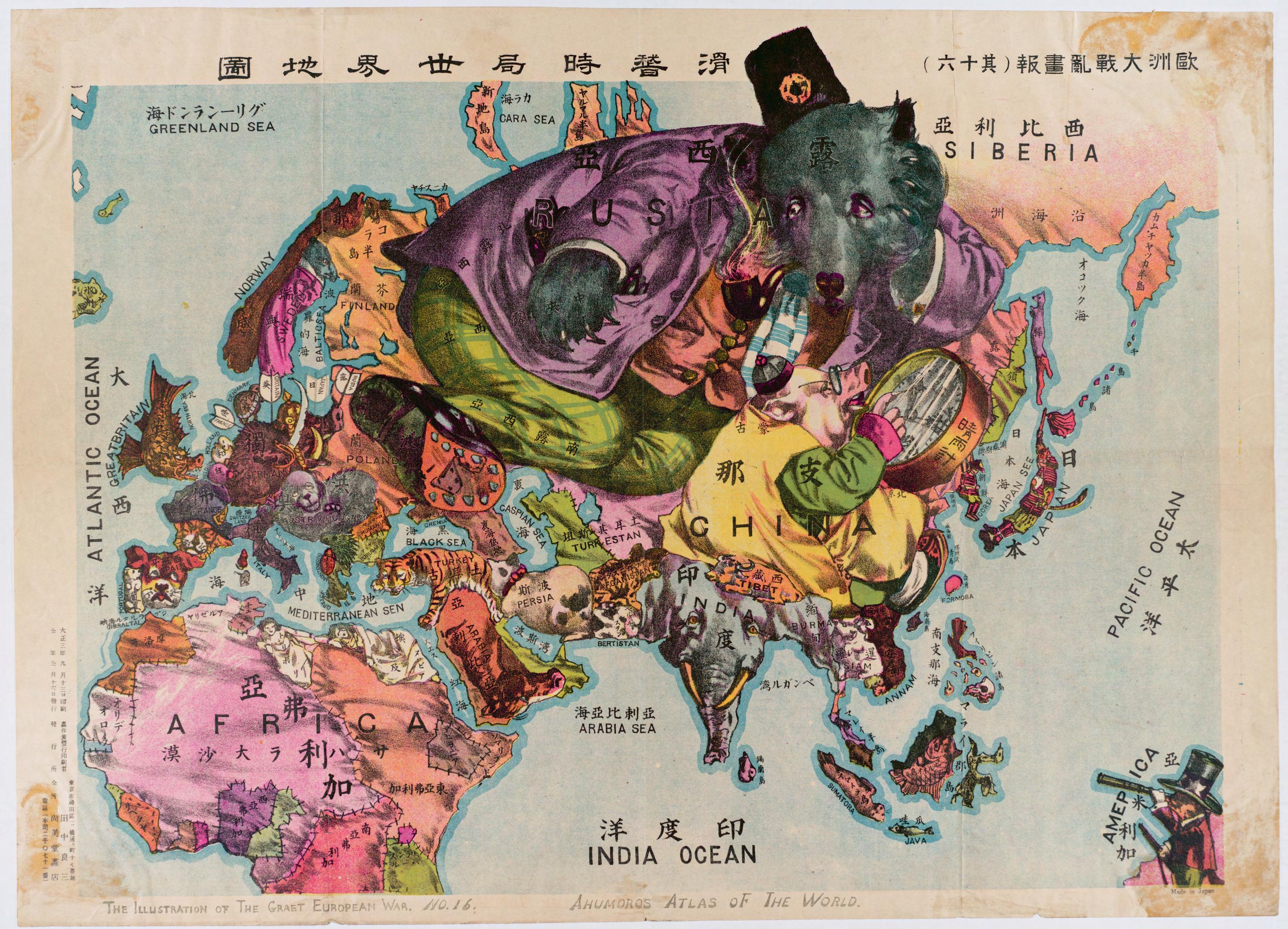
e.g.: https://upload.wikimedia.org/wikipedia/commons/3/3e/World_around_1900.jpg
And what's with the bear riding a unicycle?
4 Answers 2015-08-03
Feel free to ignore this if you feel it's not appropriate for this subreddit. Thought I'd give it a try.
I'm thinking about starting a small Youtube series based on a US Navy WWII-era cruiser. I want to make it as accurate as possible, so I'm looking for sources about protocol on ship.
For examples of what I'm looking for: The captain wants to fire on an enemy ship, to whom does he give the order to fire and how is that order relayed to the men manning the guns? After they receive the order, what sequence of actions does it take to aim and fire the guns?
I can find Youtube videos and the like showing some things, but I am hoping to find details for everything that would be done on a ship during normal operation, including in combat. I know it might be a pretty tall order, but does anyone know any websites or naval manuals that would have all or some of this information?
Thank you in advance for your time.
1 Answers 2015-08-03
I've read claims it was 500,000, and others that suggest that number was wholly inflated. What estimates do we know of, and where did they come from?
1 Answers 2015-08-03
1 Answers 2015-08-03
Obviously the original speakers of these languages were (the Hittites, etc.), but is this still the case today, at least for a significant number of speakers?
Or, more simply, how likely is it that I, a native speaker of English who is ethnically Germanic, am descended from the speakers of Proto-Indo-European who lived around the modern Caucasus?
2 Answers 2015-08-03
1 Answers 2015-08-03
I'm looking at getting this as part of a tattoo, and although I understand Punic to be almost untranslatable given the lack of sources on the language, I figured I would give it a shot and ask.
In case it is impossible, I'm aware that it is seen often in Latin, but there's several variations, is there one that fits closest to the one in my question?
Given the time period and that Hannibal's forces were heterogeneous would he have been more likely to say it in Greek or Latin? if Greek, what would be the translation?
Thank you for any information in advance.
1 Answers 2015-08-03
1 Answers 2015-08-03
I think that's primarily just chariot archers, but if there were other forms of chariot riding units then that fits with the question too.
1 Answers 2015-08-03
I am asking about Nazi-Gemany's economic policies. Was it more socialist or capitalist system? Did they for example take factories under control of the government or not?
1934 brothers of Strasser get killed and they were from the left-wing of NSDAP. Was this a real break with socialism, or didn't the leaders just like those persons?
And where could I find literature about this? Any books you can recommend?
6 Answers 2015-08-03