Are there sources for job classifications available from immediately prior to the Industrial Revolution (say, < 1800), and / or from the early 20th century (say, 1880 - 1920), before industrialization really took off heavily?
I'd particularly like sources which document the proliferation to the present set of jobs classifications. Best I've got are rough break-outs such as the general divisions of labour in Smith's Wealth of Nations, Book I, Chapter X.
3 Answers 2015-06-01
2 Answers 2015-06-01
2 Answers 2015-06-01
1 Answers 2015-06-01
I was wondering how the American Civil War was received in Canada, how Canada was involved (if at all) and how this fit in the context of the British Empire.
1 Answers 2015-06-01
This is one thing I don't understand from what I know about the D-day landings. Why would soldiers be deployed to be gunned down by machine gun bunkers, when those bunkers could have been destroyed from long range?
1 Answers 2015-06-01
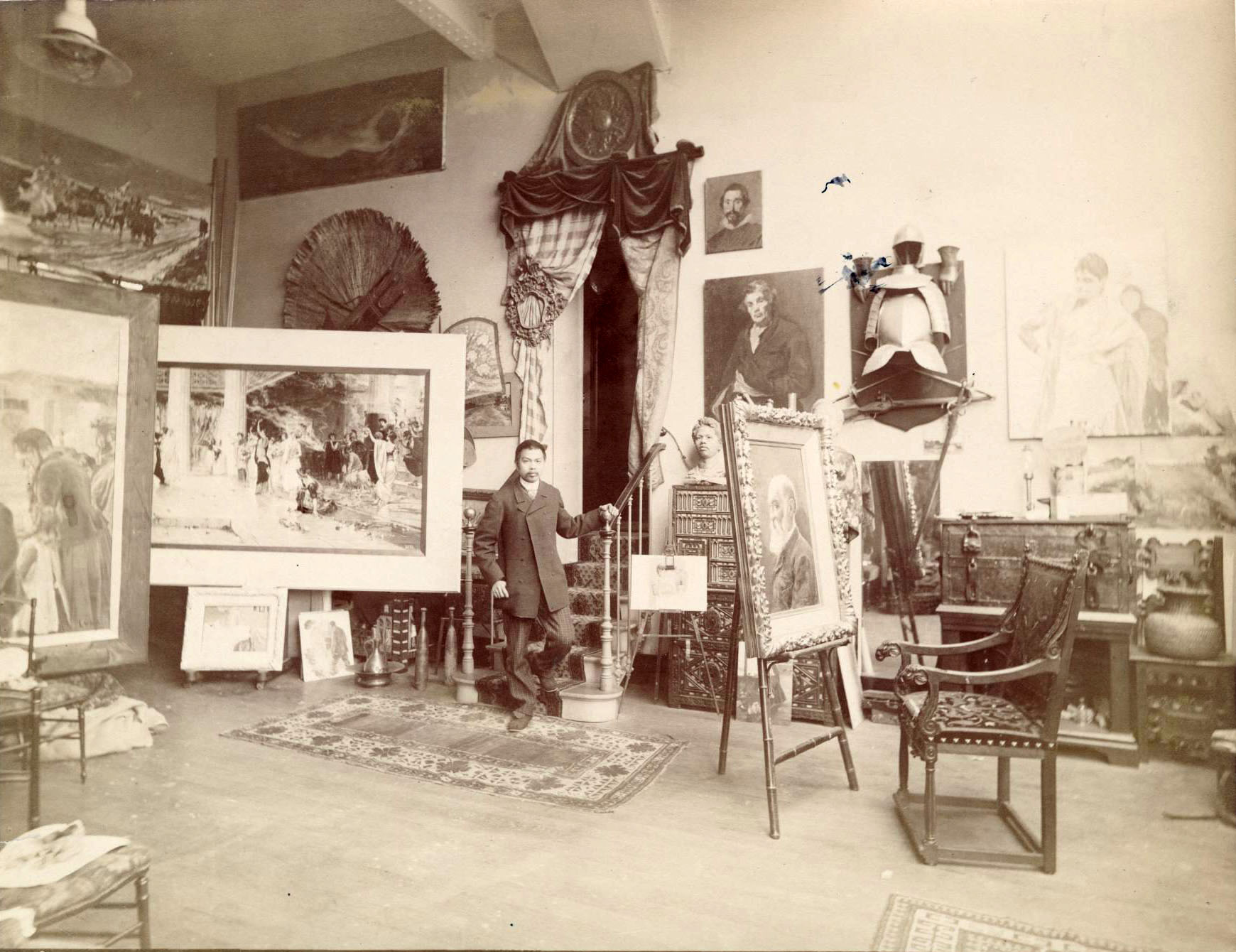
Hi guys, I'm doing research on this Filipino painter, Juan Luna, who lived for some time in Paris during the mid-to-late 19th century. We're planning on making a replica of his studio in Paris and I was wondering if anyone here in r/AskHistorians could help me in identifying the armor hung on the wall.
If you could also help identifying the other items in the room (the furniture, swords, gun, carpet) I would really appreciate it.
Thanks!
edit: Here's the link of the photo: http://upload.wikimedia.org/wikipedia/commons/4/45/Juan_Luna.jpg
1 Answers 2015-06-01
So I'm reading William C. Davis's The Cause Lost, and it's kind of coming off as lost causeish with him repeatedly saying how confederate leadership couldn't bury personal rivalries for the good of the "cause", and it comes off in a way like he wishes they had. He also praises James I. Robertson, who Alan T. Nolan outright calls a Neo-Condederate in his essay on the lost cause "Anatomy of the Myth". Are these two modern lost causers and thus should be avoided or are they good historians to turn to when reading about the civil war? By the way here is the quote by Alan T. Nolan that I mentioned, the context being him discussing the romanticism of Confederate leaders, in this case Jackson: "The neo-Confederate writers of the lost cause in this century- people like James I. Robertson Jr.- are, if anything, more elaborate in their tributes to Jackson than were his early biographers. Robertson's 1997 biography describes Jackson as a "spiritual prince," "standing alone on a high pedestal," and he says that Jackson's devotion to God, duty, and country "remain treasured legacies of the American people just as they are inspirations to people everywhere.'".
1 Answers 2015-06-01
Usually, people consider the Achaemenid Empire the First Persian Empire and the Sassanid Empire the Second Persian Empire, conveniently skipping both the Median and Parthian empires even though they inhabited the same regions? Is there a specific reason for that?
1 Answers 2015-06-01
1 Answers 2015-06-01
1 Answers 2015-06-01
Could close did Yugoslavia and The Pro Soviet Comintern come to all out war ?
1 Answers 2015-06-01
In 1990, why did Tory backbenchers not chose Heseltine to be Leader of the Conservatives and therefore PM?
It seems strange that they would chose John Major, who was not as well-known or influential as Heseltine. What academic work discusses the dynamics behind this vote (without the gossip or palace intrigue)?
2 Answers 2015-06-01
1 Answers 2015-06-01
Reading up on the Brown Bess, it seems rather bizarre to me that it was used for over a hundred years. Why was this?
2 Answers 2015-06-01
According to r/history, "specific questions go to /r/askhistorians,". After reading the rules for this sub and not finding anything within this post that would violate it. _ I came across these 16 claims I extracted from an Africa Firster's response. I can't make heads or tails of this, so does anyone have any cited research in relation to them?
Many plantation systems relied heavily on slave craftsmen imported from Africa.
Many African skills consisted of the use of wood, metal, earth and stone.
These were some of the skills brought with them to the New World and these specific skills made them indispensable for Euro-Americans.
Majority of enslaved Africans worked in plantation agriculture, but they also worked as butlers, waiters, maids, seamstresses, and launderers. ----Proportion of jobs among them, vs them among job
In addition, carpenters, stonemasons, blacksmiths, millers, coopers, spinners, and weavers for "FREE".
Slaves from the West and Central Africa imported their knowledge of growing rice.
Slave owners were taught by African slaves how to cultivate their crops.
A history lessons for you: Slaves helped build the White House and Capital, but aren't honored on the building.
Many inventions created by slaves were not recognized because the United States Patent Office refused to grant slaves patents for their inventions.
Many people are unaware of how slaves contributed to America because it's either hidden or because white people like you tell lies.
Blacks and Africans have been and are consistently stomped on by whites. Don't mention other races or "black-on-black" violence, it pales in comparison to white's oppression of blacks.
White people are not the founders of America.
It was stolen from the Indians.
Everything you guys touch turns into poison.
Therefore before you speak so negatively about slavery, learn your history instead of reading European fiction textbooks.
Also, what facts do you have that prove Africans sold their own? Please provide documentation that proves this theory?
_ I am not obligating anyone to respond to any number of these. If you are interested in doing so: cool! If not, move on ahead :) I suppose there may also be posters who wonder why I have not "researched myself" and that is because I do not want my own biases to leak through a response based on the selectivity of sources I used. Historians may provide a more objective outlook.
1 Answers 2015-06-01
1 Answers 2015-06-01
I realize it is impossible to accurately compare the cost of something from many centuries ago to today, but I'm just trying to get a general idea of how much a ship was worth. I would like to know the relative cost of a "merchantman" a "war galley" and a "carrack". It doesn't have to be a specific number if that's not possible. Would losing a few merchant ships have ruined the economy of a small country? Could a sailor ever hope to save up enough to buy his own ship? Was a trading ship generally worth more or less than the cargo it was hauling? Were warships somewhat expendable or did monarchs/governments have to protect them? Again, just a general idea of the cost is all I'm looking for.
I also realize that ships could vary quite a bit within the categories above but I didn't want to get so specific that it limited the potential sources. I can get more specific in my question if it is required in order to provide an answer. Thank you.
1 Answers 2015-06-01
I've seen this a lot with barbarians in fiction, even some "historical fiction", especially that which focused on the barbarians that fought the Romans.
Basically, soldiers were clad in metal armor, sometimes it was covered it spikes but not always. Their tactic was to run into a group of enemy soldiers and flail wildly in order to cause chaos and break up a group of soldiers.
Is there any truth to this or is it all Hollywood/videogame fiction?
1 Answers 2015-06-01