Hello.
I am currently reading Captain James Cook's journal of his first Pacific voyage. It is a very interesting read.
He mentions having iron tools on the ship. My question is, how did these iron tools not rust in the damp, salty atmosphere of ship travel? Was it an alloy, like steel?
Also, a somewhat related question. I posted this before but got no responses. How did Polynesia become French? What did France do to secure its claim to French Polynesia?
Thank you.
1 Answers 2015-05-28
With Hillary Clinton the leading Democratic nominee right now, I was wondering how has the Kingdom of Saudi Arabia treated the heads of government that have been women in the past. Were they more dismissive or were they less dismissive, or did it not really seem to matter? I know they don't have the best women's rights record around, and I wondered if it translated to their dealings with female politicians from around the world.
1 Answers 2015-05-28
1 Answers 2015-05-28
2 Answers 2015-05-28
I have a hard time understanding how in the 1st century, the apostles Paul and Peter were tortured and murdered by the Romans, but by 380 CE, Christianity was generally adopted by the Roman Empire. This seems like such a short amount of time for such a huge transformation.
What are some factors that led to the speedy Christianization of Europe after the death of the apostles?
1 Answers 2015-05-28
1 Answers 2015-05-28
Hi Historians. I read the FAQ and this type of question didn't seem out of place, but I realize that it's not what you usually deal with so just let me know if it doesn't belong here.
I'm trying to find out more details about my grandfather's service during WW2. I already know some information. He was in the 28th Infantry Division (PA National Guard, aka The Bloody Bucket) 109th Field Artillary unit. He entered France about 6 weeks after D-Day and entered combat at St. Lo. From there, he moved west through hedgerow fighting and participated in the liberation of Paris. Almost immediately, he was again sent west and saw further combat in the Hurtgen Forrest, where he spent his 20th birthday. Upon the commencement of the Ardennes offensive, he was taken prisoner and interned at Stalag Bad Orb IX-B in Germany.
I am wondering if there is way to determine the location of the 109th on a given day or week in late 1944. Are there resources that show troop movements in such detail? Are there logs that record actions taken at the unit level? Any guidance would be appreciated. Thanks in advance.
1 Answers 2015-05-28
1 Answers 2015-05-28
1 Answers 2015-05-28
1 Answers 2015-05-28
I'm talking about names like Livy, Plutarch, Aristotle or Virgil. What's wrong with Livius, Plutarchos, Aristoteles or Vergilius? Obviously they would still be pronounced completely differently, but that is true of the former set as well, and at least in the written form they are more faithful to the original names.
I should mention that I'm Czech, and sure enough, we also use different names for certain historical figures, such as Ježíš, where English speakers would use Jesus. We also often change names of foreign royalty if the name has a Czech equivalent (we still do that, such as queen Alžběta II for the current ruler of the UK), but again this is also done in English with Peter the Great, Frederick the Great and so on.
But the mentioned names seem a different case. Surely they are not equivalent English names, and it certainly can't be done to capture the pronunciation better, because let's face it, normal English pronunciation is completely incapable of doing the names any justice either way. So what gives? Why change them at all?
And while I'm on the topic of English pronuciation, is there any serious movement in English-speaking academia towards more faithful representation of names of historical figures or places, or is this seen as pointless (or do they do that already, perhaps)? It seems to me that English has truly given up on this. For example, on the wiki pages for Tiberius or Plutarch or Plato, pronunciation guides are shown next to the names. Except they are completely wrong. They simply assume the names were written in order to be read in English. I'm currently listening to the History of Rome podcast and enjoying it, but holy hell, it is irritating to listen to those mangled names. It's all Tie-beerius, Feybius, Jermennicus or Neerow. There's also a point where the author is corrected on the pronunciation of Cannae, and goes from saying Ca-NAY to Kenni. Which isn't really much of an improvement.
And I know that I'll probably just have to deal with it, but is this something to be expected for decades or centuries to come, what with the English dominance on the international stage?
5 Answers 2015-05-28
Not just European artifacts but Chinese and North African as well.
Reading about the battle of Aachen I wondered what Charlemagne's throne was doing during the whole thing. Would they have moved it to a bunker? What ruins and records have we actually lost as a result of the fire bombings and battles that raged in the cities?
Thanks in advance!
1 Answers 2015-05-28
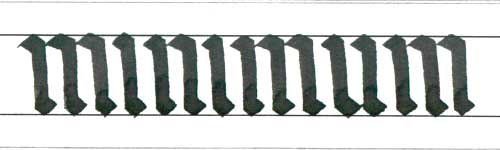
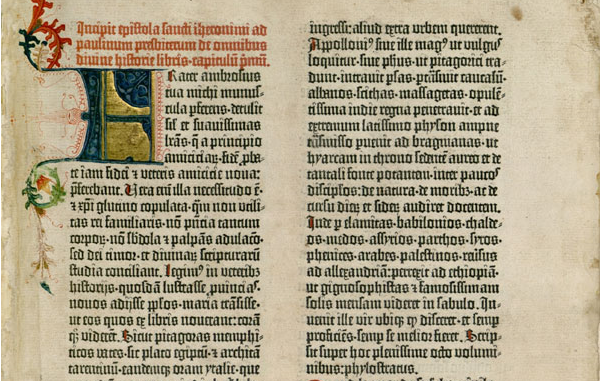
I was wondering why the script changed. The carloingian minuscle was easier to read then blackletter isn't it? example: carolingian and blackletter as an extreme example, but this version of blackletter might be a better one.
It probably is just because I'm not used to reading blackletter and the minuscule looks more like our modern font. But still I have the feeling that in minuscule the letters are more distinct then blackletter.
1 Answers 2015-05-28
1 Answers 2015-05-28
I see it all too often in history books today: interviews, diaries, or otherwise "anecdotal" pieces of evidence are used to back up claims about trends. Interviews with three farmers, for instance, might be used to claim that farmers on the whole were receptive of new production technologies. Surely not all historians argue like that, but the pervasiveness of these claim-making practices, often found in social history and some making heavy use of ethnographic methods, is astonishing to me.
To put the question another way, what use are "micro" pieces of evidence other than saying "At this point of time, somebody thought or did a certain thing, so we know for sure people did not all think or behave in the same way"? How have historians tried to justify their choice of evidence?
1 Answers 2015-05-28
I've looked around AskHistorians, and the best answer i saw so far was that the battles were fought pretty much the same as on land, with the objective of boarding enemy ships, killing or taking prisonder everyone on board and then taking the ship. Setting fire to the ship was not a smart idea because the fire would spread.
But i was hoping more could be said on this subject? How did this warfare look like, what kind of ships would we see?
3 Answers 2015-05-28
I know of prominent failures, such as Dan Sickles, Nathaniel Banks, and Ben Butler. Were there any political generals that performed admirably?
1 Answers 2015-05-28
Hello everyone,
I have been a long time lurker here and have a ton of respect for all of you.
I have recently become more interested in the naval conflict in the Pacific. The problem I have run into is trying to find narratives other than the heroic advance of the US toward victory. The problem I am having with this is looking at the Japanese fleet and the Allied fleet before December 1941 things look pretty even. I know war production played a large part in things but I was wondering if there were differences in the culture employed by two combatants and how they changed the outcome of the war.
Also if anyone has some books focusing on the Japanese, British, and Austrialian perspectives of the Pacific War I would really appreciate it.
1 Answers 2015-05-28
I have always associated this with the Klan. However, it seems rather anti-christian to be burning crosses to intimidate. When did this start happening?
2 Answers 2015-05-28
1 Answers 2015-05-28
How where they initially described? How did troops react to them, what about brass? Are there any records of discussion of anti take measures?
1 Answers 2015-05-28
2 Answers 2015-05-28
Adendum: Ok I realize that "global importance" isn't really the right term for this. What I am trying to ask is what was the role of europe in the grander scheme of pre-columbian Eurasia. Specifically what military, cultural, trade, etc influence did Europe as a whole have.
2 Answers 2015-05-28