If I wanted to travel back in time in America, how far back in time could I go, if I wanted to still be able to understand their English?
2 Answers 2014-07-01
I've heard the theory that says that it was because of the economy based on slavery (which made people think that working with your hands (ie experiments) was for slaves only so they didn't experiment anything) but was it just because of that? In Alexandria and during that time period there are records of big ideas that were proved in the 20th century and all that. So why did all that stop? Why did we enter the "dark ages" if we had such a history of at least looking and theorizing?
1 Answers 2014-07-01
Specially has surprised me this map of Europe during WWII, where switzerland was right ni the middle of germany, and yet still they were untouched, while all east Europe was overrun
2 Answers 2014-07-01
1 Answers 2014-07-01
Was this an universal tool throughout medieval Europe, or were there many alternatives by country-to-country basis? Say, drums?
1 Answers 2014-07-01
1 Answers 2014-07-01
are there big conventions for all three professions? when you write a history thesis or dissertation, do you anxiously watch the news for new archeology finds that might invalidate your theories? When do theories graduate into generally accepted knowledge?
Edit: Thank you, this is fascinating stuff. Big thanks to mods for an awesome subreddit.
4 Answers 2014-07-01
Saw 300: rise of an empire today and would like to know the real history of Greek democracy
1 Answers 2014-07-01
1 Answers 2014-07-01
With that much territory, it seems like a lot of it would only be nominally controlled or maybe some kind of frontier area. Was there actual roman presence throughout the whole empire? And if so, how much?
1 Answers 2014-07-01
Why were labor and social democratic movements more successful in Sweden, Norway, Denmark, Iceland and Finland than elsewhere in Europe? Why has the "Nordic model" been limited to Nordic countries?
3 Answers 2014-07-01
2 Answers 2014-07-01
I always thought that Israel was invaded by the Arabs and we're forced to fight to repel the attack, but today I learned it was the other way around. I also read that the Israeli government admitted that it attacked first, for self defense.
This is new to me, but I'm sure it's not new to historians. However if Israel attacked preemptively I understand why they'd do it of it means survival. If they didn't then does this mean they were the aggressors and had an intention to take land from the Arabs?
I know this is a sensitive subject and I'm not pro or negative toward either side. In fact I'm just curious from a strictly historical perspective. Does one side have the upper hand over the other or is this not worth bothering to look into because it's too controversial and too many contradicting sources?
4 Answers 2014-07-01
I've often wondered what this was about. I've had the idea that it's a form metaphor for how the blood never is shed from a noble, but instead keeps running in the veins, looking blue from the outside. Or maybe it's an actual misconception. What does the phrase come from? Was it used by nobles or about nobles? Why is "blue blood" a noble thing?
1 Answers 2014-07-01
1 Answers 2014-07-01
Im referring to before the formation of the UK. Im talking about the ages of the Picts-Gaels-and Vikings to the last Anglo-Scottish war. Is it England just had more (and better) resources? Is it because Scotland was divided in cultures? Is it both?
3 Answers 2014-07-01
In your opinion what made the Roman legion such a juggernaut post republic era
2 Answers 2014-07-01
I mean other than the "God Says So" thing, what were the earthly reasons for rules like "Do not mate different kinds of animals. Do not plant your field with two kinds of seed. Do not wear clothing woven of two kinds of material."?
What exactly were examples of people doing that sort of thing in the era, and why did Moses/Jews think it was bad?
Also from Leviticus: "When you reap the harvest of your land, do not reap to the very edges of your field or gather the gleanings of your harvest."
1 Answers 2014-07-01
If the average person went to go see Hamlet, would they know who wrote it? I guess this applies to all medieval/renaissance theatre in general.
2 Answers 2014-07-01
Polish Hussars are well known for the famed "wings" on their armor. Why did they wear them? Did the wings serve a practical purpose? If not, did they bring any disadvantage to the rider?
2 Answers 2014-07-01
I'm sorry my title isn't the clearest. I did my best, but will elaborate here.
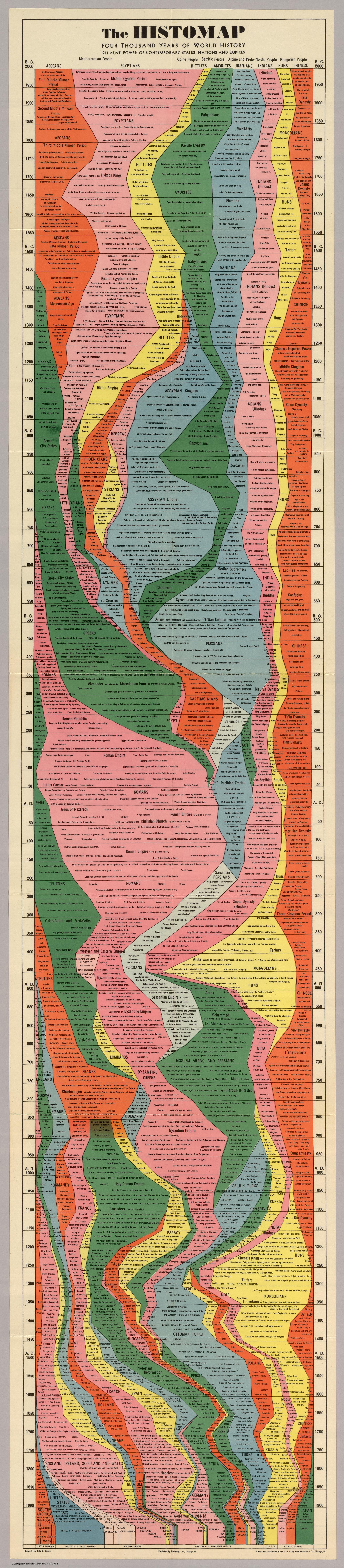
When we study history, it is often a collection of isolated matters - this battle, that agricultural advancement, here an explorer, then a shipwreck, etc. What ways are there to really pull it together and develop a deep understanding of all the different aspects and how they interplay? Something like this is great for giving some relation to areas we don't tend to learn in context of each other, but how can a student create this sort of reference when learning?
I'm interested in the broader spread, and I think this applies at many different levels, but my particular area of interest is the Canadian Rockies.
When I study historical events in the Canadian Rockies, I find three different ways of connecting individual bits:
I have stored in my memory several unrelated individual stories.
Where I am struggling is how to connect them all. How can I put together these various angles with different people in different places at different times, doing different things, and develop a comprehensive big-picture view?
I'm sure this is a common problem for studying anything not completely specific, and I'm hoping you brilliant Historians will have some ideas to help me understand how I can go from remembering unrelated events, to understanding history in its full scope, within my area of study, or more broadly.
I believe this falls under the "Questions may also be about historical method or the “world of history” more generally", and I did not find a similar question when searching. If I am incorrect and it should have gone elsewhere, or I missed the question already answered, I would appreciate being redirected.
1 Answers 2014-07-01
On a painting of the battle of Tewkesbury there is a soldier with what looks like stars on it. Could soldiers actually do this or is this just the artists interpretation of the battle?
2 Answers 2014-07-01
As the title asks.
edit: I wasn't sure how to tag the title.
1 Answers 2014-07-01
It seems like there's a lot of conflicting information, some from video games or other wholly unreliable sources, and not much with a lot of background. All I know is that it was used in things like lamellar, holding to wood/metal lamellae, and was used as the structure for brigandine. And I've heard some ideas that it was probably used as boiled plates or coats on its own, but nothing definite. That's what I'd most like to know about.
1 Answers 2014-07-01