In readings about early modern Ottoman life, references to white and black eunuchs often pop up. I assumed at first that white eunuchs were those of European or West Asian stock, while black eunuchs would have been Sudanese or Sub-Saharan African. In hindsight, though, I realize that I'm applying modern American racial ideas onto a much earlier culture.
What was the difference between a white eunuch and a black eunuch? Was this an actual Ottoman term, or something created by Christian observers? Did skin color play a role at all?
1 Answers 2014-05-07
I just read this, which mentions a few possible ancient inscriptions with his name. However, it's almost 15 years old now so I was wondering if there have been any new discoveries or if there is something of a consensus.
2 Answers 2014-05-07
I'm studying for a history final in a few days and I'm trying to think of the name of this person just in case it asks on the final. Here is the stuff I know:
-He went on a campaign into Egypt -Put up a small monument claiming that he had made it deeper into Egypt than any Roman ever has -Was a poet
My professor said something along the line of that being as egotistical as Augustus was, he sent a message telling the person that they must either leave the boundaries of the empire or he should kill himself. I cannot find this anywhere.
Thanks!
1 Answers 2014-05-07
1 Answers 2014-05-07
1 Answers 2014-05-07
I live in Arizona, which became a state in 1912. At what point in the last 102 years did those speaking English outweigh those speaking Spanish? Was there a high number of English speakers even before it became a state?
1 Answers 2014-05-07
2 Answers 2014-05-07
1 Answers 2014-05-07
1 Answers 2014-05-07
From what I've learned in history classes and my own research, he seemed to only favor the rich and Catholics and persecuted Buddhist. My father claims that he was forced to do so to try to put down communist hiding among Buddhist civilians and if the United States hadn't gotten involved in the war, he never would have been assassinated and brought a South Vietnamese victory.
1 Answers 2014-05-07
I was reading book set in Japanese occupied Korea. The general theme of the book was how the older generation lamented the loss of Korean culture due to the laws and prohibitions set by the Japanese. The characters also mention that there was a rebel leader in the Northern part of Korea who was fighting the Japanese. That rebel leader was Kim Il-sung.
Also the name of the book was "The Calligrapher's Daughter".
2 Answers 2014-05-07
It seems that through popular media today the Soviet Union is perceived to be the lesser of two evils during WW2. Why is the Soviet Union so much less vilified than Nazi Germany?
4 Answers 2014-05-07
How did the world powers of the time see the atomic bombings? Was it terrible or a justified necessity?
1 Answers 2014-05-07
I need ideas for an essay please help!!! I already understand racial interrogations in Latin America and Mining, Plantation. I know that in Africa the gender roles of women increased due to the lack of men but I need more ideas. Note the time period given is 1492-1750
1 Answers 2014-05-07
John Breckenridge won the majority of the electoral votes from the South in the last national election before the Civil War, and only a year before the CSA formally materialized, but Jefferson Davis was elected President for the Confederacy. It seems to me that he would be a popular choice, but it doesn't look like his name was even considered.
http://upload.wikimedia.org/wikipedia/commons/0/01/ElectoralCollege1860.svg
1 Answers 2014-05-07
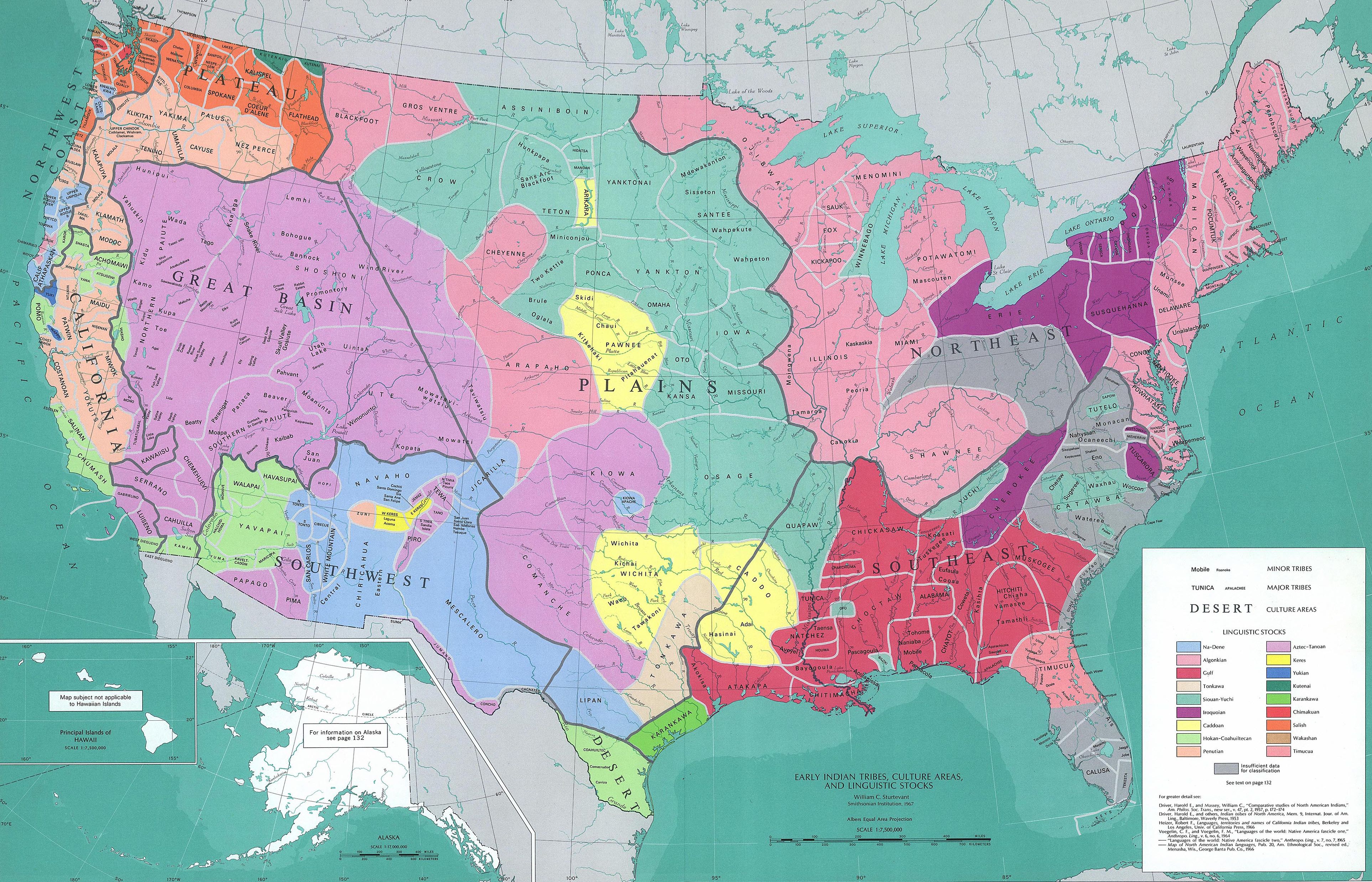
This question comes after viewing this map of Native American linguistic distribution (in what I assume must have been the post-Columbian period). Looking at the map it seemed to me like the Shoshone as a single tribe had the most territory, but is there a more definitive answer as to which Native American tribe, as a single culture, was spread over the greatest land area in the post-Columbian period?
And can there even be a definitive answer for this question? Or is the definition of a tribe as a cohesive unit too vague, such as the division or lack thereof between the Shoshone and Paiute or the Santee/Yankton-Yantkonai/Lakota? And for that matter, how permanent were these tribes really in the context of their formation after the deaths from diseases introduced by Europeans?
Any answer would be greatly appreciated!
1 Answers 2014-05-07
I've got an exam tomorrow and the two questions I have picked are.
And
I have the points and all I'd just like to know if there's anything I've missed.
Much thanks in advance (:
1 Answers 2014-05-07
In the event of an actual nuclear apocalypse, which would more than likely be the result of the cold war, a fallout shelter would be essentially useless. What made them so common?
1 Answers 2014-05-07
It seems like after the reconquista ended they were both leading the world in military and naval power for a couple centuries. Why didn't they cross over to Africa and continue gaining land for their kingdoms much as the ottomans had done in Eastern Europe?
1 Answers 2014-05-07
I've heard that the Dieppe raid didn't really teach anything new or important for future landings in North Africa and Normandy, that previous operations like at Gallipoli should have been enough for the Allied commanders to know attacking a heavily fortified port with light artillery support was a doomed venture. Is there any merit to this?
1 Answers 2014-05-07