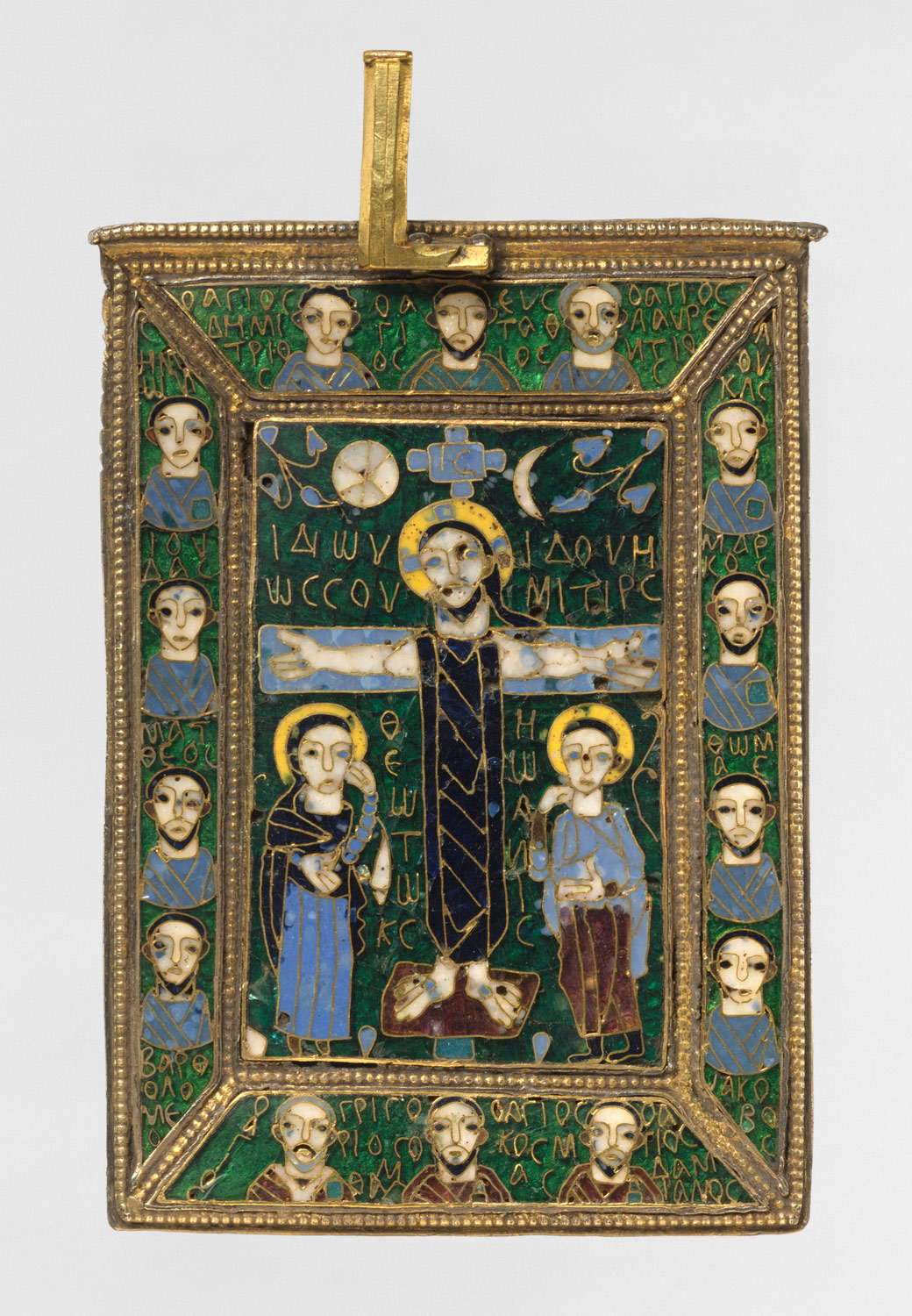
Hi, /r/askhistorians!
I was deep in wikipedia the other day, and came across this reliquary, which purports to contain a fragment of the true cross. I don't want to debate the historicity of relics of the cross; I just can't read the thing!
My Greek is extremely limited - I took one semester (pass/fail no less) of NT Greek my senior year in college. But as I study - for my own edification - ancient Judea and the Apostolic age, I do run across a lot of discussion about the Septuagint and the early texts of the New Testament. When it's in a book, and printed, I am familiar enough with the characters to usually puzzle out the pronunciation and make a guess as to what words in English it may be related to.
But looking at this beautiful piece of art, I don't even recognize some of the letters! The Met has, at this website, a more in-depth explanation of this piece, including a translation of the markings. It says "Inscribed in Greek: [On lid] Here is your son...Here is your Mother (on either side of Christ's head); Jesus; Mother of God; John" (and then goes on to talk about the border and the sides). I can't make any of that out.
Around the main figure, for example, I see: ιδων ωccον and ιδονμ μιτιρc - and I don't recognize the 'c' characters - much less am able to make sense fo it, even though I know what it says (google translate, in modern greek, translates it as "Εδώ είναι ο γιος σου, Εδώ είναι η Μητέρα σου").
Can anyone point me in the right direction?
2 Answers 2018-01-28
I have a supposed quote in Japanese about the flavor of awamori from the log/diary (not sure) of a member of the Perry expedition, but can't seem to find the actual wording I think it is attributed to Bayard Taylor. Does anyone know it?
1 Answers 2018-01-28
1 Answers 2018-01-28
I understand that the word ‘sword’ can be used as a very broad term, but I would most interested in the sword that first comes to mind when thinking of ‘inaccurate’ medieval movies I.e. Norman swords. However, information on Asian style swords, the gladius and other general cutting weapons would be very valuable too. Any information on weighted weapons and their relationship to ‘swords’ would also be much appreciated.
I’m interested in whether swords became almost non-existent on the battle field due to plate or mail armour, and what were the reasons for its popularity at its peak usage.
1 Answers 2018-01-28
I was directed to post here by the mods on r/history. This may be the wrong place to ask this and if inappropriate, the mods will of course remove it. Also I don't mean any offense to anyone with this question.
Regarding Auschwitz, I hear that sometimes people were gassed in huge rooms by the hundreds. Sometimes within a day or two of their arrival. Other cases are of people surviving 2-3 or even more years and eventually surviving. Do we have any information on why some people were kept alive for a longer time and some people were gassed immediately? Who chose who lived and died?
1 Answers 2018-01-28
Would people in the mid 1700's, during the American Revolution, use the phrase "Call Me" when parting ways. It was obvious that there was going to be great distance between the two individuals, so to say "Call me" really broke up the otherwise great story.
1 Answers 2018-01-28
I'm sure it has been asked before but I was just wondering what the popular consensus on Wild Bill Hickock is. Was he a charlatan or was he one of the greatest heroes of all time? I read https://books.google.com/books?id=M2ZNAAAAYAAJ&printsec=frontcover&source=gbs_ge_summary_r&cad=0#v=onepage&q&f=false and it really made me believe in the glory of this man but it has recently been brought to my attention that he may be just another Calamity Jane and all this may be fabricated. Can any wild or far west experts please give me their opinion on this legend?
1 Answers 2018-01-28
It's been known since during the war itself that the German heer (armed forces) were involved in atrocities, not just the SS, so how did we in the West get the notion that their hands were relatively "clean?" Did it develop more or less organically since there were a relative handful of atrocities in the West as compared to the East (and maybe a lingering view of Eastern Europe as barbaric and Asiatic) or was it a successful whitewashing campaign by the Western Allies who after all wanted a new Germany to be their ally in the Cold War?
1 Answers 2018-01-28
I’m currently reading Thucydides’s history for a class (precise book is The Landmark Thucydides) and one thing I’ve noticed is that there are several references to ‘corn’, especially in defining time. (E.g. “The next summer, just as the corn was getting ripe, the Peloponnesians and their allies invaded Attica.” ) I get the point trying to be made, but the use of the word corn confuses me.
Corn is a New World crop, so whatever is being referred to hear can’t be corn as is commonly thought of. So, what kind of crop is Thucydides referring to here? Is this just a translation issue, or is he referring to a distinct crop from wheat, barley, or some other Old World crop?
Thank you for any answers this gets! I know it seems a silly question, but this is really getting to me.
3 Answers 2018-01-28
I've read about the cura annonae that provided subsidized grain to the city of Rome proper. I'm wondering if any similar system of food subsidies existed in Roman provincial cities of similar size like Alexandria or Antioch? Could day laborers in these cities survive without any public assistance?
Feel free to answer from any particular time period in Roman history.
1 Answers 2018-01-28
I unfortunately can't remember where I read this, but I was reading something about people who say there's not enough evidence to conclusively prove Jesus of Nazareth existed. The article said that if someone takes that attitude, they'd also have to agree Alexander the Great never existed as we have less proof for him. Is this at all accurate?
1 Answers 2018-01-28
Hi there fellow historians,
Hi there mods. I posted this a day or two ago and got no response. It was late when I posted, and I kind of screwed up the title of the post. I deleted that post and recreated this with a much more specific title. Hope you don't mind.
I'm having some trouble. I need to find out how Alexander Martin Sullivan either founded or came to own the Morning News in 1859. His brother, Timothy Daniel Sullivan, wrote that the Evening News, which began on January 18, 1859, quickly turned into a morning paper, which first appeared on April 26, 1859. Ann Andrews, in Newspapers and Newsmakers, stated that Sullivan "took control of three other Dublin newspapers," the Evening News and Morning News among them. Sullivan posted a prospectus for the Evening News in the Nation (Dec. 18, 1858), but not for the Morning News, wherein he later becomes addressed as the "Editor of the Morning News" in later editions of the Nation. Alternatively, Marta Ramon cited that Dr. John C. Waters was the editor of the Morning News by 1863. Waters was a popular contributer to the Nation, so perhaps he was eventually made editor of Morning News, but I cannot, for the life of me, figure out where the Morning News originally began. Later, in 1860, Sullivan wrote to O'Brien and discussed the paper, but there seems to be no evidence of its creation or purchase. The British Newspaper Archive has either failed me, or I have failed it. Anyone able to help clear this up for me?
1 Answers 2018-01-27
1 Answers 2018-01-27
The Huns conquered most of Eastern and Central Europe in the Fourth century and maintained their hold until the Fifth before quietly disappearing in the sixth. Despite their importance in history and their association with nomadic empires and being the quintessential "barbarians" I can find next to nothing about their history, society, culture, religion, or government. I would assume this is because they were not literate that we know of, but surely we know something from archeological evidence or the writing of the peoples they conquered.
1 Answers 2018-01-27
To clarify the "completely unknown", I was thinking along the lines of how they found the Hittites almost by accident, and we didn't have anything on them apart from references in the Bible.
1 Answers 2018-01-27
2 Answers 2018-01-27
Hey all!
One of the things I really like about history is learning about everyday life, common people, trades and how they were performed, the cities and how they were constructed, etc.
Basically, most historical programs I've seen all have to do with nobility, and the stories/drama of their lives.
Even a program about Versailles for example is mostly about the politics, and less about the history of the palace itself and the inner workings.
Are there any resources to learn European history that do not have to do with nobility, and focus on the other aspects?
An example of something I really liked was the BBCs Farm series, where they put the theory to practice, and tried their best to live as people would during, say, Tudor times for example.
Thanks!
1 Answers 2018-01-27
I'm finishing up an essay on Turkish political history that encompasses the 2016 attempted military coup.
Of course, I'm using news articles from 2016 from reputable websites like the BBC and Reuters to support my arguments.
Would these be considered primary sources in respect of that event?
Thank you
1 Answers 2018-01-27
I was reading the following article:
and one of the recipes includes the use of soy sauce. This cookbook is intended for usage under siege conditions, where exotic or unusual ingredients would probably be very hard to get ahold of. Soy sauce would then, I assume, be a very common thing in a German kitchen.
Does anyone know how far back this would have been true?
1 Answers 2018-01-27
I'm the Nutmeg of Consolation by Obrian this is mentioned and it strikes me as strange that such a thing would be purposefully done.
1 Answers 2018-01-27
I know this is a broad, possibly example-seeking question, but I can't think of a way to word it that isn't restrictively narrow. This Reform Judaism blog post talks simply about gender identities beyond male and female, including what we today would call transgender people.
My question is, have existing people like this been recorded outside the Mishnah? I don't want to narrow my question to a particular era, because I don't anticipate there possibly being more than a handful of examples across history if any, but I'm just really curious about whether we have records of these people outside their definitions in Jewish texts.
1 Answers 2018-01-27
1 Answers 2018-01-27
Saw this pic of USS Wisconsin earlier and have seen other photos of late-WWI era battleships with wooden deck planks. If nothing else, I'd imagine they'd be a fire hazard and/or a waste of time to lay down and maintain. Was there any particular reason for it?
1 Answers 2018-01-27
I guess this question is more directed towards heavier slave owning regions, though if you know something about small Appalachian farmers, that’d be great too.
How many people owned land but not slaves? How many were employed to oversee slaves? Did white day-laborers have to compete with slave work gangs?
1 Answers 2018-01-27