1 Answers 2016-08-16
There's Hammurabi's Code, there's Gilgamesh Epic and then Greek Literature.. Why is it that nothing of significance popped up in between, geographically or chronologically? Asia Minor was surely populated by polities that traded enough and were smart enough to pick up influences... I reckon.
Edit: autocorrect messed up my question, it should read "... in the region leave any works ..."
1 Answers 2016-08-16
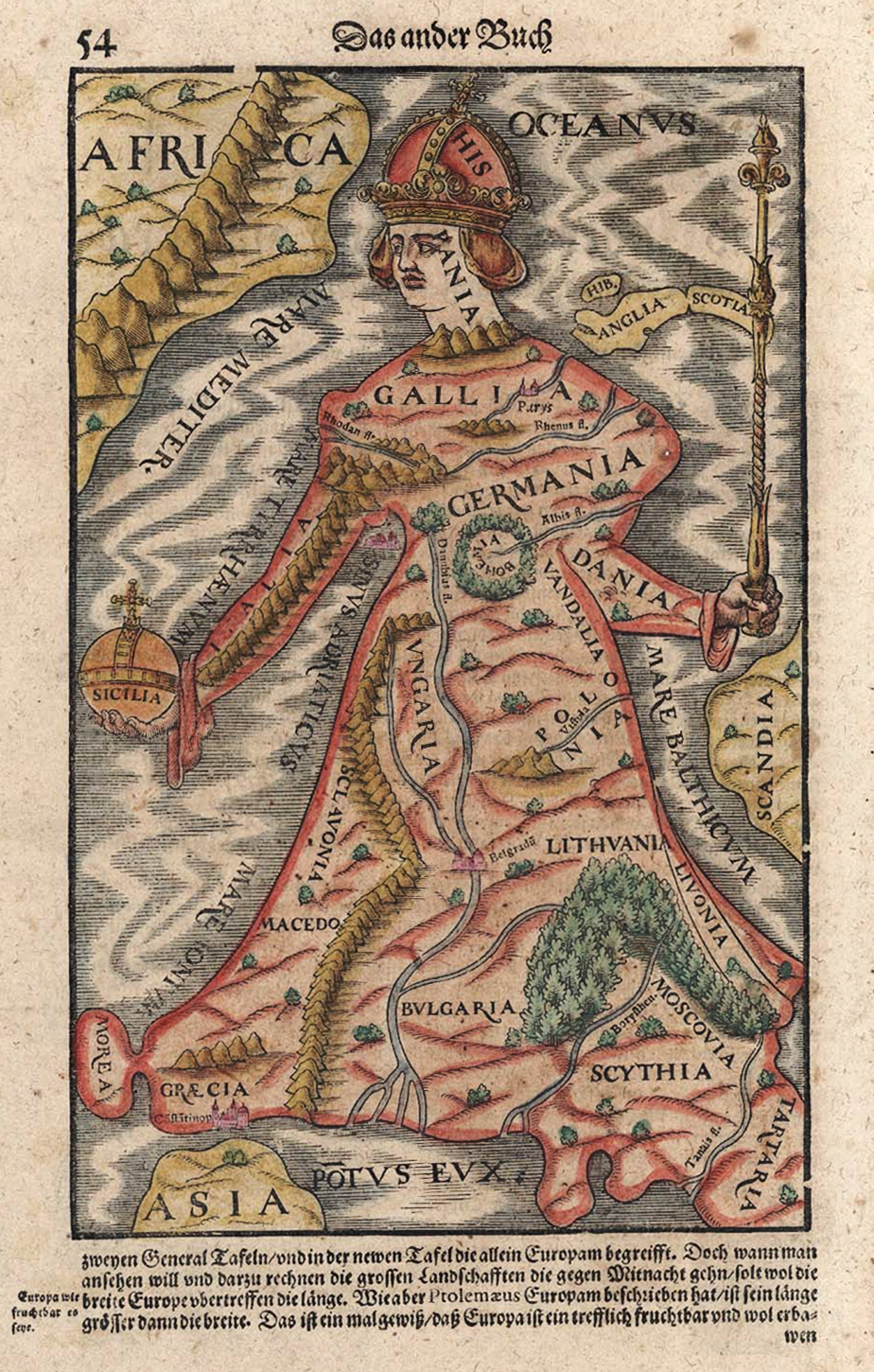
The map in question, Europa Regina.
I've talked with a colleague about this and we're not finding much information about this other than eux. might mean euxine, but we're far from certain.
Would greatly appreciate if anyone could shed some light on this for us.
2 Answers 2016-08-16
Were concentration guards forced or did they volunteer? Was there any vetting to check for antisemetic views ect...
Also what do we know about the effect of working in a concentration camp on guards mental health, did many suffer afterwards? Are their accounts of guards openly apologising?
1 Answers 2016-08-16
For example, Issac Newton was not (To my knowledge) referred to as "Dr. Newton", though if he were born in modern times and made comparable discoveries, he would most likely hold a doctorate in physics. So, when did we start calling people doctor even though their chosen area of expertise had nothing to do with medicine?
1 Answers 2016-08-16
Has the advent and popularization of writing changed the way languages are spoken? For example, are words and sounds now more separate and distinct than they were several thousand years ago?
1 Answers 2016-08-16
In 1824 Jefferson, in correspondence w/ abolitionist James Sparks argued
In the plan sketched in the Notes on Virginia no particular place of asylum was specified; because it was thought possible that, in the revolutionary state of America, then commenced, events might open to us some one within practicable distance. this has now happened. St. Domingo [HAITI] is become independant, and with a population of that colour only; and, if the public papers are to be credited, their Chief offers to pay their passage, to recieve them as free citizens, and to provide them employment. this leaves then for the general confederacy no expence but of nurture with the mother a few years, and would call of course for a very moderate appropriation of the vacant lands. suppose the whole annual increase to be , Start insertion,of, End, 60 thousand effective births.
because founders.archive.gov is a real and amazing resource here is the letter and here is the letter from sparks sparking this one
so how unusual was this view? was it advocated?
1 Answers 2016-08-16
1 Answers 2016-08-16
1 Answers 2016-08-16
Hello everyone and welcome to the 17th installment of our continuing series of Rules Roundtables! This project is an effort to demystify the subreddit and also to gather your feedback to help improve it! We aren't just covering the hard and fast rules though, but also looking at other aspects of the subreddit and the community. This week, we're looking at periodization and regionalization, and how to ask better questions even if you don't have much of a historical background.
#Periodization/Regionalization
Periodization and regionalization refer to a practice of history and archaeology in dividing up time and space into classificatory units (“periods” and “regions”, respectively). This practice is in some ways fundamental to the way history and archaeology as disciplines are structured, dividing up university department and academic journals into regional and period specializations. Additionally, periodization and regionalization are important for how research is conducted. While many are broadly familiar with the concepts of periodization and regionalization as they are taught in primary education or interpreted in popular culture, the intent of this post is to present a more academic and rigorous view of these concepts with the goal of helping you, dear reader, ask better questions in /r/AskHistorians. Having a better understanding of periodization and regionalization can not only help ensure that your answer doesn't get deleted, but also increase the chances that you receive an /r/AskHistorians-quality answer.
##What is the purpose of Periodization and Regionalization?
Classification of space and time is a fundamental endeavor of history and archaeology because it helps to understand larger trends, both in time and across space. Periodization refers to the creation of chronologies, the succession of different “periods”, “ages”, “eras”, or any number of other synonyms. Regionalization is similar, except that the classification created involves dividing space into distinct regions, often based off shared culture, language, or geography. The famous archaeological chronology of “Stone Age, Bronze Age, Iron Age” is one example of a well-known (but problematic) periodization. Likewise, the classification of different landmasses into seven continents is a very basic example of a regional classification.
Even non-historians are familiar with the concept of periodization and regionalization in the study of history, with terms like “The Renaissance” or “The West” entering into common parlance. The importance of these time periods and regional blocs are as a means to convey a general historical idea or theme that sets that period or region apart from others. For instance, “The Renaissance” is more than just a division of time. “The Renaissance”, even colloquially, has the connotation of a time period in which European societies were looking backwards for inspiration from the Classical Roman and Greek past. These sorts of divisions can help us quickly grasp the general historical trajectory of a period, in the case of chronologies, or where cultural and historical similarities exist between societies, in the case of regional systems.
However, the criteria which these schemes and classifications are based on are hardly ever straightforward or agreed upon. While early researchers, both archaeologists and historians, tended to treat these systems of periodization or regionalization as encoding “natural” divisions within the world, historical disciplines have since recognized that these divisions are largely arbitrary and reflect the interests and biases of the researcher. In other words, “The Renaissance” does not exist as an entity except inside of the texts written by historians (and perhaps in the heads of a few Renaissance elites). That isn't to say that these periods are entirely fictional: they do capture real differences and changes in societies. However, we could select any number of other equally valid criteria to use in defining periods or regions and these would be just as valid as whatever criteria define “The Renaissance” or “Western Europe”, for instance.
##Problems and Dangers with Periodization and Regionalization
All that said, we shouldn't think that chronologies and regional classifications are not useful for researchers, or for you as a reader of /r/AskHistorians. Even though these classifications are largely arbitrary they can still be a tremendous aid to research if used properly. Most importantly, these classifications should never drive our understanding of history. Instead, our research interests should guide which chronologies or regional schemes we end up using.
Primarily, a good researcher should always be vigilant that the criteria used to define a chronology or regional classification matches their research interests. For example, imagine a period of time that is divided up based on the period of rule for a society's kings. Now, say a researcher is interested studying changes to agricultural production in this time period. Changes in agriculture might coincide with changes in kingship, but if they do not there is no reason our hypothetical researcher should continue to use a chronology based on a criteria (kingship) that doesn't necessarily have any bearing on the topic of their research (agriculture). Since the criteria we use to create these chronologies and regional systems are largely arbitrary, we should select the classifications that have the most direct bearing on our historical interests.
We must also be careful to not let these schemes blind us to interesting historical questions and areas of research. For instance, a common method of dividing time in studying Native American history is to place emphasis on the changes that occurred after conquest by European powers, setting up pre-colonial and colonial time periods. However, this division of time suggests that Native societies were immediately and significantly impacted by European colonialism. While this is true in many cases or in certain specific ways, it may lead us to assume there wasn't any or much continuity between pre-colonial and colonial Native societies. It would be a tragedy then to never research these continuities in Native societies because our chronology led us to assume they weren't there. It is important to always remember that these divisions of time are not “natural” breaks or discontinuities in history or societies, but rather only encode certain sets of changes in societies. Continuity between periods can be just as interesting a subject of study as the discontinuities.
Furthermore, we have to be careful not to apply chronological schemes outside the historical, geographic, and cultural context for which they were developed. A good example is the well-known chronology of Stone Age-Bronze Age-Iron Age. This chronology was originally developed to describe changes to societies in Europe, and was later applied with modifications to other societies. While this scheme seems to work fairly well for describing historical changes in the Near East, and in Africa and China to a lesser extent, popular imagination often applies this scheme to Native American cultures or Polynesian societies, asking why they never developed beyond a “Stone Age”. This is a fundamental misunderstanding of the chronology.
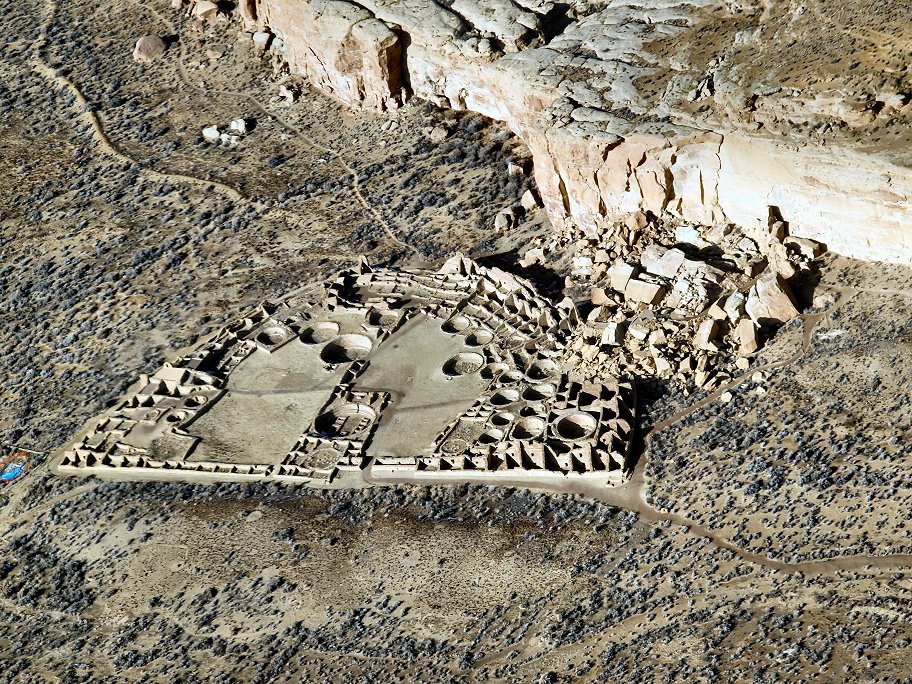
As already mentioned, we should be always careful not to view chronologies as encoding “natural” divisions in time, or “natural” developments of society. The Stone-to-Iron Age chronology is descriptive of social changes in developments in the Near East, but isn't a predictive model of universal culture change that can be applied cross-culturally. For instance, compare these two structures, both built by Pueblo societies in what is the present-day U.S. state of New Mexico, but separated by nearly 1000 years. Both structures are indicative of a society that is nominally “Stone Age” in the sense that they lack metal tools, but there are clear social (and architectural) changes between the society that built the first structure and that which built the second. Calling both “Stone Age” would consequently cover up these significant changes. Instead, a different chronology should be developed to capture the social changes specific to this region and culture, rather than applying a chronology developed for a completely different context.
##How can all this help me ask better questions (and get better answers) in /r/AskHistorians?
This is all well and good for understanding how historians use regional systems and chronologies, but how can this help you on /r/AskHistorians? One of the most common reasons for a question to be removed from /r/AskHistorians is violation of our Example Seeking rule. Within this category, one of the most common reasons for violating the Example Seeking rule is not specifying a sufficiently narrow geographic or temporal range. To quote from the rule:
Questions likely to be removed are those asking about all history and all places at once or an extraordinary range. If a question isn't reasonably limited to a specific time and/or place, it likely will be removed.
The easiest way to avoid having your question removed under the Example Seeking Rule is therefore to specify both a time and place. Generally, the moderators have decided that even broad categories like “The Middle Ages” or “Europe” are specific enough that a question asking about “Medieval Europe”, for example, would not violate the Example Seeking Rule, despite covering an entire continent and many hundreds of years. Examples of both regional classifications and chronological schemes are provided below as a starting point for narrowing down the scope of your question and give even those without a solid background in history the ability to better specify what they are interested in when writing a question.
Giving this kind of specificity isn't just valuable in avoiding the removal of your question. Generally, the narrower the geographic and chronological scope of your question, the more likely you are to receive a very high quality and satisfying answer. While we do allow questions with very broad regional and chronological scope - “Medieval Europe”, for example – it is important to realize that there may be very significant differences between, say, 10th century Bohemia and 14th century Normandy, both of which fall under the category “Medieval Europe”. Indeed, we would expect that even experts may not be able to answer questions for all time periods and places encapsulated by a category like “Medieval Europe”.
For the most part, the broader the time period and region the more general an answer must be to accurately describe all the variation inherent to a longer time period and wider regional scope. The more specific the regional and chronological constraints of the question, the more specific the answer can be. Consequently, the more you are able to narrow down both the time period and region of interest, the more likely you are to receive an answer that is brimming with specific detail and a compelling story, rather than a very general answer lacking in detail. The example chronology and regional systems provided below can be a good starting point for asking a more narrowly defined question, but the moderators are always happy to help a prospective inquirer narrow down the scope of their question if contacted via modmail.
##REGIONAL SYSTEMS
Below are several examples of systems of regional classification. These are not meant to be authoritative or comprehensive – many other schemes are used in scholarly works. However, this can be a starting point for you to help narrow down the regional scope of your question. These classifications largely focus on continental divisions, but cross-continental schemes also exist and a few have been suggested at the end. Each scheme has an associated map (linked to in the title of the region) to help acquaint you with the divisions in a visual way.
Note: Most of the linked maps of regional divisions are based on the boundaries of modern nation-states, rather than cultural or geographic divisions. It is important to remember that these modern national boundaries do not necessarily coincide exactly with cultural/geographic divisions in the past, but are rather intended as a guideline for the approximate geographic boundaries of each region. For example, while the majority of the Amazonian basin lies within the boundaries of modern Brazil, portions extend into nations normally classified as part of the “Andean Region”, such as Peru and Ecuador.
For reference, here is a link to an album of all the maps used here if you would like to peruse them together.
See also Mediterranean and Indian Ocean
See also Mediterranean, Circumpolar, and Indian Ocean
Note: The inclusion or exclusion of Russia and Turkey from "Europe" is a fairly political matter, and some maps may decide to exclude or include one or both. Additionally, both nations and the regions they cover cross the continental divide between Europe and Asia, adding to some confusion about where they should be classified.
See also Mediterranean and Circumpolar
See also Caribbean and Circumpolar
Note: The "Northwest" region on this map includes areas traditionally seen a part of the U.S. Southwest, and not part of Mesoamerica at all, including Baja and much of northern Mexico. Refer to the North America map for the actual northern extent of Mesoamerica as a region.
See also Caribbean
See also Caribbean
Note: Eastern/Western New Guinea is usually divided between Oceania and Indonesia/Asia because of political boundaries, despite being the same landmass.
See also Indian Ocean
CROSS-CONTINENTAL REGIONS
##CHRONOLOGIES
Chronologies tend to be more specific than regional classifications, applying only to certain societies or individual regional divisions. As such, this post would become unreasonably long to include examples of chronologies for all the regional divisions already listed. As such, we have provided a single, global chronology which can be reasonably used to formulate your questions.
Bear in mind that this division will not work in every place or for every society, but it can be a starting point to narrow down the time period you are interested in. Generally, it will be best if you use a chronological division in formulating your answer that was constructed for a particular region. For example, using dynastic changes to discuss Chinese history.
Furthermore, we have provided a single example of a more specific regional chronology and the rationale behind the chronological divisions, as a way to highlight the kinds of criteria used to distinguish between different time periods.
###GLOBAL CHRONOLOGY
By virtue of attempting to classify the entire history of humanity across the planet, this chronology is extremely general. Additionally, it is very much open for argument how much each of these time periods really applies on a global scale. However, the intent is to give users a starting place to at least begin asking question with some more specificity by including time periods that are more or less sensible to talk about everywhere.
(mya=million years ago and kya=thousand years ago)
Paleolithic 2.5mya (Africa only) or 1.8mya to 10kya
Neolithic 10kya to 5,000-2,000 B.C.
Antiquity 5,000-2,000 B.C. to A.D. 1-500
Middle Ages/Medieval A.D. 1-500 to A.D. 1500
Early Modern A.D. 1500 to A.D. 1815
Late Modern A.D. 1815 to A.D. 1945
###PECOS CLASSIFCATION A chronological sequence for describing Pueblo and Ancestral Puebloan cultures in what is the modern Four Corners region of the Southwestern U.S.A. As Pueblo people still live in the states of New Mexico and Arizona, the chronology spans the earliest peopling of the Americas up until the present.
This particular formulation of the Pecos Classification is modified from that presented by Liebmann 2012 (34-36).
Paleoindian (~15,000kya-10,000kya): When the Americas were populated is still under debate, but the most recent possible period is circa 13000 B.C. However, human habitation of the Americas probably occurred earlier than that. This period is at the end of the Pleistocene (the last “Ice Age”) and is defined by largely nomadic, hunter-gatherer societies.
Archaic/Basketmaker I (10,000kya-1500 B.C): With the transition to the Holocene (our current geological epoch), environmental changes resulted in increasing experimentation with wild plants. Earliest evidence for semi-sedentary villages (in semi-subterranean pit-houses). Gradual extinction of megafauna in this period (e.g. mammoths).
Basketmaker II (1500 B.C.- A.D.500): Introduction of maize and other domesticated crops from Central Mexico. Involved adapting the sub-tropical domesticate maize to the arid climate of the Southwest. Neither fully agricultural nor fully sedentary yet, but experimenting with both.
Basketmaker III (A.D .500-750): Introduction of beans from Central American and full adoption of sedentary agriculture. Earliest pottery vessels.
Pueblo I (A.D. 750-900): Move from semi-subterranean pit-house structures into above-ground roomblocks (e.g. “Pueblos”). Coincides with population increase and spread of farming.
Pueblo II (A.D. 900-1150): Growth of Chaco Canyon in New Mexico as a major regional center. Intensification of long-distance trade (from as far as Mesoamerica and potentially the Eastern Woodlands). Largest settlements and structures yet seen in the Southwest. Spread of Chaco-related pottery-designs and architecture.
Pueblo III (A.D. 1150-1300): Collapse of Chaco Canyon as a major center, and shifting importance to Aztec Ruins archaeological site in Northern New Mexico. The San Juan region (present-day Four Corners region) continues to grow and solidifies its place as the population center of the Pueblo world, e.g. Mesa Verde national monument.
Pueblo IV (A.D. 1350-1600): Sudden and massive outmigration of almost the entire population of the Four Corners around A.D. 1275. This population moves south, combining with existing populations in southern and central Arizona and along the Rio Grande in New Mexico. Rise of new religious ideologies, like the Katsina cult and Salado cult. Fewer villages on the landscape, but existing villages grow in population size and become very dense.
Pueblo V (A.D. 1600-1848): Colonization of New Mexico by the Spanish and the establishment of a mission system. Attempted Christianization of the Pueblo people, but traditional religious beliefs are maintained. 1680 Pueblo Revolt expels the Spanish from New Mexico until 1692 and wins Pueblo groups increased rights and autonomy from the Spanish crown.
Pueblo VI (A.D. 1848-Present): U.S. Annexation of New Mexico and Arizona following the Mexican American War. Like other Native Americans, Pueblo people subjected to attempted cultural extermination in Indian schools. Reservation system established, which remains up to the present.
Source: Liebmann, Matthew. 2012. The Rest Is History: Devaluing the Recent Past in the Archaeology of the Pueblo Southwest. In Decolonizing Indigenous Histories: Exploring Prehistoric/Colonial Transitions in Archaeology, edited by Maxine Oland, Siobhan M. Hart, and Liam Frink, pp. 19-44. University of Arizona Press, Tucson.
10 Answers 2016-08-16
I want to know more about arabic, persian, and egyptian sailing but I really just don't know anything about it or even where to start looking. I'm specifically looking for information about the medieval era, but earlier is fine too. Does anyone know of any resources I should be looking at?
1 Answers 2016-08-16
For somebody making a YouTube video on the Medical History of Depression?
1 Answers 2016-08-16
And if so, how did he and international communists who supported the USSR reconcile that (and the ethnic deportations) with anti-racist communist ideology?
1 Answers 2016-08-16
1 Answers 2016-08-16
The popularity of the musical "Hamilton" recently led me to purchase Ron Chernow's biography of Alexander Hamilton. It's an extremely engaging read so far, and despite always have been interested in American politics, I've been developed a new interest in the time period. Once I finish up "Alexander Hamilton," I know I'd like to keep reading, and I'm looking for a little direction on what I should read next.
Ideally I'd like to read biographies of a few more of the key founding fathers, especially Washington, Jefferson, and Madison. I'm assuming that Chernow's biography of Washington is the best option there, but are there definitive options for Jefferson and Madison? Furthermore, are there any good books that delve into the generalities of the Revolution, development of the Constitution, and subsequent governance? Chernow has been great, but he does assume a fairly comprehensive grasp of the American Revolution at points. This hasn't been a major barrier, but at points I've had to look something up.
Thank you for any suggestions. :)
1 Answers 2016-08-16
Is this a modern phenomenon or was it an argument used in, say, the four-way 1912 presidential election?
1 Answers 2016-08-16
What events led to this?
1 Answers 2016-08-16
While flipping thru some radio channels, I heard Glenn Beck state as fact that 25-30% of lynching victims were white. I don't doubt that there might have been some white lynching victims, but do we have a definitive racial breakdown of who was lynched?
1 Answers 2016-08-16
Additionally, going through population tables I've learned how much smaller England was than France! I've always thought of the French/English relationship as a rivalry of equals. How could such a relatively small country as England challenge France for much of medieval to premodern history?
| Year | France | England |
|---|---|---|
| 1400 | 16,600,000 | 2,080,000 |
| 1600 | 20,000,000 | 4,100,000 |
| 1800 | 30,000,000 | 7,700,000 |
| 2000 | 59,000,000 | 49,000,000 |
5 Answers 2016-08-16
I found an older post. However, I think the community has grown significantly. I wanted to know if there are any good beginner-level chapter books for kids in 1st–3rd grades.
To narrow it down, my kiddo's very interested in Ancient Egypt, and Ancient China.
2 Answers 2016-08-16
I had a shower thought about human/dog relationship throughout our history: Our relationship with dogs predate even our use of written language (as far as i know). Its almost as if owning a dog is a fundamental part of being human in a soco-symbiotic sense, they have been with us longer than almost anything. We've shaped them and they've helped us survive.
It got me thinking, what were the earliest documented cases of dog domestication? What civilizations favored dog domestication over others and why? What were they used for? and have any of these breeds stood the test of time and still exist today?
2 Answers 2016-08-16
I'd have to imagine that at some point in the almost two hundred years between when the US was formed and when the Cold War again, the two sides must have gotten mad at each other once or twice. But I don't remember hearing about anything major.
3 Answers 2016-08-16
Americans associate tomatoes and potatoes with places like Italy, Ireland, and Russia but they are from the Americas. When the foods showed up in Europe did people just start planting them everywhere?
2 Answers 2016-08-16
I've seen people bring this up as an interesting fact several times, but haven't seen any sort of sources. It's said that because fighter pilots were dying so frequently, they wanted to ensure their families would be taken care of if they died. The swinger's movement supposedly came out of this as pilots were expected to care for the families of fallen friends and group sex formed the necessary bonds to ensure this would happen. Is there any truth to this?
1 Answers 2016-08-16