Was it called this during the war? Or was it renamed in 1789?
And more specifically when did "Revolution" becoming an accepted term for political upheaval. It seems like a silly term for starting something new. Revolution implies returning to a starting point, which is the exact opposite of what famous revolutionaries wanted.
1 Answers 2016-01-02
Regardless of how powerful, say, Stalin was, his children didn't succeed him in power.
1 Answers 2016-01-02
Question brought up during a NYE party last night. Curious of the answer.
2 Answers 2016-01-02
Napoleon, from what I understand, was very popular within France, but the coalition powers seemingly stopped at nothing to remove him from power. Why did they not care that Napoleon III became emperor a few decades later? Why the change of heart about Napoleons?
2 Answers 2016-01-02
As far as I'm aware, the estimates of 500 million are after 1880.
1 Answers 2016-01-02
I've heard they were druids but I also heard that was unlikely. The more detailed the better.
1 Answers 2016-01-02
I know the Mayan cultures had a different way to subdivide the year into months based on 20 day cycle.. Are there comparable alternative systems for time of day, like minutes and hours that aren't 12/60 based?
1 Answers 2016-01-02
From my understanding, after the Wall Street Crash and the elections in Weimar Germany after that, the Nazi and Communist party both became much more popular with the Nazi party being the most popular out of them all. But they viewed the KPD as a big rival, so what gave them the edge in terms of popularity, and what specifically was the KPD missing that the Nazi party had?
2 Answers 2016-01-02
I've heard this tossed around and I was just wondering what evidence there was for it because I can't find much. Thanks!
1 Answers 2016-01-02
It has a very anglican focus, so something that goes into more depth on the non Russian/German/US/Britain/Japan elements of WWII would be helpful. But what else?
Sort of a bonus question, but what are the major shortcomings of the documentary? What did it miss or get wrong?
1 Answers 2016-01-02
It might sound like a broad question, so maybe their actions between 1980 to then? What was the reasoning behind this?
1 Answers 2016-01-02
To expand on the second question in the topic: I've read before we can verify if written accounts are accurate by comparing them to other writings from the same time and looking for minor details and incidental events that match up. (As an example, I've read this is how we know parts of books in the New Testament describe actual events and how we know some of it is not at all true.)
Herodotus is the only reliable source that far back. How do can we know he writes the truth with nothing to compare or verify it against?
I checked the FAQ and did a search and, to my surprise, could not find anyone else asking this. My apologies if I missed a post. It seems like something that would have been asked by now.
3 Answers 2016-01-02
I.e. fish at lent, precious metals for churches, etc.
1 Answers 2016-01-02
From what I've heard, there was first about a 1:1 ratio of pikes to muskets, which made cavalry pretty much ineffective as the muskets could just retreat into the middle of the pike whenever cavalry came near, but the pikes didn't actually really engage in much combat, as most of the battle was just shooting ( when both armies were using pike and shot ) meaning that if an army reduced the number of pikemen and added more muskets they would have the advantage. As far as I can tell, reducing the number of pikes and increasing the number of muskets along with armies forming longer thinner formations ( eventually lines ) rather than squares happened gradually, until eventually the pike was phased out and instead they used bayonets in case of close combat ( but I'm not sure how much close combat of musket armies ever actually happened )
Noone replied, but it got an upvote, Im just not 100% and interested in find out if / how right it was.
2 Answers 2016-01-02
I was wondering if there has ever been a group of Knights that has never fit into the Chivalrous type of knighthood. I understand that the Teutonic, Templar and Hospitalier knights were all of Catholic origins, but has there ever been a non-religious order of knights?
1 Answers 2016-01-02
[deleted]
1 Answers 2016-01-02
If not, why not? If so, in what format?
1 Answers 2016-01-02
2 Answers 2016-01-02
And pronouncing "thou" as "you", or not pronouncing "y^e" as "the"?
1 Answers 2016-01-02
Multiple lay historians who I've met have insisted that the borders of Azerbaijan and Armenia were deliberately drawn by prewar Soviet officials (possibly including Stalin himself) with the expressed or implicit goal of fostering potential instability and increasing Russian power over the Caucasus -- in the inevitable event of war, as caused by the borders, Russia would need to intervene, justifying direct military involvement in the region.
However, this sounds conspiratorial and overly complex. Did Stalin's government really draw deliberately "bad" borders for Azerbaijan and Armenia?
2 Answers 2016-01-02
Mainland China's goal was to increase literacy by making characters easier to learn and use, but if that could be established, why didn't HK, MO and TW adopt them? Was it because they were against the communist government and its choices?
1 Answers 2016-01-02
Bit of an odd one, hopefully this fits here.
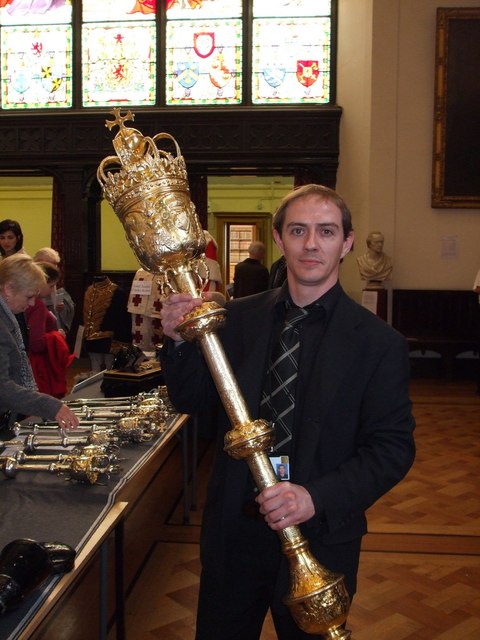
Specifically I'm thinking of the maces used ceremonially in the UK - ranging from the ones used in parliament to this one on the right that a macebearer carries whenever the Mayor makes an appearance in my home town.
I read that the mace bearers originally were a kind of bodyguard, before it shifted towards the more ornamental maces we see today.
Naturally and childishly I've been wondering when the last time someone got hit with one of those maces was. Obviously nobody's going to charge into battle wielding something like this, but, for example, has a Mayor been attacked and had a mace-bearer come to his aid by clubbing down the assailant?
Similarly, I read that there have been a few cases of ceremonial maces being thrown to the ground (or even through a window) to express outrage - has anyone ever gone a step further and clobbered someone with thirty pounds of oak and gold when things got too heated in parliament?
If this turns out to be more common than I realised, I'd also be morbidly curious about the narrower question of the last time someone was fatally struck by such a mace.
1 Answers 2016-01-02
Pretty self explanatory title. Looking over the list of British PMs it was very common for their time in office to last two years or less in many cases. Then when you hit Thatcher that seemed to change and now modern PMs seem to last many more years than in the past. Was there some structural change in the UK parliament that led to this?
2 Answers 2016-01-02
1 Answers 2016-01-02