1 Answers 2015-04-20
I remember that my teacher in history and philosophy at high school once told the class a story about a monk being able to read without spelling out the words with his mouth, and that people travelled to watch him read, and that he got tested on multiple occasions to see if he faked it or not.
I can understand that with no uniformed way of writing, and differences in style can make it really hard to read, and that it may help to spell out the letters and words as they are read. But writing had been a part of history for many thousands of years (no writing, no written history), surely it couldn't be that rare, impressive and unspoken of that someone was able to read silently?
Bonus question: When did it become the norm to read silently?
3 Answers 2015-04-20
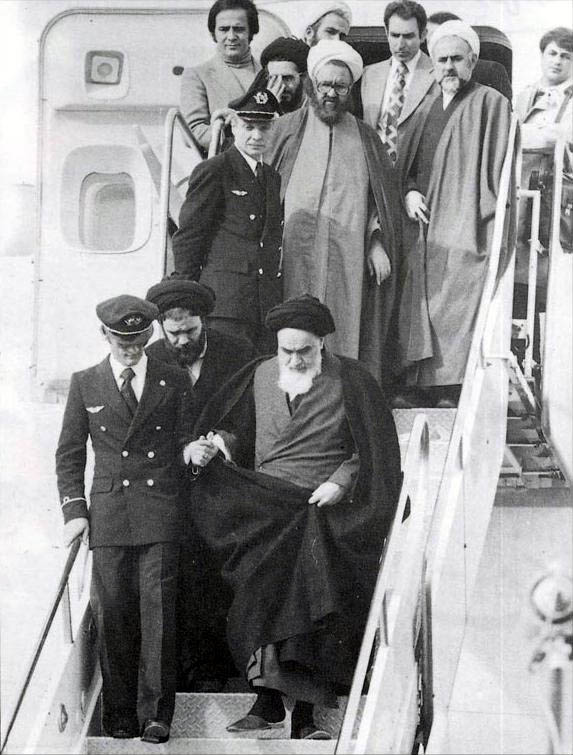
In this famous image, we see Khomeini returning to Iran during the revolution.
Who were the other people behind him? I'm having difficulty trying to identify exactly who they are.
Thanks!
1 Answers 2015-04-20
I've always been interested in the tumultuous philosophical/political movements in the late 19th century and early 20th century. In particular I'm thinking of the time period pre World War 2. Were any aspects of the anarchist movement successful? How prominent was the movement? How much of a threat was the anarchist movement to the US (government, industry, etc.)? How did anarchism align with other movements of the time (labor, Marxism, suffrage, civil rights, etc.)? What were watershed moments in the movement (labor unrest, international conflict)?
1 Answers 2015-04-20
That part of the Bible always bugged me.
So, several accounts on the gospels accounts that crucified Jesus says, in Aramean, "Eli, Eli, lema sabachthani?" ("My God, my God, why have you forsaken me?").
Matthew adds that the people watching misunderstand him, and think he is calling the prophet Elijah, and make fun of him for this.
Why on earth would this happen? Since Jesus always was preaching in Aramean, I thought everybody spoke that language... Wasn't it the case?
5 Answers 2015-04-20
I've always pondered this, as people often take the Middle Ages still as a dark time, where most to everything was cut off to a given degree. I realize now that to some extent, this is wrong, but it makes me question if the medicine at the time was still good. This is because I'm under the guise that until Germ Theory, survival chances from anything such is surgery in time of war: Things kind of died and mostly from infections contracted.
2 Answers 2015-04-20
1 Answers 2015-04-20
1 Answers 2015-04-20
I know that he lost his nephew Roland in Spain when they were leaving(retreating?) But what else happened while they were there? And why?
1 Answers 2015-04-20
Wasn't sure if this is the ideal place to post this but I'm sure you guys will know.
Was watching UFC last week and one of the fighters was from Ukraine. When all her stats appeared on the screen they appeared with a blue and orange flag (instead of yellow). I've never seen that before. Was it a mistake or is there something to it?
1 Answers 2015-04-20
We're five days away from the 100 year anniversary of the landing at Gallipoli.
So I thought I'd ask. Just how significant was the Aussie contribution at Gallipoli and on the Western Front?
3 Answers 2015-04-20
The Green Sahara or Neolithic Subpluvial was a period of greater rain in the Sahara region. The Sahara region was greener and capable of supporting much more life, including humans. That period lasted from 7500-7000 BCE to 3500-3000 BCE. Ancient Egypt can be said to get its start around 3150 BCE. Could the drying Sahara have pushed people into the Nile Valley and somehow spurred that civilization?
1 Answers 2015-04-20
I understand that under Augustus' rule he worked tirelessly to stabilize the the former client kingdoms and provinces of Rome after the civil war, but what is the meaning behind "the empire without end"? I mean the Romans knew of other civilizations and empires outside of their own (i.e. Parthia).
1 Answers 2015-04-20
I am looking for as much information about the wild west and the old west. i dont trust wikipedia much and it also doesnt contain much info about specifics. some question i am trying to find info on:
2 Answers 2015-04-20
1 Answers 2015-04-20
2 Answers 2015-04-20
1 Answers 2015-04-20
I always wondered why Brazil stayed whole while the Spanish land became separated after there independence was declared. Thank you to anyone who can answer this question.
1 Answers 2015-04-20
Hey guys, I know this is probably not the best place to ask but I am a little stuck after finding very little looking through a few university libraries. I'm looking for books or good articles on the effects of the breakup of Austria-Hungary and the subsequent breakups of Austria and Hungary, but in particular the Treaty of Trianon. Unfortunately its a very political and very touchy subject in Hungary so it is hard to find unbiased sources and everything I have found so far basically portrays the treaty as the worst thing in the world and completely unfair, (and having lived in Budapest for a little, I've heard the same thing in the news and from many people (though the opposing side seems to just be self-defeatist saying "we deserved it")), but I'm sure there is more to the argument.
Basically, I'd love to learn more about how the redrawing of these borders affected the region, both in stifling it economically compared to the larger, more stable western nations, and leading to the wars (Hungary joining Nazi Germany as a rejection of Trianon, Czechoslovakia eventually breaking up, the disaster of Yugoslavia, etc). Any help would be much appreciated, Thanks!
1 Answers 2015-04-20
Sorry, I have literally 0 knowledge on the issue but I saw on Wikipedia that Pol Pot was a fan of a broadcast called "Voice of America", and knowing he was quite the despotic dictator I was wondering, was he another one of America's numerous questionable allies? And does anyone know why America would condone an allied relationship with him? (Assuming they knew what he was doing, because if they did not then I would understand)
2 Answers 2015-04-20
I'm wondering if a great evil like the Holocaust was able to materialize because it happened by dribs and drabs. I read somewhere that a woman who had been freed from a camp applied for asylum as a 'political prisoner' because no one really had a full grasp of what had happened, or called it the Holocaust, until years later. This made me wonder whether those who carried it out also didn't really have a grasp on what was happening or how it would end. If Hitler had just carried out his military campaigns and there had been no death camps, would that have changed the course of the war?
1 Answers 2015-04-20
I understand that the culture in Japan was extremely passionate about winning the war and keeping a Pacific empire. The people of Japan, as I understand, were armed to the teeth and many were very angry about the outcome of the war. Did the Japanese people attempt to stop the occupation? Was it dangerous for American soldiers?
1 Answers 2015-04-20
1 Answers 2015-04-20