While reading "Epic of New York City" I came across a throwaway line that Gomez, one of the first explorers to view New York, was a "Negro". For a commander of an important exploration vessel in the 1600s, that's a pretty big deal. I've found no other references to his race one way or the other, and the one google image I found was pretty inconclusive thanks to the beard...
1 Answers 2014-12-08
1 Answers 2014-12-08
Sorry if the title is worded poorly, but I've recently seen that works like Preacher, American Horror Story, and many others depict the Creole culture to be creepy and supernatural. I just want to know what happened through history that made the media depict it that way.
1 Answers 2014-12-08
2 Answers 2014-12-08
1 Answers 2014-12-08
That's pretty much it. I realize this might not be the best subreddit, but I've tried in a number of more bible-related places and haven't had much luck.
The Bible itself doesn't say. I'm hoping for some outside source (even if that source is well-reasoned speculation).
1 Answers 2014-12-08
Basically, is there any clear historic evidence of Frederick II's influence on Napoleon's tactics and strategy?
2 Answers 2014-12-08
This is a question regarding the actual use of lances as a battlefield weapon. I know that there are a lot of misconceptions due to the popularity of jousting, but I am interested in the actual battlefield use of the lance as opposed to a sporting tool. To narrow down the time and location let's say 14th century France.
The word "tilt" has an association with jousting, meaning, IIRC, an individual "pass" between two combatants in a joust. "Tilt" also describes the mechanical action of lowering a 3+ meter long wooden pole from a vertical resting position.
My question is, how essential was this "tilting" action? I saw a video several months ago (that I cannot find for the life of me) where modern jousters talk about timing the drop of the lance as being absolutely necessary to achieve maximum force. Trying to hold a lance level aiming at a target while on a charging horse is a difficult task. The idea behind the "tilt" is that by only lowering your lance in the final moments before impact you can hit your target with more accuracy, more force, and with less stress on your arm. The final effect is not unlike hitting a baseball with a bat, except the arc of swing is vertical instead of horizontal.
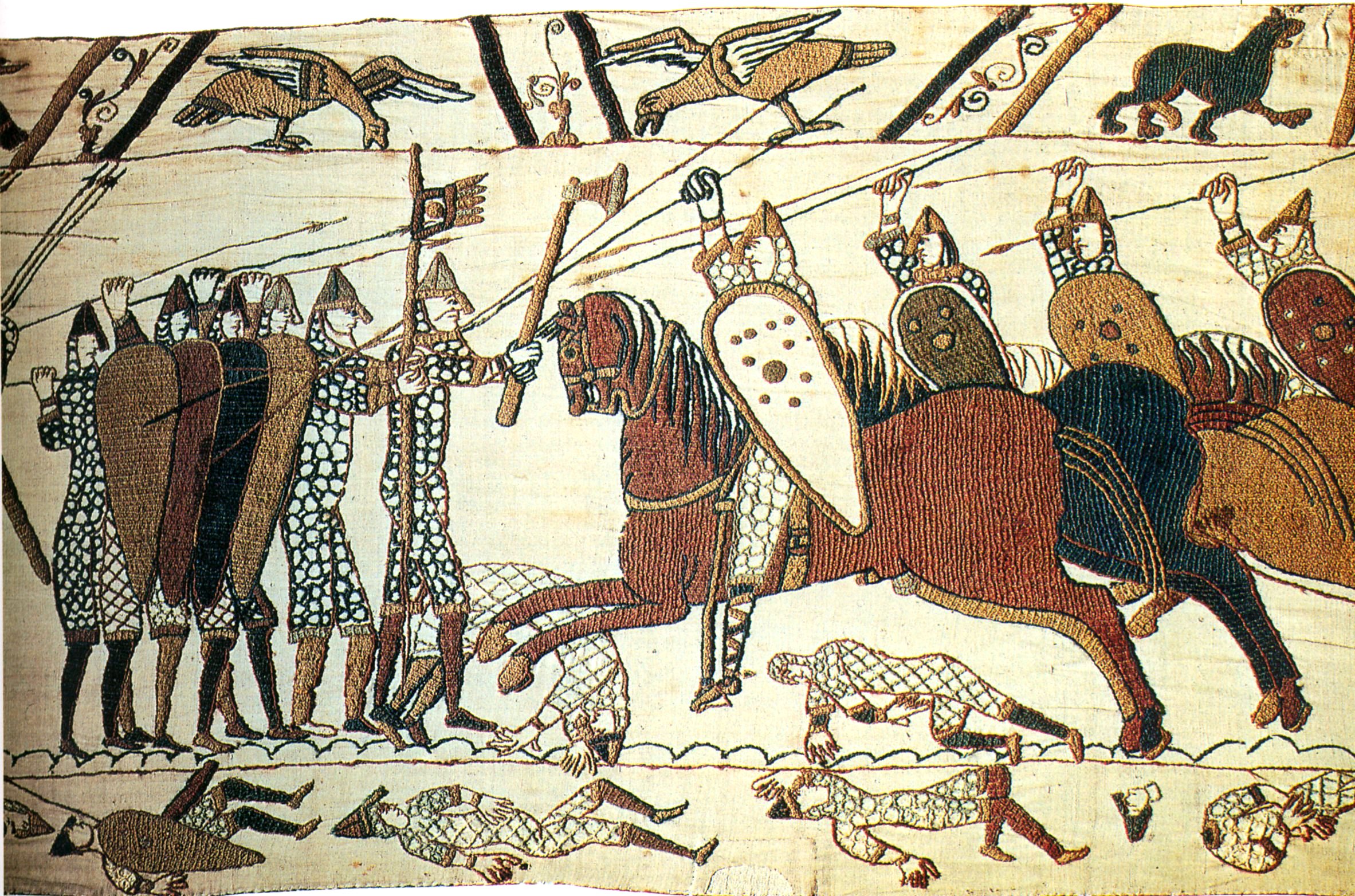
I suspect there is some truth to this due to sheer physics, but I hesitate because of confusion surrounding the joust as sport. This tactic makes sense with a very heavy, specialized jousting lance designed for the tournament. But were lances used in war in the 14th century as heavy as 16th century sport lances? The Bayeux Tapestry shows lightweight lances being used overhand. Renaissance paintings like this one show heavier lances.
Is there any basis to this explanation for the "tilt"? How was a lance really used in battle?
3 Answers 2014-12-08
1 Answers 2014-12-08
1 Answers 2014-12-08
4 Answers 2014-12-08
I recently read a comic book about Dracula that was more inspired by the life of Vlad the Impaler than the actual Stoker book. I wanted to learn more about the historical figure and the war between Wallachia and the Turks. Can anyone recommend a good book about the actual man?
1 Answers 2014-12-08
I'm having a hard time finding a definitive number of vessels sunk. Also, how many still rest at the bottom? Have any been risen?
1 Answers 2014-12-08
3 Answers 2014-12-08
As the title asks, did other civilizations write/tell post apocalyptic stories, or is it more of a modern creation?
1 Answers 2014-12-08
In most depictions of the legendary Golem of Prague, there is a large crack on his chest, covered with a metal band. I've spent hours searching, and I've found nothing, aside from the scroll of life being inserted into it's head. What is the reason/origin of this part of the legend?
1 Answers 2014-12-08
Hey everybody, and welcome to the eighth week of our newest feature. As ever, we have a specific initial prompt aimed at stimulating responses and discussion. This week's is the following.
When is something a gift, when is it a tax, and when is it tribute?
These terms are all used fairly frequently by historians to refer to various relationships/exchanges throughout human history. But it is not necessarily easy to actually distinguish how and when these terms should be applied. So this is everybody's chance to grapple with the topic, and see whether or not decent headway can be made at actually reaching some common ground.
It's quite likely that not only will historians with different periods and places of interests differ in their conclusions, but also that you will find historians, anthropologists, and archaeologists all coming to (at least slightly) different conclusions as well. If this is the case, then you should probably be prepared to explain your thought process in a way whereby specialists with different backgrounds are able to understand your reasoning.
Here are the upcoming (and previous) questions, and next week's question is this: How do you draw up the limitations to your expertise?
3 Answers 2014-12-08
There's significant religious tension between Muslims and Christians during this period. But considering the rise of universities in Europe at a time when Islam was home to most advanced centers of learning, (i.e. Baghdad, Antioch, etc.) to what extent did they collaborate academically or scientifically, putting religious differences aside?
1 Answers 2014-12-08
Whether its an amazing general overview or one captivating perspective that is part of a whole, what are some good books if I want to learn about the Khan?
1 Answers 2014-12-08
2 Answers 2014-12-08
I've been watching the Yale Early Middle Ages courses on Youtube; at one point, Professor Freedman mentions a story in connection with (by?) a Saint Antoninus of Noricum, about a Roman army emissary going to collect pay from the empire only to find that the empire no longer existed. Could anyone identify the source of this?
Not sure if links are OK, but it's here.
edit: typo.
1 Answers 2014-12-08
1 Answers 2014-12-08
As someone who grew up in America, the idea of learning about a war in which people who may have been your parents or grandparents were horribly defeated, your homeland destroyed, government forcibly abolished, and leaders publicly tried and put to death seems utterly foreign to me. Not saying America is the best, but really the only thing I have that's close to that feeling is the Korean and Vietnam (and of course now Iraq and Afghanistan) Wars but none of those were on American soil and didn't come anywhere close to affecting the US the way WWII affected post-war Germany and Japan.
How did Germans and Japanese renounce the ideals that many of their family members (and themselves) held so fervently? To me it seems like a similar question to the classic "What happened to the ethnic Romans?" - as in, when did the people who were conquered stop being Nazis (or the aggressively Imperialist Japanese?) and start being Germans and members of the State of Japan. It seems plausible now to say, "That was 70 years ago and thus a totally different population," but the gradual process of getting there seems hard to follow.
Sorry for the long question, just always so curious to hear about how my upbringing has affected/not affected my view on the world so I can better understand others.
And I couldn't sleep last night so... :)
Edit: I guess my question wasn't meant to focus specifically on schools as much as just discussions and everyday conversation (maybe between grandparents or parents and young kids being told about the world).
I know much of my historical knowledge does not come from school or books (though a lot does) but from people using historical context as arguments or examples in broader conversations. The question more is, how are these events, particularly the horrific ones, described and discussed in everyday life.
Edit2: I would also love to hear a lot about Japan. Maybe it's just because I know much less about their history, but the lines seem much more blurred there for a few reasons:
1: a much larger percentage of the population (I am assuming based on basic knowledge of Japanese so-called "Honor Culture" and the incredible stories of whole families committing suicide rather than be captured - from another AskHistorians thread) agreed wholeheartedly with the cause.
2: The horrific events were far less obscene (wrong word but you get the idea) than those of Nazi Germany. Yes, there were horrific warcrimes like the Rape of Nanking but mass killing and rape in the wake of conquest has been a wartime tradition of thousands of years. Incredible, systematic mass-extermination of civilians in non-battle zones like the Holocaust has no parallel in history and is probably thus easier to throw away as completely unjustifiable (as in "it was just those insane people who did that," I hope I'm explaining this well).
3: The country itself did not entirely cease to exist the way Germany did. German's (and probably as importantly, the rest of the world) have a natural demarcation line in the 40 years of disunion and crushing communist rule between the horrible, antagonistic Nazi Germany, and the world super-power and important western ally of Modern Germany. Thus, I can almost forget that they are the same country. This is not the case with Japan, it had to happen gradually.
Probably huge oversimplifications but hopefully I qualified my stupidity enough to make it okay :)
7 Answers 2014-12-08