I'm going to run a tabletop RPG campaign based in the 1540s and I want to make it as historically accurate (except for the addition of magic) as I possibly can. Another friend recently ran a similar one in 1920 and we had to retcon half the session because he added several historical inaccuracies so the players argued he was making things up to artificially increase difficulty. I want to know enough to avoid ruining immersion and to keep my setting somewhat historically accurate
2 Answers 2016-01-22
My grandfather served in an Acorn unit in WW2, which were US navy units that landed with Marines, set up airfields, and then guarded and operated those airfields in the Pacific. I've been trying for quite a while to find information about them, but it seems to be scant online. For example, they are mentioned in the Wikipedia page on Argus units (which I gather performed flight control on Pacific airfields), but there is no such page on Acorn units themselves. Is anyone here familiar with them, and can anyone recommend any books or other sources about their activities in the war?
2 Answers 2016-01-22
Fiddler on the roof is a musical made in 1971. but it is set on 1905 in Russia, they use the line "May you come to be In Israel a shining name" when doing the Sabbath prayers.
Did the writers were referring to the state of Israel? or where they referring to something else?
Israel was founded in 1948, so in 1905 there was no state of Israel as we know it, but when they say Israel in the context of the movie were they referring to the same place?
As an additional question, was it common for Jewish people to refer to Israel before the state was formed? how likely would it have been for me to hear Jews talking about Israel in the early 1900s?
The full prayer they sing
"May the Lord protect and defend you.
May He always shield you from shame.
May you come to be In Israel a shining name.
May you be like Ruth and like Esther.
May you be deserving of praise.
Strengthen them, Oh Lord,And keep them from the strangers' ways.
May God bless you and grant you long lives.
May the Lord fulfill our Sabbath prayer for you.
May God make you good mothers and wives.
May He send you husbands who will care for you.
May the Lord protect and defend you.
May the Lord preserve you from pain.
Favor them, Oh Lord, with happiness and peace.
Oh, hear our Sabbath prayer. Amen"
2 Answers 2016-01-22
What are the unique factors that led the British colonists who settled New Zealand to adopt the customs of / integrate with the native Maori to a far greater extent than (it would seem to an untrained layman such as myself) other European colonists in other places did?
1 Answers 2016-01-22
From my understanding life as a serf in Imperial Russia was sorta shit, being sort of close to chattel slavery in many ways. So I was wondering if joining the Russian army was an upgrade in life quality at all? Was it a small step up the social ladder? Was the notoriously draconian life of the Russian army any worse than life as a serf? (when you weren't in battle that is)
1 Answers 2016-01-22
I have been reading about the political philosophy contemporary to the writing of the Constitution and Declaration of Independence, and have noticed a lot of references to Roman philosophers and politicians, like Cato and Cicero. Many of these sources claim that there is a lot of commonality between the Republic's philosophy and the Founders'.
The Founders seem to have a relatively well-defined political philosophy, e.g., in terms of the State deriving its authority from the people, or in terms of liberties and rights.
Did the Roman Republic have a similarly well-defined political philosophy? Were their thoughts on government tyranny, liberty, and the source of government authority really that similar to those of the Founders?
Are there any good references on the subject? I've tried looking through Amazon, but without knowing exactly what I'm looking for it is hard to find something.
2 Answers 2016-01-22
I know it was socially acceptable at the time for the men to be with little boys, but how was Sporus allowed to be Nero's actual "wife" when the marriage couldn't have given him any heirs? Couldn't he have married a woman and kept Sporus on the side?
3 Answers 2016-01-22
2 Answers 2016-01-22
Why did ancient humans live in places like Scandinavia or anywhere with harsh winters where it was harder for them to survive?
2 Answers 2016-01-22
Thinking about the use of this common trope in popular culture, I wondered how it originated, if it is somewhat historically reliable. Were mechanical traps such as arrows or sliding doors used to protect ancient temples against looters?
1 Answers 2016-01-22
Im aware that different *-archys have different rules for succession, but assuming the case in general for europe during the medieval era.
1 Answers 2016-01-21
Aside from maybe, just wanting to conquer land, did he have any specific reasons? And what kind of justification, if any, did he give for these actions?
1 Answers 2016-01-21
2 Answers 2016-01-21
I know he was Spanish and left because of a war, almost definitely the Spanish Civil War. He was anti war, which is why he left. I believe he was from Castile. He smuggled himself out of the country on some form of a Cargo Ship and headed to New York. His name was Francisco Perez, don't know a Middle Name. I believed he might be from a Nationalist Controlled Region, as he smuggled himself despite the British Blockade, so a Nationalist Port of Origin might make more sense. I do not expect a direct answer, but I would like clues on what to search on. What ports might have he left from? Is it possible he was from a Republican Region and just bribed his way past Nationalist Authorities? The US accepted him after he arrived. Could this be an indication of where the ship took off from? Since the US was somewhat unofficially somewhat friendly towards the Republicans, would this imply he was from a Republican town? Is there subreddit or other website that could help? Thank you so much!
1 Answers 2016-01-21
Just in case the question was too poorly worded, I meant to ask if there were any other civilizations that focused on improving one's physical strength and combat ability to the same extreme that Sparta did. I.E. killing off babies from birth after being deemed "too weak".
1 Answers 2016-01-21
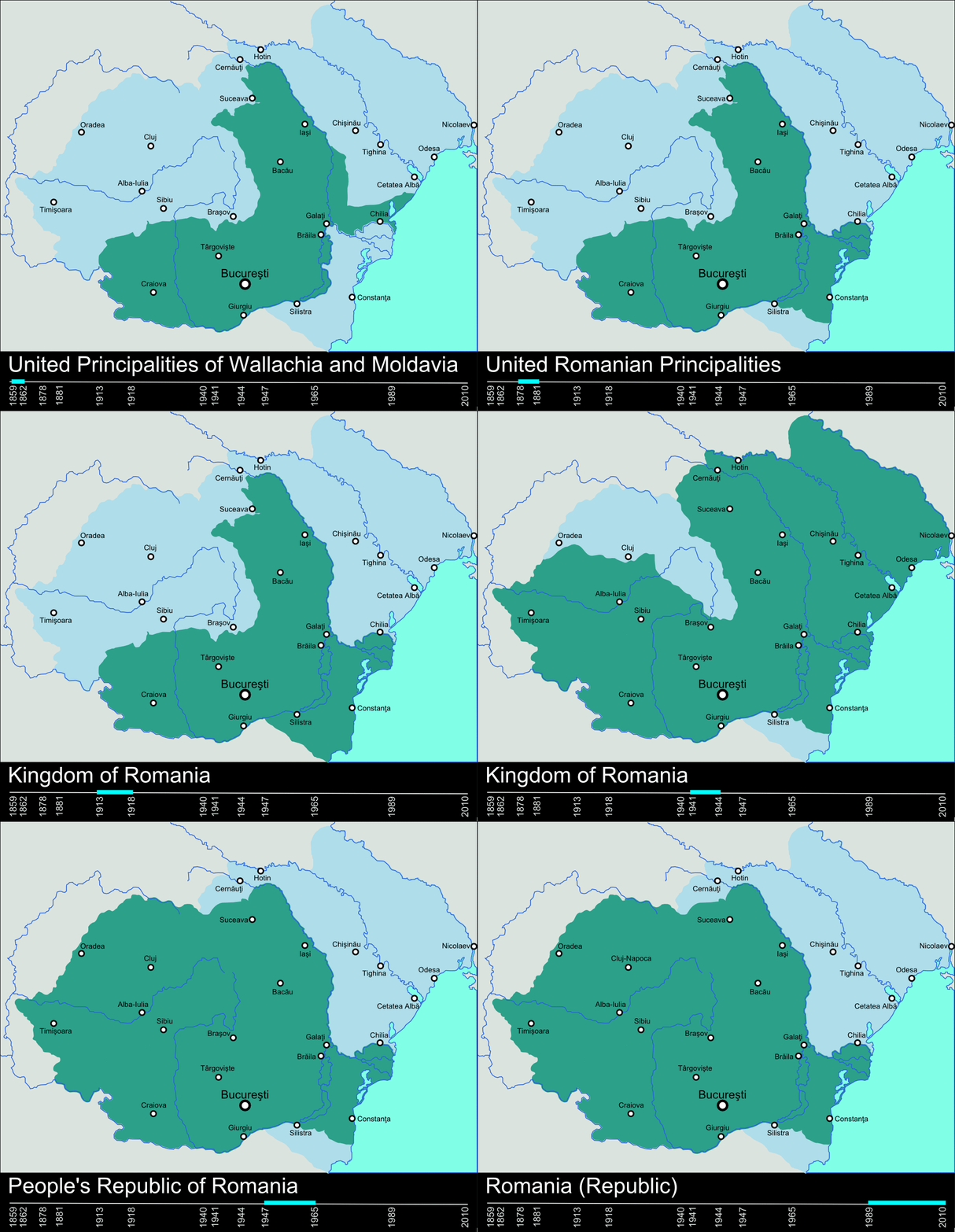
For reference, Romania's territorial evolution can be seen in this GIF.
1 Answers 2016-01-21
I guess the question is self explanatory.
Also, any info on the Sea Peoples in general would be awesome. I just started hearing about them and I'm fascinated to get my hands on anything you guys recommend that might be good reading.
1 Answers 2016-01-21
1 Answers 2016-01-21
I googled a bit, i found some mystic websites without much clarification such as this: http://www.ancient-code.com/third-eye-in-the-ancient-americas/ and Wikipedia only mentions Asia continent. Actually if you know any other source of such statues from Mesopotamia or ancient Africa, it would be interesting to read too. I find that shape very interesting. Thanks in advance
1 Answers 2016-01-21
I'm a fantasy writer, and while I'm not trying too hard to be realistic about the setting, knowing history is never a bad thing. For the world I'm currently working on, dragons aren't particularly intelligent or anything, they're just large predatory animals.
I wanted to draw from real methods of bringing down large dangerous animals in figuring out how they would be hunted, though naturally it'll have to diverge a bit from that. A basis is always good, though.
For tech-level reference, the earliest guns have been invented in this world, but they haven't yet reached the country in which I'm telling stories.
1 Answers 2016-01-21