There was the French and Polish underground resistance movements that continued for years after the original countries were vanquished; how come there didn't seem to be any Nazi resistance movements against the Allied occupiers?
1 Answers 2015-02-03
When (and where) did people start using the week system like we have it today, and did people always have the weekends off? Its a question that has been on my mind for a really long time and google hasn't given me an answer.
1 Answers 2015-02-03
I have a few, hope you don't mind.
Is Prussia a current state of Germany, like Maryland or Pennsylvania in the US?
What was the transition from Prussia to Germany? When did this happen?
If Prussia is just a state of Germany, is it the most powerful, considering its location and cities? (Kind of like how New York would be considered more powerful than, say, Delaware.)
Sorry if the language confuses you. I don't really know how to ask these questions.
1 Answers 2015-02-03
I was recently in an interesting discussion over whether the church should accept homosexuals into their congregation and the Bible was quoted many times. So the question came to my mind of whether the Bible even speaks to the topic of homosexuality and whether or not it even existed at the time of the Bible's writing.
2 Answers 2015-02-03
I've done a tiny bit of reading on the fall of Mussolini, but I can't quite wrap my head around the details of exactly what happened during his meeting with The Grand Council of Fascism. I know that this council (which Mussolini viewed as advisers more than anything else) voted to remove him from power.
That said, I don't really understand how the coup happened. Did the Council always have the power to depose him? Or were they just admitting that they had no confidence in Benito's leadership? Finally, weren't the council afraid of Mussolini? Didn't Il Duce have the power to get rid of the members that opposed him?
In short, can anyone give me some background information on the events of "25 Luglio" and the Grand Council of Fascism?
1 Answers 2015-02-03
1 Answers 2015-02-03
https://i.imgur.com/8YlObNZ.jpg
Supposedly he was in the Italian Army, and this painting is from the late 1800s, but I don't even know if any of that story is true. Does anyone know anything about this uniform? Is this even an Italian Army uniform? I'd love some input or advice.
1 Answers 2015-02-03
I come from Morocco. I saw a post from an American friend on Facebook about Black History Month and how black people "made significant contributions to European development in the 15th and 16th centuries. You should read that article about the Moors"
I was a bit amazed. To my understanding, the invasion of the Iberian peninsula were the results of Berberes (mostly) and Arabs. Sure more diversity might have been mixed, but to assume Moors were black and fit to be studied during Black History Month seems far fetched to me.
I thought that if the Moors were very dark skinned in european paintings it's because painters are usually not historically accurate and wanted to paint exotic looking characters.
Am I in the wrong or are Moors fit to be studied during Black History Month ?
PS: friend refered to websites such as this. They don't look like websites written by Historians, and are seriously lacking nuance
1 Answers 2015-02-03
Sorry if this has been asked but I haven't seen the question asked here before that I know of.
3 Answers 2015-02-03
If so, why? Is it so the Nazi soliders were sent into battle by inexperienced leaders? And did this have any affect on the war?
2 Answers 2015-02-03
1 Answers 2015-02-03
1 Answers 2015-02-03
Any help would be greatly appreciated!
Front - http://imgur.com/gBUTMus
Back - http://imgur.com/PJp6tJA
1 Answers 2015-02-03
1 Answers 2015-02-03
1 Answers 2015-02-03
Hi guys. Quick question. I'm helping a friend put together a lecture on Catiline and obviously the Porcian laws are a big deal. My friend pointed me to the wikipedia page for the Porcian laws where we found this text:
This [the first] Porcian law of 190's BC stated that a citizen of Rome could escape death by voluntary exile. The third Porcian law extended the right of protection and appeal for the Roman citizen outside Roman city limits and throughout the military districts. This is indicated by numismatic evidence in the form of a Roman coin that was minted in 104 BC or thereabouts.
I researched these laws about ten years ago as the intended topic of my MA thesis - that didn't go anywhere (I wrote on Roman headhunting instead), but I'm pretty sure I'm right in remembering that we don't actually know the content of these laws. Am I mistaken on that point? And what is this coin of 104 BCE? I searched the ANS database for it but the description is so vague... nothing noticeably relevant popped up.
1 Answers 2015-02-02
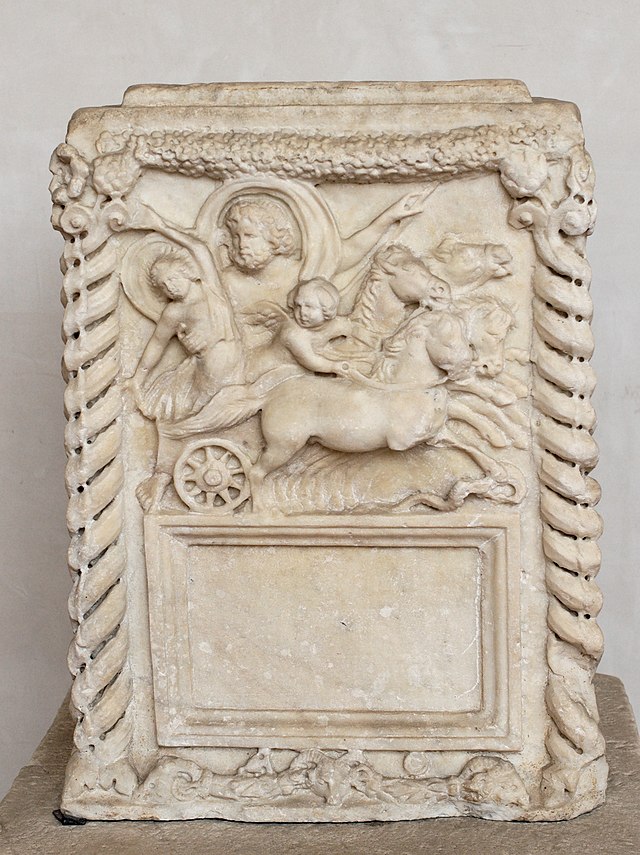
I just found this image of a second century Roman cinerary altar depicting the rape of Proserpina, and I noticed the chariot wheel has 9 spokes.
This strikes me as really odd. Is there a reason for such a seemingly weird number of spokes? Is it a mistake? Does it mean something? Did 9-spoked wheels actually exist? (They seem heavy...)
1 Answers 2015-02-02
It seems to me that there were a great deal of conflicts involving major world powers fighting in intercontinental theaters so why is WW1 considered the first? Shouldn't that title go to, say, the Seven Years war, the French Revolutionary wars or War of Austrian Succession?
1 Answers 2015-02-02
1 Answers 2015-02-02
1 Answers 2015-02-02
2 Answers 2015-02-02
I was at a anthropology workshop today and the facilitator brought up that Jesus was a title passed down to each leader of a Jewish revolt against the Romans. I had never heard this before and it sounds fishy to me. Does it hold any water? He also mentioned that Islam was created as a response to Roman (Byzantine?) Christian invasion. This sounds even crazier. Does it have any merit?
2 Answers 2015-02-02