Is this something that gets lost in translation? The version I read came with the original Latin on the other side, and in it, Trajan uses mi Secunde carissime, which translates to much the same thing if my four years of high school Latin serves me correctly.
Was there a deeper meaning to this form of address? Was it casual, in the way that we in the modern day might begin letters with "Dear so-and-so?" Did Trajan refer to all of his higher-ranking servants this way?
1 Answers 2014-12-21
1 Answers 2014-12-21
There was an interesting Imgur post about a number of historical battles, and one of the mentioned was the Battle of Mikatagahara. In the battle a ninja named Hattori Hanzō attacked in the dead of night and threw the enemy's vanguard into disarray. Upon reading further about Hanzō, though, it seems he is also regarded as being a samurai.
So here's my question:
Didn't samurai have a strict code of honor that a ninja's actions (like a sneak attack at night) would go against, thus preventing Hattori Hanzō from being both?
1 Answers 2014-12-21
3 Answers 2014-12-21
Question says it all.
1 Answers 2014-12-21
3 Answers 2014-12-21
Thinking of the classic image of an angel, it seems a lot of artists from the Renaissance era depicted Angels as babies, sometimes equipped with wings. The word 'cherubic' came to mean babylike or soft and rounded.
When did this image appear, and why? It is obviously a far cry from the description of Angels in Biblical texts (golden skin, burning swords) and does little to portray the power they were written to have.
1 Answers 2014-12-21
Family argument.
Anyone more knowledgable able to comment?
1 Answers 2014-12-21
1 Answers 2014-12-21
Germany is a rather small country compared to the allied countries grouped together. How come they were so successful during WWII?
1 Answers 2014-12-21
What caused the divergent development in this regards?
1 Answers 2014-12-21
I'm talking really only about pre-Partition, and primarily pre-Mongol Invasion.
Islam has always had negative views towards Zoroastrianism. It's strange, because it's a monotheistic religion that influenced Judaism, but Muslims seemed to like Romans much more than Persians. I thought that views towards it would get more favorable throughout history, but I read that it only got worse. Did anyone have positive views towards them?
Despite the persecution of Zoroastrians, so much of Islamic culture came from Persians. Some of the greatest philosophers, like Ibn Sina, Al-Ghazzali, and Al-Biruni, were Persian. Many of the Classical Islamic scientists were Persian. One of the greatest works of Islamic literature (the Shahnameh) is Persian, and uses many things from Pre-Islamic Persia). Some of the greatest Islamic poets, like Hafez and Rumi, are Persian. I read that the Persian dastgah influenced Arabic classical music. Most pre-modern Islamic painting I found is Persian (why does it look so Chinese by the way? Is it because it all is post 13th-century, and has Mongol influence?). Persians even have a colorful, unique theological branch in Islam (Ismailism), though I guess that is not well-received by Arabs.
It seems like a lot of what we think of as Classical Islamic culture comes from Persians, yet Muslims persecuted Zoroastrians. What explains this discrepancy? Did they really influence all of the Islamic world, or is it that they remained in their Persian sphere, and we just know a lot about them (which would mean the Sunni/Arab world remained uninfluenced)? Why did Arabs seem to take the backseat in Islamic cultural history to the Persians and Turks?
4 Answers 2014-12-21
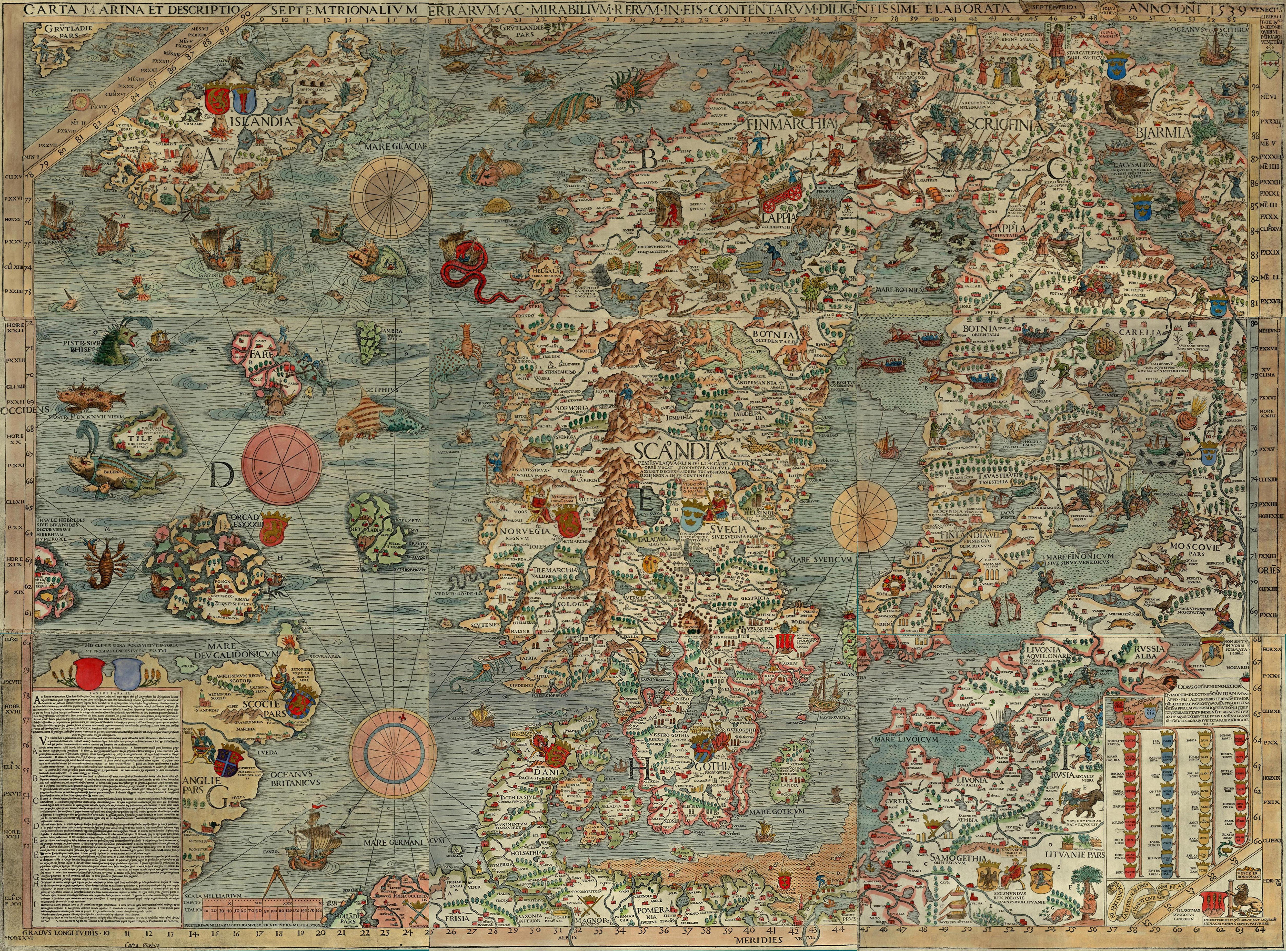
Or were they just put there as decorations?
Link to the map: http://upload.wikimedia.org/wikipedia/commons/e/ea/Carta_Marina.jpeg
3 Answers 2014-12-21
1 Answers 2014-12-21
I have read that later Mayan writing is gibberish and that these later scribes were imitating their predecessors but did not know what the symbols meant. Can anybody explain this phenomenon? Why did these scribes write gibberish if it is indeed gibberish, and how do we know it is not in fact another language?
2 Answers 2014-12-21
Maybe it's just how the high school curriculum is, but the Greek, Roman, Babylonian, Persian... empires were all in the similar area. Why?
1 Answers 2014-12-21
I've seen some say Joseph Henry, others Michael Faraday and others still Francesco Zantedeschi.
1 Answers 2014-12-21
1 Answers 2014-12-21
1 Answers 2014-12-21
I'm not sure if this is just a local phenomenon, but all wall clocks with Roman numerals in South Africa and Namibia seem to use IIII instead of IV as the symbol for 4.
1 Answers 2014-12-21
Edit: how did they prevent it how did they treat it. Are there any records of skin cancer?
1 Answers 2014-12-21
Recently, I watched this video, which claimed that a large and sudden flood filled the Black Sea to its current level, and may have inspired the Noah's Ark flood story (and presumably other flood myths). If this were to be true, it would be thousands of years between the flood itself and when the Noah's Ark story was written down.
Although I'm doubtful that a Black Sea deluge was responsible for the world's flood myths, it got me thinking. If a major event took place before the advent of writing, how long could word of it be passed down? I assume that there'd be a point that a story is either lost or distorted to the point that it seems unrelated to the original event, but I don't know how long that would take. Are there any examples of prehistoric events being passed down in the form of stories and myths over a long period of time?
1 Answers 2014-12-21