I'm sorry if this is against the rules, as it is not exactly a question on history. However, I am desperate to find this video. My recollection of the movie/documentary/news show is vague, but I will tell you what I can.
I saw this in Civics class in the early or mid 1990's - though the video seemed to be filmed way before then. The main part I remember is that they would take children of different races and give them a white doll and a black doll, then ask them which doll they look like. All children said the white doll, even if they were black.
Unfortunately, that's all I remember. However, the film made me cry. No one else in class was affected like I was, and my classmates made fun of me for crying. I remember the video making me feel so sad though - heartbroken.
If anyone can give me the name of this documentary or refer me to a clip from the program, I would be very grateful. It has stayed with me all these years.
1 Answers 2014-12-15
Please answer my brother is dying to know for some strange reason.
1 Answers 2014-12-15
I recently read that there were several million returnees. I'd never really thought of that possibility before.
1 Answers 2014-12-15
1 Answers 2014-12-15
Why or why not? If not, did the Chinese Empire technically end in 1271?
1 Answers 2014-12-15
Other civilizations, both ancient and medieval, were more centrally located in Eurasia and had more contact with their neighbors. How was isolated China able to stay so far ahead of the other world civilizations despite trading with them little? If competition fueled advancement in post-industrial revolution Europe why didn't competition fuel the same advancement in Persia, India, Muslim states, Rome, or Byzantium?
1 Answers 2014-12-15
Hello all, and sorry if this question is offtopic, but it seems that there's no better place to ask it.
I'm looking for best publications related to wars between mentioned sites. They're a gift for someone who's a professional historian (specialised in Roman Republic, Carthage) who's looking to expand his interests in that direction.
I'm looking preferably for sources (I'm aware that there won't be many), archaeological records, and secondary sources in the last place.
1 Answers 2014-12-15
My family has owned land in TX since it was its own country, probably before, as far as we can tell. I never really thought about it until now, but the change from Mexican to American must have had some broader implications for the Spanish/Mexicans already living in the west of what is now the United States. But of course this goes much further than that, in the New World land was being bought up and sold by different countries constantly… but what about your average Joe? How did he deal with the drastic change in government?
1 Answers 2014-12-14
1 Answers 2014-12-14
The Iberian peninsula was occupied by the Visigoths at the time of the Muslim conquest, and they were a Germanic people. Would the 'Spanish' at that time therefore have been Northern European in appearance? Do the Spanish look as they do today because of the Berber conquest?
1 Answers 2014-12-14
I've been reading about him and the claim that "his legend inspired generations of European explorers, traders, settlers etc" caught my attention.
Also second question; Did Muslims or any other peoples have a legend similar to this?
1 Answers 2014-12-14
Just spit balling here... it seems the timing lines up. Was it more that the Airwolf creators recognized the cool factor of this new chopper (the AH-64) and designed a show around the hype or is it at all possible that the Army unofficially nurtured it's creation to encourage pilot recruitment to counter soviet build up of tanks on the borders of Eastern Germany?
1 Answers 2014-12-14
All the governments of Cuba seem to be corrupt or dictatorships, even while the U.S. government set up the small island state for success after they helped overthrow Spanish rule in the late 1800's.
What kind of governments had been in control of the country after the revolution after the fight for independence, and why has Fidel's Castro had such success in his government?
1 Answers 2014-12-14
Was there any kind of training or qualification? Did education and background vary from doctor to doctor? Any information would be appreciated.
1 Answers 2014-12-14
Maybe a weird question, but I've always wondered about this. Periods must have been hell for women in the middle ages and anytime before that.
1 Answers 2014-12-14
Explain how slavery and racism were experienced differently in British North America and the rest of the Americas. How do you account for this difference? HINT: This will have to do with the "One Drop Rule."
question in my history class I need help on!
1 Answers 2014-12-14
I'm reposting this from /r/history, I was invited to repost it here. The site is (condottieri di ventura) [www.condottieridiventura.it] . On the right sidebar of the site you will find the analytical index listing few thousands of biographies. The extended bibliography is listed under the Bibliografia tab. Edit: I just added a (facebook page) [https://www.facebook.com/condottieridiventura], just in case someone is interested to keep in touch with us.
9 Answers 2014-12-14
2 Answers 2014-12-14
The Roman navy is a really fascinating topic that I was hoping to learn more about. Are there any great sources I could check out to learn more? Thanks in advance!
3 Answers 2014-12-14
What is the origins of these people? I've read they have a large percent of African ancestry yet they identify as a Native American tribe. Could this be true and if so what happened to their African heritage? Also why do they not have federal recognition?
1 Answers 2014-12-14
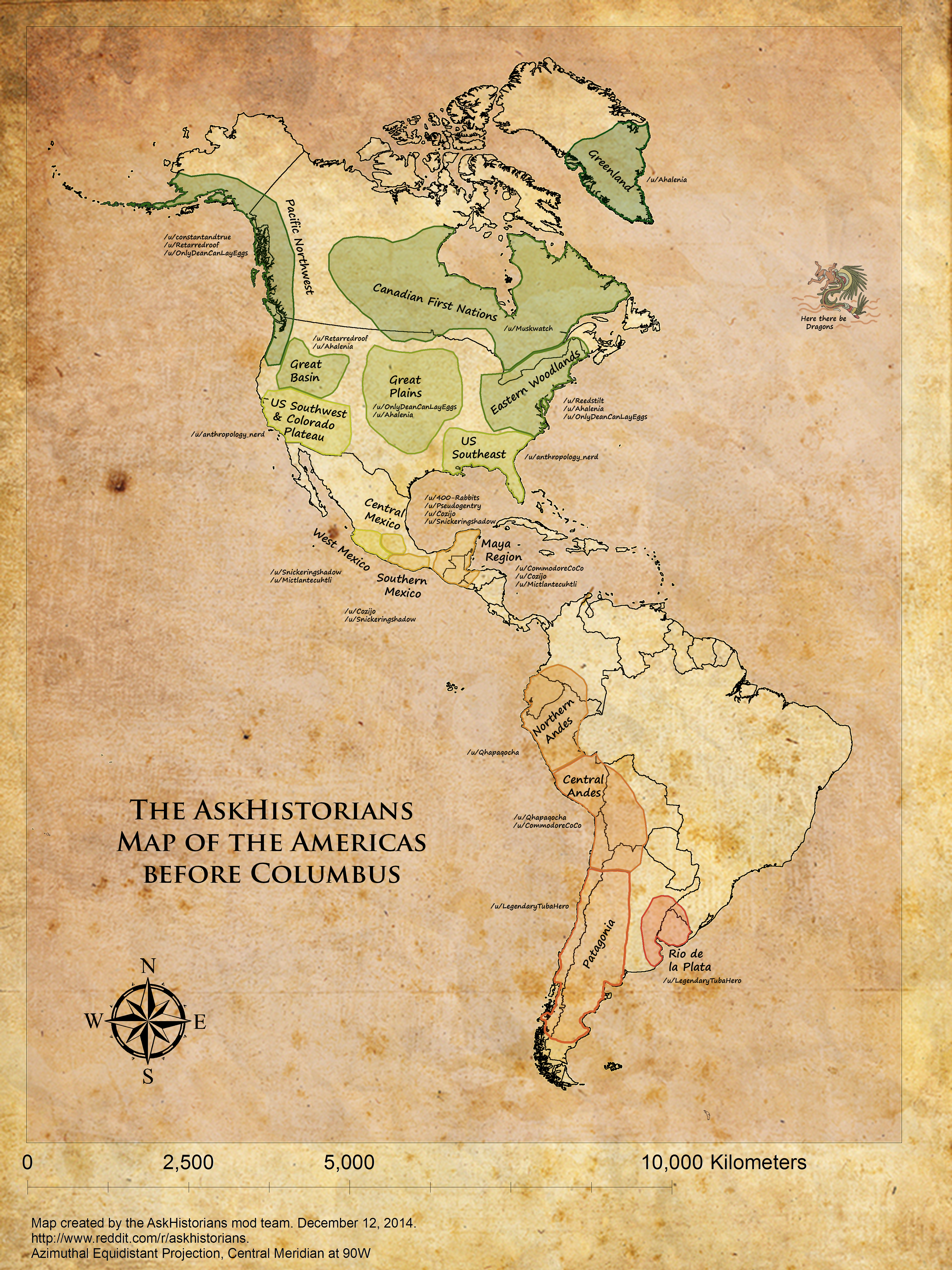
Hello everyone! This has been a long time in planning, but today is the day. We're hosting a massive panel AMA on the Americas before Columbus. If you have a question on any topic relating to the indigenous people of the Americas, up to and including first contact with Europeans, you can post it here. We have a long list of panelists covering almost every geographic region from Patagonia to Alaska.
You can refer to this map to see if your region is covered and by whom.
Here are our panelists:
/u/snickeringhsadow studies Mesoamerican Archaeology, with a background in Oaxaca and Michoacan, especially the Tarascan, Zapotec, Mixtec, and Chatino cultures. He also has a decent amount of knowledge about the Aztecs, and can talk about Mesoamerican metallurgy and indigenous forms of government.
/u/Qhapaqocha studies Andean archaeology, having performed fieldwork in the Cuzco basin of Peru. He is well-aqcuainted with Inca, Wari, Tiwanaku, Moche, Chavin, and various other Andean cultures. Lately he's been poking around Ecuador looking at early urbanism in that region. He can speak especially about cultural astronomy/archaeoastronomy in the region, as well as monumental works in much of the Andes.
/u/anthropology_nerd's primary background is in biological anthropology and the influence of disease in human evolution. Her historical focus revolves around the repercussions of contact in North America, specifically in relation to Native American population dynamics, infectious disease spread, as well as resistance, rebellion, and accommodation.
/u/pseudogentry studies the discovery and conquest of the Triple Alliance, focusing primarily on the ideologies and practicalities concerning indigenous warfare before and during the conquest. He can also discuss the intellectual impact of the discovery of the Americas as well as Aztec society in general
/u/Reedstilt studies the ethnohistory of Eastern Woodlands cultures, primarily around the time of sustained contact with Europeans. He is also knowledgeable about many of the major archaeological traditions in the region, such as the Hopewell and the Mississippians.
/u/CommodoreCoCo studies early Andean societies, with an emphasis on iconography, cultural identity, patterns of domestic architecture, and manipulation of public space in the rise of political power. His research focuses on the Recuay, Chavin, and Tiwanaku cultures, but he is well-read on the Moche, Wari, Chimu, Inca, and early Conquest periods. In addition, CoCo has studied the highland and lowland Maya, and is adept at reading iconography, classic hieroglyphs, and modern K'iche'.
/u/400-Rabbits focuses on the Late Postclassic Supergroup known as the Aztecs, specifically on the Political-Economy of the "Aztec Empire," which was neither Aztec nor an Empire. He is happy to field questions regarding the establishment of the Mexica and their rise to power; the machinations of the Imperial Era; and their eventual downfall, as well as some epilogue of the early Colonial Period. Also, doesn't mind questions about the Olmecs or maize domestication.
/u/constantandtrue studies Pacific Northwest Indigenous history, focusing on cultural heritage and political organization. A Pacific Northwest focus presents challenges to the idea of "pre-Columbian" history, since changes through contact west of the Rockies occur much later than 1492, often indirectly, and direct encounters don't occur for almost another 300 years. Constantandtrue will be happy to answer questions about pre- and early contact histories of PNW Indigenous societies, especially Salishan communities.
/u/Muskwatch is Metis, raised in northern British Columbia who works/has worked doing language documentation and cultural/language revitalization for several languages in western Canada. (Specifically, Algonquian, Tsimshianic, Salish and related languages, as well as Metis, Cree, Nuxalk, Gitksan.) His focus is on languages, the interplay between language, oral-history and political/cultural/religious values, and the meaning, value, and methods of maintaining community and culture.
/u/ahalenia has taught early Native American art history at tribal college, has team-taught other Native American art history classes at a state college. Ahalenia will be able to help on issues of repatriation and cultural sensitivity (i.e. what are items that tribes do not regard as "art" or safe for public viewing and why?), and can also assist with discussions about northern North American Native religions and what is not acceptable to discuss publicly.
/u/Mictlantecuhtli studies Mesoamerican archaeology with a background in Maya studies (undergraduate) and Western Mexico (graduate). He has studied both Classic Nahuatl and Maya hieroglyphics, although he is better adept at Nahuatl. His areas of focus are the shaft tomb and Teuchitlan cultures of the highlands lake region in Jalisco, Nayarit, and Colima. His research interests include architectural energetics, landscape, symbolic, agency, migration, and linguistics.
/u/Legendarytubahero studies colonial and early national Río de la Plata with an emphasis on the frontier, travel writing, and cultural exchange. For this AMA, Lth will field questions on pre-contact indigenous groups in the Río de la Plata and Patagonia, especially the Guaraní, Mapuche, and Tehuelche.
/u/retarredroof is a student of prehistoric subsistence settlements systems among indigenous cultures of the intermountain west, montane regions and coastal areas from Northern California to the Canadian border. He has done extensive fieldwork in California and Washington States. His interests are in the rise of nucleated, sendentary villages and associated subsistence technologies in the arid and coastal west.
/u/OnlyDeanCanLayEggs focuses on savannas and plains of Central North America, Eastern Woodlands, a bit of Pacific Northwest North America. His studies have been more "horizontal" in the topics described below, rather than "vertically" focusing on every aspect of a certain culture or culture area.
/u/Cozijo studies Mesoamerican archaeology, especially the cultures of the modern state of Oaxaca. He also has a background on central Mexico, Maya studies, and the Soconusco coast. His interest is on household archaeology, political economy, native religions, and early colonial interactions. He also has a decent knowledge about issues affecting modern native communities in Mexico.
So, with introductions out of the way, lets begin. Reddit, ask us anything.
74 Answers 2014-12-14
I was thinking and can not think of a two state solution that did not lead to armed conflicts then and current tensions now. India-Pakistan boarder considered one of the most dangerous in the world. Israel-Palestine is a mess. Northern Ireland is where the second most British troops died since WWII.
2 Answers 2014-12-14